Saturday, July 16, 2011

TI-nspire Start Up Worksheet

I've just created a "getting to know you" sheet for my students for the TI-nspire. Again, we'll just be using it for in-class explorations, and I don't expect students to rush out to buy them.

A really nice person sent me a "Scavenger Hunt", and I used that as my inspiration. Of course now that I go through my e-mail to thank her in "person", I can't find the message, so a PUBLIC THANKS to you.

My next goals are to create a teacher sheet for the other math teachers at my school to show them where the resources are, and IF I HAVE TIME (and it seems to be quickly dwindling), I want to create actual activity sheets.

You can find this sheet here. If the graphics mess up, then I'm guessing you know how to adjust them. Preview:


Thursday, July 14, 2011

Summer Math Packet Update...

Back in mid June before I went to my workshop I sent out 2 sets of e-mail for summer math work - one to my rising precalculus students, and one to my rising geometry students. I'm still working out how I'll grade these or assess these, since this was a last minute decision, and basically given out via e-mail without any warning to the students to watch for e-mail (long story).

I'm not sure of the fairness in holding them accountable for this work since some may not even get it. What I'm leaning towards is for THIS SUMMER (as opposed to next because I'm sure this will now be a given) is to either give them extra points on the homework portion of their semester grade, or to create an extra quiz grade and assess it that way, and for the students that did not do it, they do not get the quiz opportunity.

Here's my precalculus e-mail:

You can finally breathe a sigh of relief, your summer math work has arrived. You're going to be learning a ton of cool things in precalculus next year, and there are a few things I want you to refresh your memory on: function notation, right triangle trigonometry, and special right triangles.

You're welcome to do these things in any order and at any time over the summer, but I highly recommend spreading the wealth out and not cramming it into one or two sessions. I also recommend maybe ALSO looking at the information and doing the practice once every few weeks, so it has time to soak in and get trapped in your brain cells.

Here are some suggested sites for each of the three topics. Note that they may not be the best for how you learn, so you're welcome to Google search on any of the purple topics on your own. You know if you're successful if you can complete all of the "goals" with great accuracy. By mid July, I will send you some online quizzes for each of these topics. Your job is to take the quizzes and score 80% or better. You can take various versions of the quiz as many times as you like.

Please send me e-mail once you've received this e-mail, and you can e-mail me any time during the summer.

function notation video:

http://www.youtube.com/watch?v=Kj3Aqov52TY
http://www.youtube.com/watch?v=FoDHSqQZuiw&feature=related
GOALS:
1. be able to evaluate functions presented in function notation for numerical inputs (i.e. find g(7) if g(x) = 5x^3 - 9x + 1)
2. be able to evaluate functions presented in function notation for any expression input (i.e. find h(x^2+1) if h(x) = 4x - 3x^2)
3. be able to find the input that satisfies the output (i.e. find x such that f(x) = 10 if f(x) = 2x^3 - 6)

sine cosine tangent:
http://www.mathsisfun.com/sine-cosine-tangent.html
http://www.mathwarehouse.com/trigonometry/sine-cosine-tangent.html
http://www.algebralab.org/lessons/lesson.aspx?file=trigonometry_trigsincostan.xml
http://www.youtube.com/watch?v=_S35Ht4imhs
GOALS:
1. given any right triangle and a designated acute angle in that triangle, you can set up equations for sine, cosine, and tangent
2. you can pronounce "sin" accurately
3. on any right triangle with angle information given and one side length given, you can use trig to find the remaining 2 side lengths
4. on any right triangle with side lengths given, you can find the remaining angles of the triangle

special right triangles:

http://www.cliffsnotes.com/study_guide/Special-Right-Triangles.topicArticleId-18851,articleId-18821.html
www.mente.elac.org/presentations/spec_tri.pps
http://www.youtube.com/watch?v=nVTtSE5nv7c
GOALS:
1. you can recognize 30-60-90 triangles and 45-45-90 triangles
2. you can quickly place the ratios of sides around either
3. you can find all exact side lengths of a special right triangle given any side

For geometry I decided to make it two-fold: actual math practice, and a project.

Here's the e-mail:

Hello Mathies,

Here is your summer geometry work with instructions included in the document. I'd recommend downloading the attachment instead of just viewing so that the formatting doesn't go all crazy on you. Have fun, and look for another e-mail from me some time in July (as mentioned in the attachment).

Please send me e-mail if you have any questions.

Big Hugs and Big Math,

Ms. D

(here's part of the attachment):

Hello Future Geometry Kidlets,

There are 2 parts to your summer math work (you’re welcome).


PART 1:
Choose one of the following projects to complete. These are due the first day of class, and we’ll share out. I will do the project also and share my results.


PROJECT 1:
1. Go to this link: http://www.district87.org/staff/powelln/Geometry/Projects/GoldenRatio/GRProject.htm
2. Click on various parts to see what’s what.
3. If you didn’t already, click on the “learn about pantographs” link under the “CONSTRUCTIONS” part of that page (http://www.ies.co.jp/math/java/geo/panta/panta.html). Play around with the applet on the bottom.
4. Make your own real life pantograph. Figure out how much larger you make your drawing (give me a ratio and explain how you found it). You can be creative with the objects you use. You don’t have to spend a ton (any?) money. Extra points if you can do this for free.


PROJECT 2:
1. Go to this link: http://www.district87.org/staff/powelln/stringart/index.html
2. Click on the various links to explore “string art”.
3. Explore this YouTube video: (http://www.youtube.com/watch?v=gPn8obkZyPI) and possibly others shown on that page.
4. Create your own string art. Again, you can be creative with the objects you use. You don’t have to spend a ton (any?) money. Extra points if you can do this for free.


PROJECT 3:
1. Go to this link: http://www.district87.org/staff/powelln/Geometry/Projects/OrigamiMobiles/OrigamiMobiles2007.htm
2. Click on the various links to explore “origami mobiles”.
3. Create your own origami mobile. You must have at least 6 different origami pieces. Your mobile must balance.
4. Again, be creative with the objects you use. You don’t have to buy origami paper. Extra points if you can do this for free with objects found around the house.


PART 2:
Complete the following problems. You must show all your work. I will send an answer key soon for you to check your work. I will also send a few online quizzes some time in July to make sure you understand the concepts. You can take the quizzes as many times as you want, but you must ultimately score at least an 80%.

Now the chickens come home to roost, or the fat hits the frying pan, or whatever.... I'm off to make the quiz assessments on proprofs.com. And I will also do all 3 projects for fun and to see what the various cool math aspects are.

Wednesday, July 13, 2011

Trips Galore...

I'm finally home after basically 3.5 weeks away: 2 weeks for the Digital Electronics training, and 1.5 weeks for visiting family old and new friends.

POed graciously agreed to meet me while I was in NYC, and we had a walking and talking marathon. She suggested tons of great places to visit: the highline park, riverside park, yotel, gershwin hotel, and YES, the best pizza ever - at Ray's way down south. You know it's a great pizza place when you ask for fresh garlic as a topping, and they pile 2 heaping tablespoons full on top. My husband will be surprised that even I had to scrape some off. I'm very impressed with POed, though, she was not such a sissy and finished all her garlic topping like a champ.

Love her, by the way - she's smart, friendly, caring, and fun to trade war stories with. Here are some pictures from NYC.

Sculpture along Riverside Park:


Another Riverside Park sculpture .... inside was basically living quarters - bed, chair, toilet, ....:


Yotel. This was a robot in the entryway and you could command it to store your baggage in these little drawers. How cool is that?


Highline Park, built along old railroad tracks:


View from Highline Park. There's amphitheater type seating with a Plexiglas window in front where you can watch the street action:


Sculpture from one of the many parks we passed on our trek:

Wednesday, June 29, 2011

Workshop Thoughts

Okay, it's Wednesday, and Friday is the last day of our 2 week workshop. Here are random teaching thoughts that have floated around in my head while it's being crammed with electronic information:

1. Hey workshop participant, you don't have to voice every thought that passes through your brain. ALL the way through our class from 8am - 5pm.

2. Linking new information to a good story or visual is a great latch. For example, on certain IC chips (details not relevant to the story), there are two inputs that serve a certain purpose. If they're "activated" they basically take over in a certain way. So our cool teacher spun this tale about Zeus and Hades and said that the gods don't "follow the clock", so when they wake up, whatever they want goes, and Zeus is "higher" so things change to 1 whenever he wakes up, and Hades is "lower", so things change to 0 whenever he wakes up. They're gods, and do what they want. When they go back to sleep, the IC chip pattern follows the clock again. So now whenever I come across these certain "pins" in my homework, DING, I think back to Zeus and Hades, and the information of how to proceed is immediately available to my head.

3. Perseverance is key. My table mate and I were pushing through and seeming to struggle with breadboards for the LONGEST time. Note: we finally and successfully completed the assignment, but the thing that sticks in my mind is somewhere after 4 days, one of the teachers said, "well, you know, you can use this OTHER automated breadboard and don't have to continue to fiddle with these ones". What I HEARD was, "hey, dummy, now that you can't handle the hard stuff, here's the baby version that may be more your speed." Well, that put additional light under my butt and I refused and was ultimately successful and proud of myself, versus if I gave up and settled for the easy way out. Also note to self, don't make the same suggestions of any sort to my students. DO mention that overcoming something hard will make you better.

4. pandora.com ROCKS .... especially at 12:30am when you're finishing your homework, and yes, I'm late to the game.

5. I love meeting new people and hearing various cool things about their lives or experiences and occasionally meeting new friends and laughing so hard I have to pee.

Thursday, June 23, 2011

Ignorant vs Stupid

And not that you'd call anyone "stupid".

Maybe I haven't mentioned it more than 5 baZILLION times, but I'm SO excited to be at a 2 week training for "Digital Electronics" in the PLTW curriculum. I've been through 3 actual days of class time now (Thursday at 11pm), and it's intense but loads of fun.

Let's just throw around some terms that I've bantered about and slowly become acquainted with in the last few days: ohm, resistor, digital logic board, capacitor, analog, digital, light emitting diode, power source, switch, TTL, Boolean algebra, sequential logic, SOL, AOI, DE, valence shell, soldering, tinning, oscillator circuit, frequency, duty cycle (tee hee), time high, time low (hee and hee), breadboard, .....

If I could go back in time and read those words (say before last Sunday), you'd see this glazed look over my eyes combined with a fight or flight response of, "ackh! others know more than me, and I should know this, and they're saying it's obvious and oh no, let's switch the subject..."

Now, peshaw! I'm totally going to be throwing those words out at my next math party and be the hit of the evening, right?

But anyway, a typical day so far has been: get up at 4:30am in a panic because I didn't finish the homework from the last class(es). Do as much as I can before I hit the gym at 6am. Shower and have breakfast. Class from 8am - 5ish pm (with lunch). Dinner and unwinding for a couple of hours. Homework until 11:30pm until I crash, and repeat all over again the next day.

Anyway, tonight I had to create a "Voting Machine" logically on paper and in a simulation program before I took it to actual DLB to work. (so if you know what I'm talking about great; if not, you're me 4 days ago). One of the instructors was down in the common room helping us (8pm - 9:30pm). I was apparently doing something TOTALLY ridiculous on the simulation program. Sure, the theory I have down pat; it's logic and math. My paper version was all correct. The electronics .... (wait for it), I'm "ignorant on" at this point. Well, sheesh, that's why I'm here, to learn. I'm not stupid .... (obnoxious and anonymous brag alert) ... I have 4 math/applied math degrees .... (end of alert). But I am IGNORANT about electronics. Please don't treat me as if I'm stupid. Just explain it to me and answer my actual questions so that I can internalize and process the information (shout out to my instructor). ... To give him credit, in the end, I finally understood the issue (I think) .... hint: for a circuit to work that has an LED in it you have to ..... okay, you don't care.

The point is, "note to self", don't treat my students as stupid, and be sensitive about when you may be making them feel stupid when really they're just ignorant on the current topics. AND be very careful to answer the questions they ask, not the ones you think they're asking with all your filters of assumptions on what they get or don't get or can get or can't get.

Okay, what am I doing blogging when I have homework to do .....

Monday, June 20, 2011

Fun Problems

A few days ago, Allison posted a problem you could really sink your teeth into and enjoy the puzzle of it all. It reminded me that it's been a while since I did this sort of brain challenge type problem just for the heck of it. Many years ago, I came across this problem:

Consider a square cake that's frosted on the top and sides. How do you cut it into 5 pieces so that everyone gets the same amount of cake AND the same amount of frosting? You must serve the whole cake. (be able to prove why it works) (added bonus: what if it's a rectangular cake?)

Now as a selfish person, I'm wondering if anyone has links to other cool such problems that make you think and tinker for a longer while than usual. Share! Share!

Friday, June 17, 2011

Fun Crafts

We're soon visiting my husband's brother's wife's sister's two little girls, and I wanted to make some knitted or crocheted toys for them. I didn't have a ton of time, and I like really fast projects, so I altered and eyeballed and shrunk down visually from a doll pattern and came up with these two beauties that are about 3 to 4 inches tall. Woot Woo!

The alien baby dolls. Or maybe they can be the Einstein Dolls and the girls can play pretend relativity theory. I still have bits and pieces of 2 weeks left, so maybe I'll make dogs and leashes and beakers and microscopes and such to go with them.


Thursday, June 16, 2011

Education Experts

Did you ever think up this really cool idea for one of your lessons. You were really excited! This was going to be so clear and fun and educational and work perfectly. Of course, you spent time working out the details and thinking through all the THEORETICAL issues that could come up. You launched it.

Most often it didn't work as planned. Various things came up. REALITY set in, and you had to think on your feet. You fixed what you could. If it seemed MORE usable than not, you made notes and adjustments for next time. For me, it usually takes about 3 times through before I work out *most* of the bugs.

But the deal is, it really didn't work as you had planned. But being a teacher, and as important, just being one of you, and knowing you're the expert of your classroom you could adjust quickly and on the fly. And no one has to throw it back in your face and say, "ha! you messed up! double ha!"

But I want to get back to the "didn't work as you had theoretically planned" business. I'm thinking that this is what happened and is happening with all the uppy ups telling us how to teach and what to teach and shoving state assessments down our throats and strategic compensation and whatnot. Because theoretically, that sounds so true and good and seems to make sense: hold people accountable. Hold teachers accountable. Hold students accountable. What could go wrong? People will rise up to the high level of expectation and perform better.

Hah! Reality could go wrong, apparently. Theory is all well and good, but reality is what you have to deal with in the end. And they're such a huge bureaucracy, and they have a "ton more students and classrooms", that how long does it take to adjust their strategy? And how easy/hard is it to admit you've made a mistake when so many people are watching you.

Or maybe I have it all wrong, and "they" are still sitting "up there" saying, "it's all the teachers' faults. If only they'd be better and do what we ask, we'd fix education! A pox on the teachers. Slackers the lot of them. And they get the summers off!"

Monday, June 13, 2011

Stories and Pictures

I'm going to a 2-week Digital Electronics workshop soon, and since I didn't want to show up with no remembrance of anything electricity, I thought I'd better brush up. I didn't want my "brushing" to be too painful, so I found this book to help me, "The Manga Guide to Electricity".

Super cheesy, right? I'm not a "manga" person at all, but I figured it would be a "fun" (?) way to review.

Well, what do you know. It works! I think part of the effectiveness, for me anyway, is that when one of the characters is explaining various aspects of electricity, he links it to a picture and/or something I know. Now later on in the book when that aspect is referred back to, I conjure up that picture in my head and can see the story line and know what he's talking about. I can keep things straight instead of just plowing through various equations and thinking, now what equaled what?

Then I got to thinking, wouldn't it be fun/interesting (possible?) to have a running storyline (or a few) in, say, geometry. Then when you're teaching a new topic, there's pictures the kids can refer back to or some link that connects it to what they know. I guess ideally it shouldn't just be random things because maybe that adds to the memory retrieval problem.

What would it look like? Would they each develop their own story, sort of like that "here's a sentence and let's pass it around and everyone add another sentence and let's create a story" type of deal. Oh, maybe that's it. Every night someone new would be responsible for adding to the story. We could have an online geometry story that would be a work in progress all year. The kids could go back to it whenever they wanted to review.

Logistics: Would each class have their own story? Would we have one total? What if a kid flakes and doesn't do their part, how is that remediated? Blog? GoogleDoc? Other? Homework grade? Extra quiz grade? No grade? How many times a year will a student have to add to the story? Is there a way where they can sign up for a schedule?

It's just crazy enough for me to want to try it next year.

Thursday, June 09, 2011

Summer Math Packet

Our math department decided to give summer math work for students, the same way they get summer reading. I'm of mixed minds about this, but I'm doing it anyway. And since I came late to the game (try LAST 3 DAYS OF SCHOOL) (don't ask) (and maybe I would do it in this manner anyway), I'm going to make it more of an online "packet". My idea is to pick some topics I want them to review or refresh their memories on using YouTube or other online links. Then I'll use my proprofs account to quiz them.

I don't know if I'll have them try various quizzes until they reach a certain score or what. I also don't know how they'll be held accountable come school time. I'm batting these ideas around in my head: bonus points, homework passes, quiz the first week or 2 of school, homework grade,...

I will be doing this for rising geometry students and rising precalculus students. I'm also thinking of having various packets sent out and "due" every 2 or 3 weeks, so they don't leave it all to the end .... incentive for them to do it in a timely manner? More "points"?

Precalculus Topics: right triangle trig, special triangles, function notation, ... any other suggestions?

Geometry Topics: solving equations, graphing lines, factoring, working with fractions, ... any other suggestions?

Soooooo, I'd better get my butt in gear and actually send out the "packet" information.

Monday, June 06, 2011

Too Cool Not To Share...

As I was culling through my work e-mail today in my quest of cleaning EVERYTHING up this summer, I came across one from our excellent librarian. She shared this link. Holy Cow! It's mesmerizing, and I want to watch it over and over to see how many patterns emerge. Also, I'm sure there's math that's accessible to high school students as to when they "converge" or "meet up" or how many times they meet up. Or we could all just watch over and over again like little 2-year-olds and their movies.

Friday, June 03, 2011

Kids' Chairs

Here are some pictures of my students' cardboard chairs. They are in various stages of completion and of success. We only had time to finish prototypes, so I don't really know how people actually had time to THEN go make the final version. Maybe they had more students on each team. Maybe they could dedicate more time during the school day to the project. Maybe they were just faster than us. Anyway. Most of them supported weight (as long as you didn't move around too much). They presented their chairs on the day of their finals, and we had interesting discussions as to what worked and what didn't work and WHY and what could be tested to improve the chairs.

I also handed out a questionnaire that I found informative. The prompts were something along the lines of (because of the project):
* what did you learn about yourself?
* what did you learn about engineering?
* what did you learn about chairs?
* what do you like about your chair?
* what could be improved?
* and various questions where they graded themselves on each aspect of the project.

I liked this last section. Instead of letting them choose a 0% - 100% grading scale, I worded it as follows. I think it then was clear for the students to decided on their grade:


Wednesday, June 01, 2011

Last Day of School

Sort Of. I've become more relaxed about making sure EVERYTHING is done before the last bell on the last day. You know. "The Check Out List". Make sure you: turn in your keys, box everything up, turn in all technology, do a complete inventory of all PLTW items on a new system on the computer, have finals graded and packaged up and stored, ....

Yes, I still do those things, but I'm not too worried about them getting done by ___. Now maybe that makes me the jerk to work with, but here are my thoughts. I know I'm ethical, and I know I need to do those things, and I know I will do them. BUT. I'm not going to kill myself doing them by a certain time frame when more pressing things need to be done: grading the finals thoughtfully, entering the grades and making sure kids get the grades that will serve them best, talking with kids that either will not be back or just I'll miss or they'll miss me over the summer. Also, I don't mind going in partial days for those first 2 weeks of summer, it'll break up my day from my potential slouching on the couch sessions interspersed with trips to the refrigerator.

Today was the last day for kids, but tomorrow the staff has to go in and work and have a year-end review. I can do some packing then and on Friday and next week.

Phew! Over! Done! Sort of. Then as usual, there's the summer plans I have: go to D.E. training for PLTW for 2 weeks (ooh, acronym city), learn TI-Inspire and make worksheets for beginning teacher/student users, make activities for TI-Inspire, learn electronics before above-stated workshop, learn/practice computer programming, relearn and revamp my precalculus curriculum, revamp geometry and potentially teach it to a potentially new geometry teacher, read/have fun/relax/see movies/purge my house of more stuff that's just sitting there/knit-crochet 3 baby gifts ....

Friday, May 27, 2011

Proud "Mama"

This year in IED (the Project Lead the Way engineering course) I decided to assign a "cardboard" chair project. I had gone to a workshop in February, and 2 other IED teachers presented this project, and I totally had to do it. My class started right after our spring break in March, and I decided to do the project with my students. I JUST finished my chair, and my students' chairs are in various stages of completion.

I altered their project to fit my school's needs and time frame and such, and the kids stressed out and grumbled and such, but then I heard various whispers of them being impressed with themselves for designing and creating something totally from scratch and from their own imaginations. Part of the specs were that it could only be made out of cardboard, and it had to support 200 lbs.

I finished mine today, and it worked! Woot! Anyway, just a bragging post to show pictures, and because I was hopeful that it would work, but deep down wasn't quite sure I could pull it off.

Quarter Scaled Mock Up:


In Production:


Finished Product:


Goofy Person In Chair:

Tuesday, May 24, 2011

Like Terms

Oy! We're reviewing for our geometry finals. We're including a ton of algebra embedded very sneakily into problems. We have to dredge our minds to remember that using the Pythagorean Theorem on a right triangle with sides of length: x, 5, and 3x means that I can't just write, "3x^2"; I have to write "(3x)^2".

Then we have to remember that sometimes like terms are tricky little buggers. How do you add x^2 + x^2? Hmmm, maybe it's x^4, or maybe it's 2x^4, or maybe I just don't know. Here's a conversation I tried to get started so that a student could see the light and say, "OH! but of course, Ms. D, that's OBVIOUSLY 2x^2". It went something like this:

Me: Okay, the numbers in front are just counting numbers.
Her:
Me: For example, what's one cat plus one cat?
Her: A kitten.
Me:

Oy!

We FINALLY got it. This time.

Saturday, May 21, 2011

Units Conversion

Probably in math classes across the country no matter what level (algebra through calculus), right now, if you asked a student, "how many feet squared is 100 inches squares?", the majority of them would JUST divide by 12 to get their answer. Right? Right?

I've tried various things throughout the years, and things "stick" for the unit, but later, say the following year or years, I ask the same question, the student reverts back to JUST dividing by 12. Must be hardwired into their heads.

Anyway, this came up again yesterday in geometry class with the following problem:

You want to paint the exterior of a cylindrical container with a 4 inch radius and 15 inch height. Paint costs 86 cents per square foot, how much would it cost.

I had an answer bank on the sheet, and LO AND BEHOLD, their answer was not on there. Hmmmmmm. Then I prompted: be careful with your units. OH! Okay, convert convert. OH! the answer is STILL not on there. Hmmmmmm. The dreaded JUST dividing by 12 dilemma. Anyway, I held up a piece of white paper and basically did what you see here below.

It SEEMED to make sense to the students. I liked the visual and the methodical dividing the side by 12 AND the algebraic equation by 12 right afterward, so they see what happens. It SEEMED to stick, but I'm not going to fall for that again. I'll quiz them again next year or two to see. My optimistic self thinks, "YES! I've solved the problem of world peace." Don't burst my bubble. Anyway, one more example to add to the arsenal.

Monday, May 16, 2011

Wolfram HWK on 3D solids

I have no idea how this is going to work, but I'm going to try it anyway. My 9th graders will be out of class all week in one of my preps. I'll catch them back up during review week on these basic topics on V and SA, but here's their homework due Friday:


I have found in the past if I leave things open enough for this type of population, they (most of them) run with it. This will be their chance to explore.

Sunday, May 15, 2011

3D Cram Session

This week will be the last week of new material before we start reviewing for finals. This week is also our week of EOC testing. So, I won't see my 9th graders at all, and I still want to refresh their memories on volumes and surface areas of 3D objects. Sheesh, I have to manage my time better next year and remember that we have more "wasted" weeks than I planned for. Let's see 6-8 days of material crammed in 2 block days, 2 of which I don't see them. Quality instruction. What makes me not TOO worried is that they've seen it before (not that it's immediately accessible in their memories), and they're hard working and will do what I ask via e-mail.

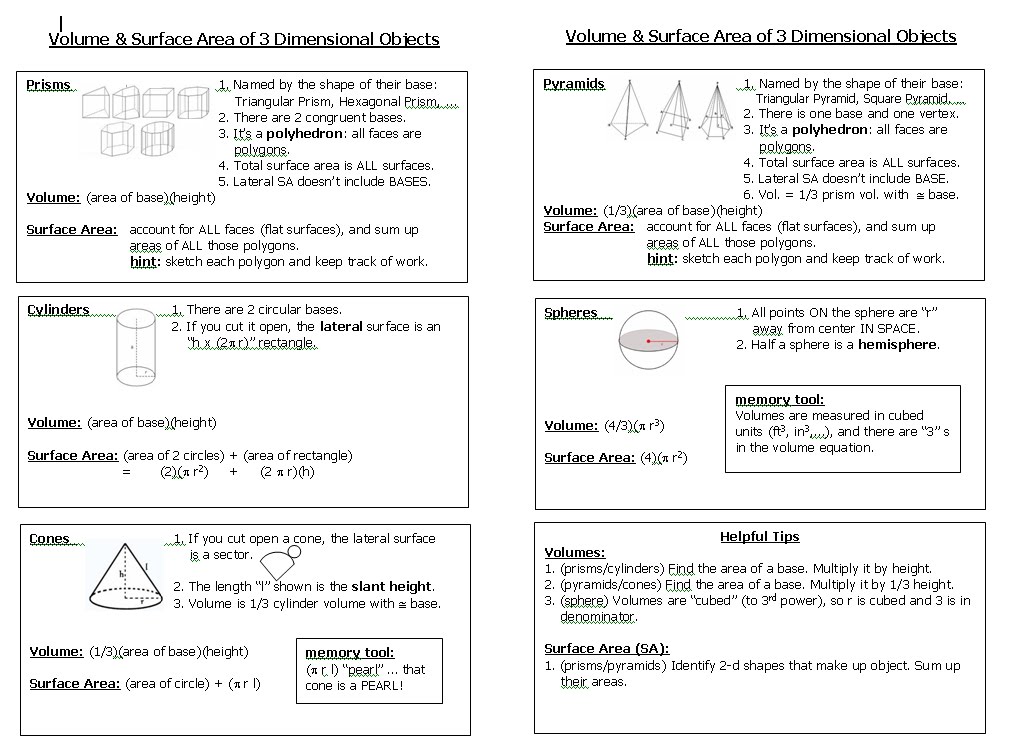
Anyway, my vision is to "teach" them via e-mail and online quizzes. Here's the formula sheet they'll paste in their notebooks:


Now I'll get to use proprofs.com to make some "homework" quizzes I can check virtually.

Friday, May 13, 2011

Haiku Fun

On the latest test for my 10th grade geometry kiddies, my last "question" was: Write a haiku about geometry, and I refreshed their memories ... (3 lines: 5 syllables, 7 syllables, 5 syllables).

Along with the "non answers", and the kidlets who didn't know what a syllable was (eeeeee), here were some fun ones:

Geometry, huh?
Well, it is so very hard,
But it's also fun. *

*(but hard.)
[Love the fact that she had to stress the difficulty]

In geometry
you're the master of numbers
watch while I compute.

Math can be fun. Just
try geometry. Really!
You will love this class.

Geometry is
equations and big circles.
It is very fun!

What am I taking?
It's a geometry test.
That's what I'm taking.
[Too funny]

Math is difficult.
Geometry is worse, though,
but I still love it.

Geometry is
an intelligent subject.
There's so much to it.

Geometry is
scary, horrifying, fun
but I learn the shapes.

Math is very hard
I'll cry uncontrollably
But D_____ ____ is cool.

I need "vinegar".
Math makes me really angry.
You evil llama.
["vinegar" is in reference to me bringing balsamic vinegar to school and the kids thinking it was a bottle of wine and me playing along. "llama" .... I don't know, somehow I got labeled the "llama lady". Don't ask.]

I need to pass this
Geometry. Pretty Please.
I will try my best.

Geometry is
About the shapes and logic.
It be more math, bleh!

Oh, Geometry!
You make my head ache so much.
Why Geometry?

Don't be sad with math.
It is useful in some ways.
Yea, Geometry.

Love geometry.
It is extremely helpful
all around the world.

Saturday, May 07, 2011

Self Teaching Segment Area

We have 4 crazy weeks left of school. Every time we blink either our schedule is shortened for (fill in the blank) assemblies, or students are missing for AP exams (but only for some classes of your prep), or students are pulled out for EOC field tests (and again only for some classes of your prep), or since there's a FAIR for the environment, so we have 40 minute classes and then a ton of prep for the fair. Weeeeee.

Anyway, lots of deep breathing going on here. Funny story. I brought some balsamic vinegar to school for my lunch salad, and I happened to leave the bottle out on my messy desk after lunch. Some time during my afternoon classes a student asked, "is that wine?!" I played along and said yes, that they were driving me to drink.

Anyway, in the spirit of needing the kids to self teach a LOT the next couple of weeks, here's what we did yesterday. I'm LOVING the answer bank concept. The answers are jumbled up, but the kids have immediate feedback on whether they did things correctly. They also are more apt to immediately go back and search for their errors if they don't see their answer. ALSO, I don't have to spend the extra time coming up with a corny joke to make up and to fashion to fit. ALSO, I can have repeat answers, and it doesn't matter because I just put both of them down.

Here it is:


Thursday, May 05, 2011

Teacher Appreciation Week

Funny Story. This week is T.A.W., and I think our AP nudged our students into writing thank you letters to the teacher (or some such gesture) because I'm getting them trickling in. They're sweet and make my day.

Anyway, today in geometry, I'm teaching the FASCINATING area concept, and I wanted to make a visual point, so I scanned the room, and saw a student seemingly doodling and not looking up. I called her on it and got her attention and went on. Flash forward to the end of class. I'm walking around the room, and I see there are cookies on her desk, and I jokingly said, "Oh! Are those for me? Thanks!" guffaw, guffaw.

Then she says, "yes, they ARE for you, and here's a note with it. THIS is what I was doing when you called me out in class."

Awkward.

Tuesday, May 03, 2011

Radical Like Terms

I threw out a goofy story one day a few weeks ago to get the kids to manipulate radicals properly, and it seemed to help some kids, so I thought I'd share ... and I guess I'll share in building up order instead of the order in which it happened.

I make sure to ask a student (or class) what this means: . I get a variety of answers:
* I don't know
* 4 times ?
* are you asking me?
* what?

So then I look suddenly across the room, "Look over there! What's that?". They look. "Just see those 4 cute little s running around!" And I go on to describe that you're just counting in shorthand how many there are.

And then if there's a problem like + , I expand the story: "... and over by the door, 8 more sexy s just joined the party! How many are in the room now?"

I guess it sticks with SOME of the students because today we had a problem like: (12)() and someone was wondering how to multiply it. So I asked: "what does mean?". Pretty quickly someone answered: you have 12 little s running around. And then we were able to finish the problem (and you have 12 sets of those 12, so .....

My next goal (someday) is to have them do a dramatic interpretation or story or SOMETHING emotional about + . I've read that things that pack an emotional punch in some way stick better in your head. Or maybe it's just the punching part ....

Tuesday, April 26, 2011

Hot Glue Hot Hassle

Hmph! Way back in forever this year, I was so excited about finding something that finally worked to put things up on the walls - hot glue. I tested it out; I put some on the wall; I waited; it didn't fall down; the next day it peeled off easily. I was set to hot glue to my heart's content.

This week, the chickens have come home to roost ... or the eggs have hatched in the basket ... or the 2 bushes ... or hands ... or whatever.

It's TAKS week (tres exciting), and so everything that is mathy or school-y must come off the walls in my room and in the hallways. I had posters of Thomas Edison. I had smaller paper posters of logic problems. I had globs of hot glue that stuck to the stucco, and still remains long after the papers are gone.

It is now my daily meditation: I will chisel off at least 4 globs per day until they are all gone. Hmmmm, math problem, If Ms. D. put up ___ this many posters and used 4 globs per poster and there are about 5 weeks left of school and she wants to tackle 4 globs a day, will she be done by summer? Follow up question. For the love of all things scholastic, is there anything out there that will stay up and not peel off the paint and be easy to remove? Bonus points for a correct answer.

Ackh! I just realized I have WAY more globs than that. There are still tons of "artsy" things in my room that have been globbed on. Depressed. Must. Administer. Ice Cream. Therapy.

Monday, April 18, 2011

Multitasking

I told one of my classes today that I was going to put up a poster listing my additional fees for duties ON TOP OF MY teaching them math. Then I would send their parents the bill. We all laughed and moved on, but seriously people.

You can probably guess one of the myriad of situations that caused this statement.

Here's my idea:

Sunday, April 17, 2011

Circle Equation Exploration on GeoGebra

Tomorrow my students will learn how to graph circles on the coordinate plane. I was JUST about to do my usual "lecture/Socratic-questions/practice approach" when I stopped myself short and remembered GeoGebra. That was a close one. I haven't tested it out yet, but here's the first draft:


Thursday, April 14, 2011

New World Order

Before
Students would start a question or a statement or an answer with one of the following:
* This is probably stupid, but ...
* I'm probably wrong, but ...
* This may be a dumb question, but ...
* I'm probably insane, but ...

And I would either inwardly roll my eyes or widen them and wait for them to continue.

Now
Students start a question/statement with the same as above.

My new response: "start over".
(repeat as often as needed until the demeaning preface is omitted).

Tuesday, April 12, 2011

Smaller Learning Communities...

Probably like many high schools around, we have a version of "smaller learning communities" where students choose a pathway and take a course or two along that pathway track in addition to their other core courses. In this way, possibly they travel to the same teachers (in some larger schools), and have a focus for their studies.

When I'd first heard of this, and young teens picking "majors" in high school, my impression was, "right! I didn't know what I really wanted to be until I was in my 30's. How are they going to decide?". Then when I heard testimonials from students that had been through such programs, I had a shift of thinking, "okay, they may not ultimately pick this as a career, but isn't it nice to test it out now in HS and know instead of paying time and money in college and THEN change your mind."

I had a conversation with one of my students who is in the engineering track at our school. She said something to the effect of, "they shoved this down our throats, and I don't want to be an engineer." She went on about the 'other' things she wanted to do, but her "shoving" comment stuck in my craw. Partially, I think she was just pushing buttons for effect, but partially, maybe she felt that way.

I had another way to explain it to her. Think about buying a dress. You can't just go home after picking it off the hanger and have it fit perfectly. You have to go in the dressing room and try it on first and look this way and that, and THEN make the decision. Maybe you buy it and maybe you don't. That's sort of what you're doing here. You're in the dressing room for your future career.

Saturday, April 09, 2011

Coi-cles

Is anyone else panicking that there are less class days left than what you comfortably need to do a good job on all you have left (or want) to teach? Sometimes I'm going along, and then if I get up the nerve, I look at how many non-interrupted-by-other-things classes we have left and compare that to content time needed. SCARY.

Anyway, we started circles just the other day. In true girly fashion, I had them make a foldable that gives the notes in question form on the outside flap and answers (chord, tangent, minor arc, etc) on the inside of the flap.

Some Always, Sometimes, Never, True, False questions that came up:
1. All chords are congruent. (TF?)
2. A chord can contain a diameter. (ASN?)
3. A chord can contain a radius. (ASN?)
4. Concentric circles are similar. (ASN?)
5. If 2 segments are tangent to a circle, then they are congruent (TF?)

And, I made up a new quiz. (Obviously, you can just enter a fake name. I have this so that elsewhere I can know which of my students have taken the quiz.):

Friday, April 01, 2011

What If You're Awesome, And You Don't Know It?

At my 1st teaching gig in central New Jersey, I taught at a newly opened school in a great district. We started out as only a 9th grade campus in 1997 where the kids fed into the "other" high school. Then the 2nd year, we were 9th and 10th, and again the kids fed into the "other" high school. Eventually, we were a full 9-12 school and fed ourselves.

In those 6 years I taught there, we started out with 6 or 7 math teachers and became pretty close. They showed me daily/monthly/yearly examples of what an awesome teacher and an awesome/sharing math department looked like. I'm still really good friends with 2 of them (hey! let's visit each other once a year or two) (even though none of us are at that school or in NJ any more) and keep in Christmas/birthday card contact with 3 of the other teachers.

Anyway, what does this have to do with this post? Eh .... only indirectly because one of the HS teachers shared this story with me one time about one year when she was teaching 4th grade, and she described it as a "magical year". She clicked with the kids, they did cool projects, they gelled, the kids loved her, she loved them, and amazing learning went on, etc. (FYI she told me this story because at that time, I taught a 9th grader that had been in her 4th grade class). Anyway, this is one phrase I always remember: "magical year".

Side note: maybe some people right now are making a goofy face and and saying, "yeah! I got your magical year, lady." because you're at a struggling school or have non-cooperating-in-some-way students or whatever. Feel your pain. Been there at other times. Sorry. Hugs. Enough about you.

Back to me.

So, you see where I'm going with this. This year. In my IED (engineering class). I'm having a magical year. Have I mentioned this before? I yap about it all the time in "real life". The kids in there are smart. They work hard. They ask great "what if" questions. They push me to be better and deliver better. We go beyond the curriculum and explore, just because we want to learn and do and be. They're MUCH smarter and harder working and savvy than I was at that age. In my mind they are rock stars.

And so I think that's obvious to them. Let's see. 14 years of teaching. Approximately 120 (rough rough rough) kids per year. Ish. 120 x 14 = 1680 kids. Yeah, I can get a general feel for average and above average students. It's a no-brainer to me that they are above average. I think of them as poised and self-confident and bla bla bla.

Well. I don't think they think so or know so. Which has altered my reality. Note that these are freshmen. Fourteen to fifteen years old. I have such a high opinion of them that it doesn't always register with me that they've had a limited view of the world. Here are 2 things that have happened lately.

First: a few of them were having trouble with another teacher. Long story short, they felt intimidated in class and stupid and not worthy for various reasons. .... What?! This is SO not the population I thought would feel "unsmart".

Second: today in IED we were having a visit to get nationally certified as a PLTW program. That means that a gentleman came for the day and put us under the microscope and asked questions and probed adults and students and counselors, etc. So. He was in my 9th grade class and talked with various students, and I saw him talking to one of my amazing girls and didn't think anything of it. Come to find out later. She told the other PLTW teacher that she was so nervous and intimidated when he was asking her questions about her classwork and such. Hah! In my mind, I was all, "Score! He's talking to one of my superstars. We'll look great! She'll be great!". And here all this time she's probably thinking, "oh no! Big scary adult talking to me. Nervous!"

She's awesome and doesn't know it. How does that slip past you? But then when I ask that question, the answer is obvious. As a person, you only have your point of view and how you act and how you think things should be done. You just think it's business as usual. There's probably other people around you going, "WHOOOOOOO! Superstar!", but they don't mention that to the person because they think it's a no brainer, and the Superstar MUST know they're great ..... so maybe no one ever TELLS them they're great ..... it's like if a person has brown hair, no one ever goes around and thinks to mention, "hey! Do you know you have brown hair?". They think it's SO obvious it doesn't bear mentioning.

And then there's that OTHER problem where HOW you complement someone affects the outcome. They may just discount your praise with a "yeah, but...." in their heads and not absorb the information.

Anyway, ramble ramble ramble. P.S. we got certified. Yay! And I'm having a magical year with my cute 9th grade IED kidlets. And I have to think of a way to get them to know they're phenomenal.

Sunday, March 27, 2011

State Test Craziness

Oy! I'll be semi-happier after the April 25 week when our math TAKS tests are over. For the last forever amount of weeks, I've been tutoring 3 sets of kids, once a week, during advisory, strictly for this test. And last Friday some words came out of my mouth to my group of tutees that now have me thinking.

I didn't want them to think they were just in there because we thought they'd have a high chance of failing. That's definitely not the case. And, I guess I'm a product of the "feel good about yourself" school of growing up .... though from what-all I'm reading, I have to think about how I offer THOSE words of praise. So after we went over some material, I said something to the effect of, "okay! we're going for commended!" and I went on with going over problems.

Well, a 10th grader in that group came up to me afterward. She's a diligent, hard-working, come-in-for-tutoring if she thinks she needs it kind of math student. It does not come easily to her at ALL, and I had her last year for algebra and this year for geometry, and I've seen a great improvement in her algebra skills this year after her having time to absorb it.

Anyway, she came up to me and said, I'm really discouraged about this math TAKS. I haven't been commended on the math portion since the 5th grade. She's passed every year, but here we are, a higher performing school, and the message we're encouraged to give is, "don't just PASS, go for commended!". So not getting commended is apparently the new failing for these students. Crap! It didn't occur to me until that moment how students may feel every year when, yes, they may pass, but, oh no, I've let down my teachers by not being commended.

I don't know how successfully, but I told her that one of the main reasons we've been saying that (in my opinion) is to get the kids to try and do their best, and I already see she puts out her effort on every question she goes through, and that's the type of diligence that's going to get her far in the world, not the "oh yay! I passed and got commended on a state test." ... It's even telling that she's stressing about the 10th grade TAKS, and it's not really as high stakes for the kids as the exit level in 11th grade.

Regardless, here's another bad side effect of these tests and what we may seem like we expect from the kids all in the name of some outside random measure of "are we doing our jobs as teachers" test.

Tuesday, March 22, 2011

Trig and Teaching and Knocking

TEACHING:
Lately I've been noticing in various forms of teaching or discussions about teaching, sometimes the "speaker/blogger/writer", either intentionally or not, conveys the message that, "if you don't do things THIS way, you're doing it wrong!" ... or ... "why in the WORLD would you even CONSIDER teaching so-and-so THAT way, you hack!". Or maybe it's just how I'm reading into things.

I think for the most part we're all trying to do the best job we can, and obviously there's no magic bullet that's going to work for all topics and all days and all teachers all of the time. We (and by "we" I obviously mean "me" because that's obviously who it's all about) should just stop beating ourselves up when someone speaks/writes/communicates how they do something, and it sounds so perfect and rosy, and my (our?) first thought is, "sheesh, THAT person has it all figured out. What's wrong with me?". Okay, my self-pep talk is over.

KNOCKING:
Anti-Joke of the moment I love:

Knock, Knock.
Who's there?
To.
To Who?
To "Whom".

TRIGONOMETRY:
As with all things we do the 1st time through (or maybe it's just me), there are kinks to be worked out with the activity I wrote about last time. The last 2 days I took my students to the computer lab, and they self-taught basic trigonometry ratios with my GeoGebra file and the 4 page packet. I realize I'm fortunate to (this year) have frequent access to a computer lab.

I know that that was one of the BIG reasons before that I didn't like Geometer's Sketchpad or even bother to learn GeoGebra. Once the kids grasped it on the one time a semester I actually got to go to the lab, then they forgot it all the next semester when we could go back, so basically what was the point. I guess that's why I'm liking this GeoGebra, because if a student has computer access at home (and I know that's not always the case), at least this is an extra resource for absorbing things. Anyway, choir .... preaching .... bla bla bla

I would do the activity again next year, but here are some things that happened and how I'd revamp. I teach a 1.5 hour class, and after we went over homework and did another small activity, we had about an hour for this activity ... WAY too little time for them to be set on their own and finish up.

The first thing I changed was I had them cross out 2 of the cases for each of the 6 tables. So they were only checking sin/cos/tan twice for each acute angle. Next year, I think I'd change it even more: check just once total and then check what a neighbor or 2 got and notice.

I also would take out the ratio of sides on my GeoGebra activity. Invariably, once a kid had to fill in column 2, they didn't read very carefully, and just used my #s above, even though they may not be the correct ratio of sides ... but HEY, all the letters started to blend together.

Other than that, with periodic "giddyup-ing" by me in the form of "you have 30 more seconds to finish up to ______". "Okay, the main point of that was _______. Now do the next section." ..... I think it went well ... Especially, since I seem to have lost my voice YET again this year. Chronic sick-fest.

Sunday, March 20, 2011

Learning Trigonometry

Now I'm almost ready to start my trigonometry unit. Here is the 4-page self-teaching packet I'll hand my students tomorrow, along with a graphing calculator and an e-mail message that has all the links they need. My goals for them are to be able to: identify opposite and adjacent sides of an angle in a right triangle, find the sine, cosine, and tangent ratios of a triangle given the 3 side lengths, and link these skills to the special triangles they just "learned". Once I make up a homework sheet (or use the textbook), I'm good to go.


Also, on a cheery, vacationy note, here are some Marfa and Fort Davis, Texas pictures from our short Spring Break trip.


Saturday, March 19, 2011

Quiz Anyone?

I'm writing up my worksheet to go along with my geogebra "baby trigonometry" applet, and I found I needed/wanted a quiz for them to take online. I couldn't find any with the right number of questions or types of questions, so I made one up. We'll see Monday if it's a success or a stinker.

Wednesday, March 16, 2011

SO excited about Geogebra

A nice person commented from my last post and showed me some applets she'd made for Geogebra (thank you Lsquared). This must have planted a seed in my mind, because today I was tinkering around with how to start up my trigonometry unit. I went to the Geogebra site. I clicked "download". Then I clicked "Applet Start". I figured my kids don't have downloading capabilities on the school computers, so this would be fine.

I tinkered around with things and came up with this activity. I'm going to make a worksheet that goes with it to guide them through a self teaching, first day of trig, what is sine/cosine/tangent activity. I think some of the questions may even be of the effect of, "set your triangles, set up your calculator just so, press cos ____ (degree shown), compare it to ratio."

I would love feedback on this "non applet". Effective? Hard to manage? Fine?

Note: I tested out opening the file on another computer. It "failed" with Firefox, but worked fine with Explorer. I DID have to change the window size to 200% or something like that. But there is a way to show WHOLE picture.

Anyway! Off to write the worksheet. I'll share. Okay, really off to dinner then Lindy Hop, then Marfa, THEN to write the worksheet.

Tuesday, March 15, 2011

Spring Break

Phew! I can't tell you what a consistent 9 hours of sleep each night can do for a person ... or maybe I can. I feel great! Here are some pressing activities on my plate:

1. Watch cheesy bad movies on Netflix streaming (Blackbelt Jones, Cherry 2000, ....)
2. Read book(s) (Saving Fish from Drowning)
3. Catch up on grading (test corrections)
4. Sign up for the Digital Electronics STI workshop for PLTW (soooooo excited)
5. Prep myself for the Cardboard Chair Project for my engineering class (design, test, create a cheap durable cardboard chair for a dorm room ... cool "hook" video)
6. Prep myself for my PBL unit (project based learning) of trigonometry
7. Take a blanket out to local parks and laze around and soak up sun and outdoors
8. Go to Marfa, TX (Thursday)
9. Do my "train" project on Inventor for IED (I'm doing the homework with my students this year ... keeps me honest)
10. Puzzles, puzzles, puzzles (hiyawake puzzles my new favorite)
11. Get ready for the PLTW certification visit on 4/1/11 (eek! hope that's not portentous)
12. Sleep more than 7 hours a night (or did I mention that already?)
13. Get my IED students to write thank you e-mails for a recent speaker/friend that came to visit and talk about his engineering experiences. (It was useful to send my students THIS e-mail as a primer):

Hey! Let's be green (and timely since it's Spring Break). Here is your EXTRA homework to turn in to me NEXT Monday 3/14/11 .... and by that I mean 3 days from now .... OVER spring break.

Please send me an e-mail, either with an attachment of a thank you card for Mr. H., or your thank you words inside the e-mail message.

I will then gather them all up together in one e-mail and send them along to him.

Thank YOU for saying more than just "thank you for coming to speak to us". Maybe indicate what you liked or found interesting or learned or whatever.

Example, here's my "thank you" to YOU, my IED students:

Dear IED students of 2010-2011,

I love teaching you because you're so creative and make me think of new things and ways to teach you. I also love that you're excited about the various things we do and learn. I look forward to your questions because they make me think through the why's and how's of various concepts.

Signed,

Ms. ______


I look forward to your thank yous for Mr. H.
Ms. _____


(I've gotten 6 out of 12 back so far)

Anyway .... must go exercise with my other latest craze (as of 4 weeks).

Saturday, March 12, 2011

Special Quadrilaterals

We finished studying special quadrilaterals a while ago, took a test, and now the kids are trickling in for their retests. Ew. Something didn't stick or even get through to some students, and I'm trying to process how to improve it for next year.

Here is how I taught it:
parallelograms: I had 4 already printed on a paper, and they were to use their rulers and protractors to measure various things to discover the facts about the angles and diagonals.

squares/rhombi/rectangles: I had them neatly draw one each in their grid notebooks (I gave the instructions on where to put the vertices). Then I had them again use their protractors and rulers to measure various things and fill out a chart as to which had which properties (diagonals congruent, diagonals perpendicular, diagonals bisecting opposite angles).

trapezoid/kite: I had a sheet with some drawn we worked through the logic of things to get to their properties.

All this went in their notes. They had review problems. At no time did I have them (and apparently they didn't think they needed to) gather all the information into one place (foldable? 1/2 page) to have a quick summary. (I will change this for next year).

Okay, then test time. The usual suspects did well, but too many kids had no idea about things they should have. For example, when a student was coming in for a retest, and I asked her about what a rhombus was, she was silent. Oy! Now I know this particular student coasts by and can look like she's playing school, but .... Regardless, I want them to learn despite themselves.

I think something happened at another tutoring session that will make me either add a day to my lessons, or replace the previous lessons with this. I'm leaning towards add to the lesson.

Another student was studying rhombuses, so that she could take the retest, and she still wasn't understanding or processing things she should know. She couldn't even draw a vaguely accurate rhombus. I took a piece of colored construction paper, and pretty quickly used a ruler to cut it into a rhombus (it turned out to be approximately 8.5" per side). I liked that it was big enough to see things on and to write on and play with. Then I had her folding it to make the diagonals. Then we stared at it. It was clear the diagonals were perpendicular. It was clear that they were bisected. It was clear which angles were congruent (you could match them up and check). It was clear that the diagonals bisected the angles (again you could fold and check).

Then as she was trying to redo a test problem, I had her write the given information on the rhombus, and then figure out the rest. ... I don't know if this will stick. I guess we'll see when she actually does a retest, but maybe the extra visual and tactile properties of the shape will be clearer in her mind.

Tuesday, March 08, 2011

Pythagorean Theorem Video

Today we started reviewing radicals, and talking about Pythagorean Theorem. I know they've seen it before, but they still need help on the harder problems. I found this cool, short video that I showed a few times in a row until they understood it. It was a fun discussion on what he was trying to do.

Then we built up their skills with individual problems of varying difficulties:

(the terms listed are "a", "b", and "c" for a right triangle with hypotenuse "c"):

FIND x
1. x, 4, 10
2. 3, 9, x
3. 2*sqrt(3), x, 4
4. x, 3, sqrt(17)
5. x, 3x, 20
6. some sort of trapezoid with 90 degree angles on one side.

Anyway, I just wanted to post about the water video. Done. Dinner.

Friday, March 04, 2011

Room Fustiness

Phew! Stinky Room Alert! I don't know what it is .... well, maybe I do, but the last few weeks while I'm teaching in my room for hours on end, I don't notice anything. But step out of the room for a few minutes and walk back in after a gaggle of teenagers have been in there, and Stink City.

It's not that way in the morning when I first get to work. It's not that way right before 1st period. But after I teach a class or two and leave the room and come back. Ew. Not HORRIBLE horrible, but noticeably smelly/musty.

So my question is, is it just my particular group of teens? They don't really smell strongly, but I guess get enough of them together and have them in there for an hour and a half and watch out. I don't like the fake smell of room deodorizers. I can't open my windows. I have one plant in there (which sometimes causes its own problems with teeny bugs that flutter around and like to hover around the vacuum of your nose only to be accidentally sucked in and EWWWW). Do we think more plants would help? Certain plants? Has anyone successfully overcome this TRAGIC situation?

Signed,

Singed Nosed Sufferer

Wednesday, March 02, 2011

Algebra/Basics Review in Geometry

I'm basically teaching two levels of geometry this year even though we call them both "preAP". I have the 8th and 9th graders in one class, and for the most part they whiz through everything and delight in the challenging problems. I'm also teaching 10th graders that are in other sections, and they approach math in a different way. I have to keep reminding myself not to rush rush rush through topics and to keep remembering that they need more practice on everything to make it stick and to make it make sense.

I am doing one thing, though, to help them keep their algebra skills fresh: ALGEBRA :). For example, for the last few topics, I made sure to make up geometry problems that ended up having a factorable quadratic equation in it at some point. This led us to recall FOILing and ("claw"ing .... Thanks, Mrs. H) and factoring. Now I'm making sure to include quadratics that CAN'T be factored (hello quadratic formula review).

BUT. Here are some things that I didn't think would come up, but did/do, and REALLY I should make a mental (or better) note to myself of where things can go askew, so that I can make more problems throughout the year to have such examples, so that we can have a discussion about them and keep them fresh in our minds.


Example 1:

A student is solving: 2x + 4 = (1/2)x + 8, for example.
Hmmmm, I don't like that (1/2)x,
so I'll just remember that I can do the opposite to x to undo it,
and I multiply ONLY the 2x and the (1/2)x by 2 to end up with:
4x + 4 = x + 8. Eeeeek.

Example 2:
A student gets to a point in an equation where they have (13/2)x = 14. Well, heaven forbid we keep things in fractions and go the easier route of multiplying both sides by 2/13 to get x = 28/13. Boom. Done.
No.
We convert to 6.5x = 14.
We stress that 14 is not easily divided by 6.5.
We chug through and do long division and create pain and suffering for ourselves.
We curse the teacher for such a hard problem and no calculator.

Example 3:
Teacher takes the expedient route frequently and makes up problems where the answers are integers. This saves time, she thinks, so that they're not struggling with messy things and they're concentrating on new material.
Students freak out the first instance an answer is not integer.
Gasp! I must have done something wrong. Things ALWAYS work out nice and pretty in "math world". Fractions are not REAL numbers, no matter WHAT my teacher says. Oh, and by the way, "your answer key says 3/2. Is it okay if I write it as 1.5? As 1 1/2?"

Example 4:
A problem comes up where you're asked to find the height of a person. The decimal answer is 4.666666666 feet. You think this either means 4' 6" or 4' 7" (if you round). You DON'T think that 2/3 of a foot is not either of these answers.