This should sum up how my school day went ... that started with a faculty meeting wherein we:
* were informed about how our school district is thinking about cutting various things to meet their budget shortfall (which may include teachers giving up a prep period)
* were chastised for not willingly giving up class time for students for extra curricular things (because we were greedy with instructional time)
* were told of upcoming events that would further alter the schedule to allow less class time
* had 1 hour less of prep time in the morning because of said meeting ....
SO....... one of the highlights of my day (aside from numerous other student interactions), was a student who informed me at the start of geometry class that they had a new joke to share (which as a bonus sums up what's expected of teachers):
Q: How do you fit an elephant in a Safeway Bag?
A: Take away the "f" in "safe" and the "f" in way.
Friday, November 19, 2010

Monday, November 15, 2010
Google Genius
Am I the last person to know this? Today we were calculating all sorts of values related to polygons and regular polygons and interior and exterior angles of regular polygons and such. As I'm sending the kiddies off with their homework, I thought to mention that if they didn't have a calculator at home, they could just "google" free calculator, and they could use one of the options that showed up.
Then a students said, "well, you could just type in your math equation right into the google search bar". What? So I tried it:
1080/3. Yup.
sin(pi/4). Yup.
log(5.234). Yup.
arctan(1). Yup.
e^(-1). Yup. Yup.
Holy Moly! Genius-ness.
Then a students said, "well, you could just type in your math equation right into the google search bar". What? So I tried it:
1080/3. Yup.
sin(pi/4). Yup.
log(5.234). Yup.
arctan(1). Yup.
e^(-1). Yup. Yup.
Holy Moly! Genius-ness.
Friday, November 12, 2010
Blogging Topics....
Maybe every "anonymous" blogger reaches this point. I've been blogging for about 6 years (I had to just go check the first month shown on the front page), and to this date, I've never directly mentioned to anyone I know, husband, friends, teachers, that I blog. At first it was because I didn't know where I was going with it. Then later it was because .... who knows. Maybe it was a "once it's out, I can't take it back" type of thing, or a "if no one I know knows I blog, then I don't have to self edit" type of thing.
Last year, I got a rude wake up call. I had written about a student and her lack of class attendance and such. Then another student was joking with me and mentioned that this 1st student had seen that I'd blogged about her. What? First of all, how do you go searching for math teacher blogs as a student (why?), and 2nd of all, why this blog? So then that started me being more circumspect. Again, maybe everyone has to do this.
Then a month or so ago, a teacher in our district was let go because of her blog. She was revealing personal student information. Yeesh, more self editing. .... All this to say, there are a ton of funny things that happen at school, but I can't process in writing. So basically, now I feel limited to sharing teaching tips, which is not bad, but it sure would be nice to vent/laugh/process/write about various things.
Anyway, bla bla bla. Just "venting" (which apparently I can't do :)).
Here's one funny (safe) thing. For some reason, unbeknown to me, a student keeps associating me with llamas: "do you have a llama herd?", "llama lover", "llamas", "how are the llamas?". I just roll with it. It reached a pinnacle today, and I went online and did a "llama lovers" search.
Go on, I dare you to type that in. Apparently, there are full on societies of llama lovers. There are songs, pictures, blogs.... Then I got crazy and tried, "yak lovers". Sure enough. There's a "yak appreciation society", a "yakkin about yaks" site, .... platypus lovers? But of course! Oh my goodness.
Anyway, this student bought me a present today. Guess what it was. Yes, a small stuffed llama. Soft. Crazy. I think I can make it my evil twin and channel my evil teacher thoughts into it: "you! shut up!" What? That wasn't me, it was the llama speaking.
Last year, I got a rude wake up call. I had written about a student and her lack of class attendance and such. Then another student was joking with me and mentioned that this 1st student had seen that I'd blogged about her. What? First of all, how do you go searching for math teacher blogs as a student (why?), and 2nd of all, why this blog? So then that started me being more circumspect. Again, maybe everyone has to do this.
Then a month or so ago, a teacher in our district was let go because of her blog. She was revealing personal student information. Yeesh, more self editing. .... All this to say, there are a ton of funny things that happen at school, but I can't process in writing. So basically, now I feel limited to sharing teaching tips, which is not bad, but it sure would be nice to vent/laugh/process/write about various things.
Anyway, bla bla bla. Just "venting" (which apparently I can't do :)).
Here's one funny (safe) thing. For some reason, unbeknown to me, a student keeps associating me with llamas: "do you have a llama herd?", "llama lover", "llamas", "how are the llamas?". I just roll with it. It reached a pinnacle today, and I went online and did a "llama lovers" search.
Go on, I dare you to type that in. Apparently, there are full on societies of llama lovers. There are songs, pictures, blogs.... Then I got crazy and tried, "yak lovers". Sure enough. There's a "yak appreciation society", a "yakkin about yaks" site, .... platypus lovers? But of course! Oh my goodness.
Anyway, this student bought me a present today. Guess what it was. Yes, a small stuffed llama. Soft. Crazy. I think I can make it my evil twin and channel my evil teacher thoughts into it: "you! shut up!" What? That wasn't me, it was the llama speaking.
Sunday, November 07, 2010
SAT questions
Great! New resource for problems. I bought an SAT math only workbook, and it's chock chock CHOCK full of geometry problems asked in all sorts of cool ways. There are a ton of triangle problems using "angles sum to 180" facts and parallel lines and transversal problems.
Here's an example: picture triangle ABC. Then picture point D on segment BC. So you have your larger triangle separated into 2 smaller triangles. Put variables representing 5 of the 6 triangle angles (a,b,c,x,y). Let the 6th angle be 50 degrees. The question asks find a+b+c+x+y.
Love it.
Here's an example: picture triangle ABC. Then picture point D on segment BC. So you have your larger triangle separated into 2 smaller triangles. Put variables representing 5 of the 6 triangle angles (a,b,c,x,y). Let the 6th angle be 50 degrees. The question asks find a+b+c+x+y.
Love it.
Thursday, November 04, 2010
Angle Pair Nitty Gritty
As I was merrily going along teaching linear pairs and vertical angles and corresponding angles and such, it came to my attention that various students were not "there" yet with internalizing the pictures and definitions, so I came up with this activity:

I like the activities I've seen where sometimes the answer is "none" and sometimes there's more than one answer, and sometimes the answers are repeated in different questions. I've tried to incorporate that style into these problems. I think it worked pretty well.
I'm also giving them a quiz on 6 types of angle pairs for the next grading period. I told them they have to identify each angle pair correctly, and spelled correctly, and no abbreviations, and no doctor handwriting, and in a timed manner. If they miss ANY, they get a 0%, and they have as many tries in the next 6 weeks to get it 100% correct. I likened it to recognizing the letters of the alphabet. It sure would be a shame if they couldn't and/or it took them a long time to process the information. I restated the fact that geometry (math) is like a foreign language, and they have to have fluency with all the words.
In other funny news. A student whose grade is suffering and who came in for tutoring today and was actually grasping things said, "wow, I should really listen more in class because this makes so much sense."

I like the activities I've seen where sometimes the answer is "none" and sometimes there's more than one answer, and sometimes the answers are repeated in different questions. I've tried to incorporate that style into these problems. I think it worked pretty well.
I'm also giving them a quiz on 6 types of angle pairs for the next grading period. I told them they have to identify each angle pair correctly, and spelled correctly, and no abbreviations, and no doctor handwriting, and in a timed manner. If they miss ANY, they get a 0%, and they have as many tries in the next 6 weeks to get it 100% correct. I likened it to recognizing the letters of the alphabet. It sure would be a shame if they couldn't and/or it took them a long time to process the information. I restated the fact that geometry (math) is like a foreign language, and they have to have fluency with all the words.
In other funny news. A student whose grade is suffering and who came in for tutoring today and was actually grasping things said, "wow, I should really listen more in class because this makes so much sense."
Tuesday, November 02, 2010
More Memory Tools ...
My 10th grade geometry students keep trickling in to take their logic retests, and many of them still had a hard time remembering the laws of inference to use in logic proofs. They would confuse the following two:
p --> q
p
-------
therefore, q
(Law of Detachment)
p --> q
~q
-------
therefore, ~p
(Law of Contrapositive Inference)
I tried 2 or 3 or 1000 different ways of explaining it, and nothing stuck. I thought I hit gold with the following:
If the Dog is a Terrier, then the CHihuahua likes MENTos.
The Dog is a Terrier. (I thought this would help them connect it to detachment).
and
If the CON is a TRAitor, then I POSsibly like TV.
I hate TV. (for contrapositive inference).
So that helped some kids, but wasn't the raving success I thought it would be. Then just the other day, we were going over problems in tutoring, and I was circling things to make a point, and saw this:

Do you see it? The Detachment scribbles look like "D", and the Contrapositive scribbles look like "C". Well. They thought that was SO cool, and then they started accusing me, "why didn't you just show us this in the FIRST PLACE!". Like I was secretly storing away the "good stuff" and doing things the "hard way" until they finally wore me down to giving up the goods. Is this on ALL their minds: teachers always do things the hard way and hold back on us. Phwueey. I told them I just thought of it, and there was nothing to prevent them from figuring things out on their own and stop bothering me kid. .... They also passed their retests with flying colors.
p --> q
p
-------
therefore, q
(Law of Detachment)
p --> q
~q
-------
therefore, ~p
(Law of Contrapositive Inference)
I tried 2 or 3 or 1000 different ways of explaining it, and nothing stuck. I thought I hit gold with the following:
If the Dog is a Terrier, then the CHihuahua likes MENTos.
The Dog is a Terrier. (I thought this would help them connect it to detachment).
and
If the CON is a TRAitor, then I POSsibly like TV.
I hate TV. (for contrapositive inference).
So that helped some kids, but wasn't the raving success I thought it would be. Then just the other day, we were going over problems in tutoring, and I was circling things to make a point, and saw this:

Do you see it? The Detachment scribbles look like "D", and the Contrapositive scribbles look like "C". Well. They thought that was SO cool, and then they started accusing me, "why didn't you just show us this in the FIRST PLACE!". Like I was secretly storing away the "good stuff" and doing things the "hard way" until they finally wore me down to giving up the goods. Is this on ALL their minds: teachers always do things the hard way and hold back on us. Phwueey. I told them I just thought of it, and there was nothing to prevent them from figuring things out on their own and stop bothering me kid. .... They also passed their retests with flying colors.
Sunday, October 31, 2010
Computer Programming...
As I was teaching the logic unit in geometry a few weeks ago, one student asked where this was used. In addition to other examples, I mentioned that logic is heavily used in computer programming and gave some examples. Then they asked why we didn't have such a class at our school. Good question. I've been looking around at resources, and other high schools in our district, and it seems that computer programming is only taught at one school.
"Back in the day" in NJ in the late 90's I taught programming. Back then (and maybe in that state), you didn't need extra certification to teach it. I taught the introductory class, and, horror of horrors, it was taught in QBasic. Gasp. But I actually found it to be cool and friendly for the students. We could create graphics (that were "cool" for those days before all the whizzy bang stuff they've seen today). We created games and questionnaires and such and all the basics (ar ar ar) were taught: loops, sorting, if statements,...
Well, it seems in Texas (and today) I'd need an extra certification, but that would just require taking another test since I already have a certificate. Then there's the question of what language to teach it in. It seems that AP Computer Programming is in JAVA. But in my (old school?) mind I'm thinking that a "non object-oriented language" would be the way to start for a 1st year student. I still think that if you learn the basics well in any language, then transferring your skills to a new language would be doable.
Anyway, hopefully it'll be put on the choice sheets in January, and maybe next year I get to have fun with programming. Of course now that I've jinxed it, it'll not come to pass. I guess that doesn't prevent me from learning JAVA (in my spare time) and learning enough to pass the certification test this summer. Does anyone teach a 1st year programming course in HS and have tips on what language works? I'd greatly appreciate any extra knowledge.
"Back in the day" in NJ in the late 90's I taught programming. Back then (and maybe in that state), you didn't need extra certification to teach it. I taught the introductory class, and, horror of horrors, it was taught in QBasic. Gasp. But I actually found it to be cool and friendly for the students. We could create graphics (that were "cool" for those days before all the whizzy bang stuff they've seen today). We created games and questionnaires and such and all the basics (ar ar ar) were taught: loops, sorting, if statements,...
Well, it seems in Texas (and today) I'd need an extra certification, but that would just require taking another test since I already have a certificate. Then there's the question of what language to teach it in. It seems that AP Computer Programming is in JAVA. But in my (old school?) mind I'm thinking that a "non object-oriented language" would be the way to start for a 1st year student. I still think that if you learn the basics well in any language, then transferring your skills to a new language would be doable.
Anyway, hopefully it'll be put on the choice sheets in January, and maybe next year I get to have fun with programming. Of course now that I've jinxed it, it'll not come to pass. I guess that doesn't prevent me from learning JAVA (in my spare time) and learning enough to pass the certification test this summer. Does anyone teach a 1st year programming course in HS and have tips on what language works? I'd greatly appreciate any extra knowledge.
Friday, October 29, 2010
Schooling Behavior...
This past Monday we had a school-wide assembly in the morning, and the speakers were discussing an event we'd have on Friday for Breast Cancer Awareness Month. Our students could show their support by wearing pink on the Friday. During this short presentation, various students were listening, and various students were quietly giggling or talking with their friends. I noticed one teacher mill around the students and appear to sternly look at them to settle them down. This went on for the whole 5 minute presentation.
At the end of the presentation. This particular teacher got up in front of the school and gave an impassioned reprimand to the "10% that were not respectfully listening to the speakers." You could hear a pin drop as she talked angrily from her heart: if you were joking and talking with your friends, you're basically saying that you don't care about this issue, and you're not considering that maybe your friend or a student you know or a teacher you know has a relative or knows someone going through this disease. You were talking with your friend and basically being disrespectful of people that are going through a devastating situation in their lives and turning your back on your peers.
This was the gist of her reprimand. It was powerful for a few reasons. She's a respected teacher, she has had experience in one way or another with cancer, and the students know it, and she wasn't harping on them, but they could hear the emotion in her voice that this was something she cared deeply about and that she was very upset with their behavior.
I'm so impressed that she stood up and said something, and I think it's something the kids will remember the next time a situation like this occurs (I know I will). They're still kids and still learning how to behave in various instances, and it's easy for me to forget that they still need guidance in what's right and wrong from ALL sorts of sources in addition to their parents ... as opposed to adults just shaking their heads and saying, "kids these days".
At the end of the presentation. This particular teacher got up in front of the school and gave an impassioned reprimand to the "10% that were not respectfully listening to the speakers." You could hear a pin drop as she talked angrily from her heart: if you were joking and talking with your friends, you're basically saying that you don't care about this issue, and you're not considering that maybe your friend or a student you know or a teacher you know has a relative or knows someone going through this disease. You were talking with your friend and basically being disrespectful of people that are going through a devastating situation in their lives and turning your back on your peers.
This was the gist of her reprimand. It was powerful for a few reasons. She's a respected teacher, she has had experience in one way or another with cancer, and the students know it, and she wasn't harping on them, but they could hear the emotion in her voice that this was something she cared deeply about and that she was very upset with their behavior.
I'm so impressed that she stood up and said something, and I think it's something the kids will remember the next time a situation like this occurs (I know I will). They're still kids and still learning how to behave in various instances, and it's easy for me to forget that they still need guidance in what's right and wrong from ALL sorts of sources in addition to their parents ... as opposed to adults just shaking their heads and saying, "kids these days".
Sunday, October 24, 2010
Test Question
For my last 2 tests, I've tacked on an extra question at the end. Partly because it's fun to read what the kids say, and partly to get a better insight into them, and partly to have them think about things.
My current question was: If you could learn one challenging skill in life, what would it be and why?
Various Responses:
* I would learn how to skydive.
* I would be fluent in another language.
* I would learn how to crack codes.
* I would learn to always be confident.
* I would learn how to always win at crane machines.
* I would learn how to keep stuff clean.
* I would learn how to remember EVERYTHING I learned.
* I would learn how to cook everything well.
* I would learn how to do a cartwheel.
* I would learn how to be more patient.
* I would learn how to use a bow and arrow.
* I would learn how to survive in the wilderness.
* I would learn how to tightrope walk.
* I would learn how to fly.
* I would learn how to see in the future.
* I would learn how to become unnoticeable when it was necessary.
* I would learn how to sing in public.
* I would learn how to be funny.
* I would learn how to tame a lion.
* I would learn how to handle stress.
p.s. I've also thought about it, and mine would be to learn how to do those floor gymnastics where I could just take off at a flying run and jump into the air and flip over a few times and land gracefully on my feet. Ta Da! THAT would be awesome. Then when I'm bored or if I see an empty hallway, I could start my trot and go flippy doodle all up in the air, then keep walking. You?
My current question was: If you could learn one challenging skill in life, what would it be and why?
Various Responses:
* I would learn how to skydive.
* I would be fluent in another language.
* I would learn how to crack codes.
* I would learn to always be confident.
* I would learn how to always win at crane machines.
* I would learn how to keep stuff clean.
* I would learn how to remember EVERYTHING I learned.
* I would learn how to cook everything well.
* I would learn how to do a cartwheel.
* I would learn how to be more patient.
* I would learn how to use a bow and arrow.
* I would learn how to survive in the wilderness.
* I would learn how to tightrope walk.
* I would learn how to fly.
* I would learn how to see in the future.
* I would learn how to become unnoticeable when it was necessary.
* I would learn how to sing in public.
* I would learn how to be funny.
* I would learn how to tame a lion.
* I would learn how to handle stress.
p.s. I've also thought about it, and mine would be to learn how to do those floor gymnastics where I could just take off at a flying run and jump into the air and flip over a few times and land gracefully on my feet. Ta Da! THAT would be awesome. Then when I'm bored or if I see an empty hallway, I could start my trot and go flippy doodle all up in the air, then keep walking. You?
Friday, October 22, 2010
Logic Proof Projects...
I collected the Logic Proof projects the other day. Actually, I just called it a "homework" and assigned homework credit. They had class time to work on it, and they checked with me as to the correctness of their setup and proof before they committed to poster board. And even with that, some students made mistakes, or didn't check with me, so some aspects of the project/homework were not satisfied. I guess that's par for the course. Here are 5 that passed muster and were clever.
Did I tell you the wonders of hot glue. A teacher at my school swears by it, and puts up all her posters and such with hot glue. I guess as long as it's on painted cinder block walls it's okay .... I guess I'll find out in June (ahem).


Did I tell you the wonders of hot glue. A teacher at my school swears by it, and puts up all her posters and such with hot glue. I guess as long as it's on painted cinder block walls it's okay .... I guess I'll find out in June (ahem).


Wednesday, October 20, 2010
Angle Pairs
We're starting geometric proofs now, and yesterday we did two activities to prep for this. First, I wanted the students to be familiar with some basic definitions and to know that they are biconditionals, and see how they're used as reasons for proofs. Second, I wanted the students to look at partial pieces of proofs and fill in the blanks with reasons, or steps if given the reasons.
Here's an activity I did to get them thinking about adjacent angles, linear pairs of angles, and vertical angles:

We first looked at the definition of adjacent angles. Then I had them go down that column and either indicate YES, or if NO, then list the parts of the definition it violated. Then we did the same with linear pair. Then I just had them write on the LHS which one(s) were vertical angles.
Next we took notes on how theorems, definitions, postulates, properties could be used as proof reasons, and I had them refer to a print out of our basic ones so far (along with definitions), and do the following:

The pesky bell rang, and we ran out of time, so I'll have to see how they did next class.
Here's an activity I did to get them thinking about adjacent angles, linear pairs of angles, and vertical angles:

We first looked at the definition of adjacent angles. Then I had them go down that column and either indicate YES, or if NO, then list the parts of the definition it violated. Then we did the same with linear pair. Then I just had them write on the LHS which one(s) were vertical angles.
Next we took notes on how theorems, definitions, postulates, properties could be used as proof reasons, and I had them refer to a print out of our basic ones so far (along with definitions), and do the following:

The pesky bell rang, and we ran out of time, so I'll have to see how they did next class.
Tuesday, October 19, 2010
Potential Slope Memory Tool
Let me start by saying that I am not in the least bit a religious person. I do watch movies and TV and live in the world, so I think I know how certain religious people do the "sign of the cross".
Today I was trying to get some geometry kids I was tutoring to remember how to calculate slope when given 2 points. In various states of nonknowing, they either didn't remember at all, or they only knew how to do it on a graph, or they kept messing up and calculating, m = (x2-x1)/(y2-y1).
We got out the graph paper, and they remembered "rise over run". So I (again) linked that to "what changes when you rise?", "when you run?". And I tried to link that to m = (y2-y1)/(x2-x1). Anyway, as I was gesturing with my hands: rise (and my hands were moving up and down and up and down) over run (and my hands were moving side to side etc), I reminded myself of making "the sign of the cross". I double checked with the kids, and yes, the up down motion comes before the left right motion, so I said, "well if you want to remember which is which, then think of making this sign, and and the up/down is first, so that's (y2-y1) change, .....".
Then a kid joked that you also want to say your prayers before you do math (or take the math test).
In other weird/new-to-me tidbits. For various reasons, today I briefly mentioned congruent in geometry, and said that soon we'll think of shapes as being congruent when they .... . And the kids said, "same shape and same size." Then one kid raised her hand (and others confirmed) and wondered out loud why when she learned "congruent" in elementary school, she learned "same shape, same size, and same color". ????? I've never heard of this. Have you? Why stop there .... same: smell, texture, .... There must be something else that was going on that I'm not aware of.
Today I was trying to get some geometry kids I was tutoring to remember how to calculate slope when given 2 points. In various states of nonknowing, they either didn't remember at all, or they only knew how to do it on a graph, or they kept messing up and calculating, m = (x2-x1)/(y2-y1).
We got out the graph paper, and they remembered "rise over run". So I (again) linked that to "what changes when you rise?", "when you run?". And I tried to link that to m = (y2-y1)/(x2-x1). Anyway, as I was gesturing with my hands: rise (and my hands were moving up and down and up and down) over run (and my hands were moving side to side etc), I reminded myself of making "the sign of the cross". I double checked with the kids, and yes, the up down motion comes before the left right motion, so I said, "well if you want to remember which is which, then think of making this sign, and and the up/down is first, so that's (y2-y1) change, .....".
Then a kid joked that you also want to say your prayers before you do math (or take the math test).
In other weird/new-to-me tidbits. For various reasons, today I briefly mentioned congruent in geometry, and said that soon we'll think of shapes as being congruent when they .... . And the kids said, "same shape and same size." Then one kid raised her hand (and others confirmed) and wondered out loud why when she learned "congruent" in elementary school, she learned "same shape, same size, and same color". ????? I've never heard of this. Have you? Why stop there .... same: smell, texture, .... There must be something else that was going on that I'm not aware of.
Saturday, October 16, 2010
Logic Culmination
We're almost finished with our logic unit, and soon we'll be moving on to actual geometry flow proofs. To cap it off, I assigned my students the following:

I made sure to have them check with me before they thought they were done (we had class time to work on it). The first draft of many of them either didn't work, or had too few steps or whatnot. They were really excited and seemed to have fun making up weird problems. Here's a sneak preview .... and I'll post some final products later.
Sneak:
"If vampire bunnies drink our blood, then we die out.
If we die out, then vampire bunnies will take over.
Vampire bunnies drink our blood or the butterflies will save us.
Vampire bunnies don't take over.
Therefore, the butterflies will save us."
Let B stand for "vampire bunnies drink our blood"
Let D stand for "we die out"
Let T stand for "vampire bunnies take over"
Let S stand for "butterflies save us"
B implies D
D implies T
B or S
not T
therefore, S

I made sure to have them check with me before they thought they were done (we had class time to work on it). The first draft of many of them either didn't work, or had too few steps or whatnot. They were really excited and seemed to have fun making up weird problems. Here's a sneak preview .... and I'll post some final products later.
Sneak:
"If vampire bunnies drink our blood, then we die out.
If we die out, then vampire bunnies will take over.
Vampire bunnies drink our blood or the butterflies will save us.
Vampire bunnies don't take over.
Therefore, the butterflies will save us."
Let B stand for "vampire bunnies drink our blood"
Let D stand for "we die out"
Let T stand for "vampire bunnies take over"
Let S stand for "butterflies save us"
B implies D
D implies T
B or S
not T
therefore, S
Wednesday, October 13, 2010
Game Day...
I am SO not a "game teacher". I have never fully worked it out, so that all the kids are involved, and I'm not stressing that there's more "fun" than learning (heaven forbid), and .....
Well, today we gave the PSAT, and so our schedule ended up being 40 minute classes. Being so used to 1.5 hour classes, I was wondering what to do. Poof! Inspiration! Now, I'm sure I'm reinventing the wheel, but I was so excited that it actually worked, and all the kids were working and time flew, and I heard good conversations going around.
Before the geometry kids got to class, I put my 5 tables in a large circle formation (for ease of movement). I put small whiteboards (thank you home depot shower board cutting idea from someone) and dry erase markers and cut up napkins to erase on each table with enough for each kid. When they walked in the room, I had them immediately put their stuff to the side of the room and just find a seat. (side note: this is SO NOT ME, that as I was directing the kids to put their stuff aside and have a seat, one kid asked me, "are we in trouble?")
I told them we were going to play musical chairs and practice for our logic exam coming up soon. I told them why I hardly ever did this (my distraction with them NOT CAPPING THEIR PENS and not being able to help them when they ask a question because all I'm thinking is CAP THE PEN! CAP THE PEN!...). I also modeled with another student that we would NOT BE "slyly" following around our REAL friends, so that we could sit by them EVERY TIME.
Then I turned on the music (I had an Amadeus CD and that was fun in many ways). They got up and wandered. I stopped the music, and they picked the nearest seat. Then I put a problem on the overhead (write the basic truth table for conjunction ... or a conditional is "if it's Wednesday, then I don't get enough sleep" and you write the contrapositive ... or factor 2x^2 + 13x - 7 ... or such). Then they could work with their current table quietly and get the answer on their board. I walked around and gave suggestions if I felt they needed a nudge, but I made them help themselves. After we went over the answers, on came the music and up they moved.
We got through about 7-9 problems in 40 minutes, and I think it ran its course, but I'm glad I did it, and it gave the kids some awareness of what they still don't know or do know for the following test.
Well, today we gave the PSAT, and so our schedule ended up being 40 minute classes. Being so used to 1.5 hour classes, I was wondering what to do. Poof! Inspiration! Now, I'm sure I'm reinventing the wheel, but I was so excited that it actually worked, and all the kids were working and time flew, and I heard good conversations going around.
Before the geometry kids got to class, I put my 5 tables in a large circle formation (for ease of movement). I put small whiteboards (thank you home depot shower board cutting idea from someone) and dry erase markers and cut up napkins to erase on each table with enough for each kid. When they walked in the room, I had them immediately put their stuff to the side of the room and just find a seat. (side note: this is SO NOT ME, that as I was directing the kids to put their stuff aside and have a seat, one kid asked me, "are we in trouble?")
I told them we were going to play musical chairs and practice for our logic exam coming up soon. I told them why I hardly ever did this (my distraction with them NOT CAPPING THEIR PENS and not being able to help them when they ask a question because all I'm thinking is CAP THE PEN! CAP THE PEN!...). I also modeled with another student that we would NOT BE "slyly" following around our REAL friends, so that we could sit by them EVERY TIME.
Then I turned on the music (I had an Amadeus CD and that was fun in many ways). They got up and wandered. I stopped the music, and they picked the nearest seat. Then I put a problem on the overhead (write the basic truth table for conjunction ... or a conditional is "if it's Wednesday, then I don't get enough sleep" and you write the contrapositive ... or factor 2x^2 + 13x - 7 ... or such). Then they could work with their current table quietly and get the answer on their board. I walked around and gave suggestions if I felt they needed a nudge, but I made them help themselves. After we went over the answers, on came the music and up they moved.
We got through about 7-9 problems in 40 minutes, and I think it ran its course, but I'm glad I did it, and it gave the kids some awareness of what they still don't know or do know for the following test.
Tuesday, October 12, 2010
Block Period Break
I teach on a 1.5 hour per class block, and lately (this year), I've just been plowing right through a concept for the whole class. I tried something different yesterday that maybe I'll keep doing (or doing periodically).
Various comments and glances at tests have reiterated the fact that basic math skills are not as fresh and exciting as they could be: adding and subtracting positive/negative numbers, factoring, FOILing, etc. I don't want to stop class and reteach these things for a large block of time, but I don't want to ignore it. A few days ago, I discussed the +/- issue briefly. I showed them a potentially new trick. Then yesterday I wanted to see if it stuck.
Right in the middle of class I announced, "Pop Quiz" and handed out quarter sheets of scratch paper. Now my pop quizzes are just for their/my knowledge, and I don't record it. I put up 6 +/- problems, and they did it and they graded their own papers. I asked for a show of fingers on how many they got wrong. We moved on back to our regularly scheduled program, since there were low "wrong" numbers. This took all of 3 minutes (?), and it provided their brains a break from logic and proofs for a bit, and I'm SURE they were refreshed and ready to go again afterward :).
Maybe next time it will be a factoring break of 2 problems.
Various comments and glances at tests have reiterated the fact that basic math skills are not as fresh and exciting as they could be: adding and subtracting positive/negative numbers, factoring, FOILing, etc. I don't want to stop class and reteach these things for a large block of time, but I don't want to ignore it. A few days ago, I discussed the +/- issue briefly. I showed them a potentially new trick. Then yesterday I wanted to see if it stuck.
Right in the middle of class I announced, "Pop Quiz" and handed out quarter sheets of scratch paper. Now my pop quizzes are just for their/my knowledge, and I don't record it. I put up 6 +/- problems, and they did it and they graded their own papers. I asked for a show of fingers on how many they got wrong. We moved on back to our regularly scheduled program, since there were low "wrong" numbers. This took all of 3 minutes (?), and it provided their brains a break from logic and proofs for a bit, and I'm SURE they were refreshed and ready to go again afterward :).
Maybe next time it will be a factoring break of 2 problems.
Saturday, October 09, 2010
Freedom To Go On A Tangent
I don't mention my IED class much (Introduction to Engineering Design), that's a PLTW class, but I love it. It's a nice change of pace from the math courses I teach. The kids get to do hands-on things. We get to play with Inventor (an AutoCad program), AND best of all, I have the freedom to add my own things to the curriculum if they fit or if we have time.
For example, our first few units were on brainstorming and inventions vs. innovations and technical sketching and drawing and such. During our innovations unit, a student asked what patents were and what would qualify as something you could patent and if you invented toothpaste, does that mean no one else could make toothpaste or if they made it a different flavor, THEN could they market it? And so on. I told her the little I knew about patents, and we went on with what we were doing, but that kept niggling at my mind.
Enter our new mini unit that we're going to sprinkle throughout the year and see how far we can take. Their first homework assignment was to find 3 new-to-them facts about patents, and then to brainstorm a 1/2 page of questions they had about patents. I'm doing all their homework with them this year, so I did it too. The following class we shared out our questions. There were some good ones: how long does the application process take? How do they decide who is the patent "winner" if 2 people submit an application at the same time? What qualifies you to work at the patent office? etc.
Their next homework is to pick 3 of their questions and become an "expert" at the answers. My ultimate vision (naive? doable?) is for us to try and patent something. They're freshman (so I'll be "near" them for 4 years), and who knows how far we'll take it, but I thought it would force us to learn what it's all about. If a 5 year old can get a patent, I'm thinking our chances are okay.
For example, our first few units were on brainstorming and inventions vs. innovations and technical sketching and drawing and such. During our innovations unit, a student asked what patents were and what would qualify as something you could patent and if you invented toothpaste, does that mean no one else could make toothpaste or if they made it a different flavor, THEN could they market it? And so on. I told her the little I knew about patents, and we went on with what we were doing, but that kept niggling at my mind.
Enter our new mini unit that we're going to sprinkle throughout the year and see how far we can take. Their first homework assignment was to find 3 new-to-them facts about patents, and then to brainstorm a 1/2 page of questions they had about patents. I'm doing all their homework with them this year, so I did it too. The following class we shared out our questions. There were some good ones: how long does the application process take? How do they decide who is the patent "winner" if 2 people submit an application at the same time? What qualifies you to work at the patent office? etc.
Their next homework is to pick 3 of their questions and become an "expert" at the answers. My ultimate vision (naive? doable?) is for us to try and patent something. They're freshman (so I'll be "near" them for 4 years), and who knows how far we'll take it, but I thought it would force us to learn what it's all about. If a 5 year old can get a patent, I'm thinking our chances are okay.
Wednesday, October 06, 2010
Wednesday Mistakes
Case 1:
Here is one major difference between my 10th grade geometry students and my 8th/9th grade geometry students. A couple of times I've had the wrong answer on an answer key that I'm projecting on the document camera. My 10th graders just quietly assume they're wrong, and mark it wrong and put my (incorrect) answer on their pages without mentioning anything to me. Are they just on autopilot? Do they just assume they don't know anything? Do they just not try to figure out their/my mistake? Do they think I'm god(dess) and can do no wrong? Three periods later, at least one of my 8th/9th graders when checking their homework, will raise their hand and politely ask how I got such an answer, and when I rework it out, I see my mistake. Yeesh!
Case 2:
I'd called on a girl to answer a question, and she had the "deer/headlights" look, and said, "don't call on me. I'm having a really bad day." Feeling sorry for her, I called to the class, "does anyone have a joke that we can cheer her up with?". No one answered, so I pulled out the 1st I could think of:
Why don't blind people like to skydive?
It scares the dog.
Pause. Laughter when it sinks in for various people in the class.
Then the original girl pipes up, "my dog just died".
Great!
Time for bed.
Here is one major difference between my 10th grade geometry students and my 8th/9th grade geometry students. A couple of times I've had the wrong answer on an answer key that I'm projecting on the document camera. My 10th graders just quietly assume they're wrong, and mark it wrong and put my (incorrect) answer on their pages without mentioning anything to me. Are they just on autopilot? Do they just assume they don't know anything? Do they just not try to figure out their/my mistake? Do they think I'm god(dess) and can do no wrong? Three periods later, at least one of my 8th/9th graders when checking their homework, will raise their hand and politely ask how I got such an answer, and when I rework it out, I see my mistake. Yeesh!
Case 2:
I'd called on a girl to answer a question, and she had the "deer/headlights" look, and said, "don't call on me. I'm having a really bad day." Feeling sorry for her, I called to the class, "does anyone have a joke that we can cheer her up with?". No one answered, so I pulled out the 1st I could think of:
Why don't blind people like to skydive?
It scares the dog.
Pause. Laughter when it sinks in for various people in the class.
Then the original girl pipes up, "my dog just died".
Great!
Time for bed.
Sunday, October 03, 2010
Studying for Tests
I recently had a conversation with a math teacher friend. She teaches 7th grade, and we were lamenting about the fact that too many students don't know how to study for a math test. Even with guidelines and verbal discussions and such, it does not really occur to some students to whip out the old homework and book and notes and redo problems from scratch and put yourself in a testing situation.
She said something that I may have to try in the future. She said she no longer tells them to "study" for the upcoming math tests. She says she tells them to "practice" for the upcoming math test. In this way, maybe the light bulb may go off in their heads and they may just redo problems instead of reading over notes and nodding their heads to themselves that, yes, they get what is being done.
She said something that I may have to try in the future. She said she no longer tells them to "study" for the upcoming math tests. She says she tells them to "practice" for the upcoming math test. In this way, maybe the light bulb may go off in their heads and they may just redo problems instead of reading over notes and nodding their heads to themselves that, yes, they get what is being done.
Saturday, October 02, 2010
Three More Updates
At my high school we have tables instead of desks, and all last year, I put up manila folders when the students were taking tests. I was never happy with that solution, but I never found/had the time/whatever to change it. This year, this is my second version. These are just LARGE poster boards cut in half (the white part) with a slit up/down the center. Then I took other board (they'd run out of white by the time I went back), and cut accordingly:

It mostly works okay. I like it WAY better than the manila folders. They're still a bit floppy towards the outsides, but I think I can fix that with some sort of teeny stands or something on the bottoms.
Another goal I had was for the students to be more reflective, so periodically on one of their homework assignments (I've only done it twice this past 6 weeks), I assign as one of the problems a "how are things going" question. Then when test time comes around, I collect their notebooks to check that they're taking notes properly and to see their responses. Wooo, glad I asked. Here's one entry:

This student is so NOT stupid, and she doesn't put on an air of feeling stupid, so if I hadn't asked, I wouldn't have known this was going on.
Finally, I had my students make their 2nd foldable to eventually glue into their notebooks. We took 4 1/2 sheets of paper (8.5" x 5.5") and offset them a bit and folded them over and stapled at the top and voila:


The middle "same colored" flaps REALLY bothered me for 4 classes (OCD anyone?), so by the 5th time I did this with my last geometry class of this topic, I figured out a way to fix it. I took the middle folded paper, and folded another one the same way, and cut out a 3rd color and just shoved it in instead of the same color, and the magic stapling fixed things. Disaster averted.

It mostly works okay. I like it WAY better than the manila folders. They're still a bit floppy towards the outsides, but I think I can fix that with some sort of teeny stands or something on the bottoms.
Another goal I had was for the students to be more reflective, so periodically on one of their homework assignments (I've only done it twice this past 6 weeks), I assign as one of the problems a "how are things going" question. Then when test time comes around, I collect their notebooks to check that they're taking notes properly and to see their responses. Wooo, glad I asked. Here's one entry:

This student is so NOT stupid, and she doesn't put on an air of feeling stupid, so if I hadn't asked, I wouldn't have known this was going on.
Finally, I had my students make their 2nd foldable to eventually glue into their notebooks. We took 4 1/2 sheets of paper (8.5" x 5.5") and offset them a bit and folded them over and stapled at the top and voila:


The middle "same colored" flaps REALLY bothered me for 4 classes (OCD anyone?), so by the 5th time I did this with my last geometry class of this topic, I figured out a way to fix it. I took the middle folded paper, and folded another one the same way, and cut out a 3rd color and just shoved it in instead of the same color, and the magic stapling fixed things. Disaster averted.
Retesting Update
At the beginning of the year I decided to have my 10th graders be guinea pigs with a retesting scheme. I had read many books and blogs over the summer and reflected on learning, and finally settled on something I was willing to try. I discussed it with my students and with my AP, and had my 1st test ... my first test that was right before the progress reports went out ... my first test in which more than 60-70% of my students ended up with a failing grade for the progress reports ... my first test in which I lost sleep afterward trying to figure out a way to stop the rush of panicked angry parent phone calls and student tears.
Here's how I set up my first test. I separated it into 5 sections, and each section was worth 10 points (no matter how many problems per section). The concepts were
A. matching geometry diagrams of lines points rays to notation
B. using the definition of distance to find coordinates of points on a number line
C. segment addition postulate
D. T/F & A/S/N on visualizing geometry
E. naming conventions of points lines planes
I was firm with myself in grading: have they convinced me of their knowledge? and/or am I just being nice "because they tried". I was firm. There were MANY zeros per section. There was no final TOTAL grade, just 5 grades entered into my gradebook.
I sent home the following letter:

There were 3 weeks until the end of the grading period. Students started to slowly trickle in after school and during lunch to study with me and to retest. I made hand printed/copied versions daily of new tests for each section (there were only 2 problems average per section ... except matching which had 6 pictures and 8 notations ... and T/F which had 5 questions). I started to get worried because there were still some students that never talked to me and never came in.
Flash forward to the 2nd to last day of the 6 weeks. An AP e-mail reminder of calling parents for potentially failing students prompted me to send home a generic e-mail (I do NOT like phone calls: they take too long and are inefficient and I have to talk to people :o ). I sent the e-mail to the parent, student, and my AP. This got a majority of the laggers to come in on the last day.
Final tally: only 1-2 students never made the effort to improve their grades out of about 50 students.
I'm a grudging "retest" convert ... or SBG as it seems to be called around these parts. It's a ton more work, but I've had students thank me for allowing them to retest and learn. My AP likes it, and she mentioned that her daughter who goes to another high school in town has a math teacher doing the same thing. ... I just gave my 2nd geometry test Friday ... bring ON the RETESTERS.
Here's how I set up my first test. I separated it into 5 sections, and each section was worth 10 points (no matter how many problems per section). The concepts were
A. matching geometry diagrams of lines points rays to notation
B. using the definition of distance to find coordinates of points on a number line
C. segment addition postulate
D. T/F & A/S/N on visualizing geometry
E. naming conventions of points lines planes
I was firm with myself in grading: have they convinced me of their knowledge? and/or am I just being nice "because they tried". I was firm. There were MANY zeros per section. There was no final TOTAL grade, just 5 grades entered into my gradebook.
I sent home the following letter:

There were 3 weeks until the end of the grading period. Students started to slowly trickle in after school and during lunch to study with me and to retest. I made hand printed/copied versions daily of new tests for each section (there were only 2 problems average per section ... except matching which had 6 pictures and 8 notations ... and T/F which had 5 questions). I started to get worried because there were still some students that never talked to me and never came in.
Flash forward to the 2nd to last day of the 6 weeks. An AP e-mail reminder of calling parents for potentially failing students prompted me to send home a generic e-mail (I do NOT like phone calls: they take too long and are inefficient and I have to talk to people :o ). I sent the e-mail to the parent, student, and my AP. This got a majority of the laggers to come in on the last day.
Final tally: only 1-2 students never made the effort to improve their grades out of about 50 students.
I'm a grudging "retest" convert ... or SBG as it seems to be called around these parts. It's a ton more work, but I've had students thank me for allowing them to retest and learn. My AP likes it, and she mentioned that her daughter who goes to another high school in town has a math teacher doing the same thing. ... I just gave my 2nd geometry test Friday ... bring ON the RETESTERS.
Tuesday, September 28, 2010
Counterexamples
We're moseying along in geometry and are now doing truth tables and "Laws of Inference". Soon we'll be taking it to one step proofs and then real proofs. Before we get there, though, I want the kids to start thinking about what proves and what disproves things. Is it enough to consider EVERY EXAMPLE IN THE WORLD and if they're all true, then the statement is true? If you just find one counterexample to a statement does THAT make it a false statement (what if you find an example that makes it true?)?
Anyway, along those lines, I made up the following sheet:


I love the document camera because we worked on the 1st few one at a time, and then I could put various students' papers up there and we discussed if their drawings were suitable or not and how to fix them if they weren't.
Anyway, along those lines, I made up the following sheet:


I love the document camera because we worked on the 1st few one at a time, and then I could put various students' papers up there and we discussed if their drawings were suitable or not and how to fix them if they weren't.
Saturday, September 25, 2010
Comment Board Outcome
I mentioned earlier that I was going to implement a comment board in my classroom, ala Whole Foods. This is what it looks like:

The response has been good so far. The kids mention that if they have any concerns, they can just post a comment. Among the various comments I got, I'm happy about 2 things that came up that I probably wouldn't have been aware of otherwise. Here's one:

I'm never angry or frustrated when kids ask questions. At least I'm never outrightly frustrated. I know I scrunch up my face or have a set look on it sometimes, but that's just me thinking of another way to phrase some explanation or it's me concentrating on what the kid is asking. Now after this comment, I've been making sure to reiterate that I totally need them to ask questions and to know that my expression is not a reflection on my frustration.
Here's another comment:

In the mornings I'm rushing around and scrambling to get ready, so I was JUST having tutorings in the afternoons. Well, I got enough comments about kids being in band every day and not being able to make it, that I started tutoring one morning a week.
So all in all, I'm glad I implemented this this year. Here are 2 other posters I like in my room (made them from old calendars and cut out or hand written extras):


The response has been good so far. The kids mention that if they have any concerns, they can just post a comment. Among the various comments I got, I'm happy about 2 things that came up that I probably wouldn't have been aware of otherwise. Here's one:

I'm never angry or frustrated when kids ask questions. At least I'm never outrightly frustrated. I know I scrunch up my face or have a set look on it sometimes, but that's just me thinking of another way to phrase some explanation or it's me concentrating on what the kid is asking. Now after this comment, I've been making sure to reiterate that I totally need them to ask questions and to know that my expression is not a reflection on my frustration.
Here's another comment:

In the mornings I'm rushing around and scrambling to get ready, so I was JUST having tutorings in the afternoons. Well, I got enough comments about kids being in band every day and not being able to make it, that I started tutoring one morning a week.
So all in all, I'm glad I implemented this this year. Here are 2 other posters I like in my room (made them from old calendars and cut out or hand written extras):


Thursday, September 23, 2010
My Day Has Been Made
Today was grueling. I promised myself I wouldn't mention the "T" word (tired), since that seems to be the 1st thing EVERY DAY that comes out of my mouth when people ask how I am. I must sound like a broken record. Anyway, I did pretty well not mentioning it, until last period when I slipped twice. They're my chattiest class, and I keep shushing them, and feeling/sounding crabby.....
Anyway, I came home to this message on FaceBook:
Ms.Cookie,
I am not sure if you remember me or not but I am an ex-student of yours. I was in your Pre-Cal class at ***** in the 06-07 school year. I'm the guy that never did homework. I failed your class by one point actually.
Anyway, I'm just writing you to let you know that despite sucking at math in high school (and just doing bad in general), I'm majoring in math now at *******. Well, physics and math. I guess it just took me a little longer for me to realize that doing homework helps one understand things. So thanks for not passing me, it helped me change a few things about myself and I'm doing better now!
Now off to bed smiling and uplifted.
Anyway, I came home to this message on FaceBook:
Ms.Cookie,
I am not sure if you remember me or not but I am an ex-student of yours. I was in your Pre-Cal class at ***** in the 06-07 school year. I'm the guy that never did homework. I failed your class by one point actually.
Anyway, I'm just writing you to let you know that despite sucking at math in high school (and just doing bad in general), I'm majoring in math now at *******. Well, physics and math. I guess it just took me a little longer for me to realize that doing homework helps one understand things. So thanks for not passing me, it helped me change a few things about myself and I'm doing better now!
Now off to bed smiling and uplifted.
Wednesday, September 22, 2010
Logic
We've reached one of my favorite units in geometry: logic. Today we just learned about conditionals, hypotheses, conclusions, and the 4 types of statements. I tried to be all interdisciplinary, and when we got to the part where the students had to i.d. the hypothesis and the conclusion, I said, "you know, it's just like science." Then everyone got the guess wrong. Well, duh, in science, the hypothesis reads something like, "if ____, then ____". So I revamped for my NEXT class, "you know how words have different meanings in different contexts? That's how it is with hypothesis here....". Here's the in-class sheet I used.
Tomorrow truth tables, mwa ha ha ha.
In fun news, here are my Lindy Hop aspirations.

Tomorrow truth tables, mwa ha ha ha.
In fun news, here are my Lindy Hop aspirations.

Sunday, September 19, 2010
Homework Location
Before school started I was talking with a middle school English teacher, and she mentioned that one of her 1st assignments is to have the kids keep a log for a little while on where and when they read and what effect it has on their reading. They read in 4 different types of situations and answer some questions about how it went.
I'm thinking that's a great homework assignment for my math students. Something to the effect of:
For the next 4 weeks, attempt doing your homework in a variety of locations and situations and discuss the effect this had on the success of your work.
Examples of place: at the kitchen table, on my bed, in the cafeteria, in the library, on the couch, ...
Examples of time: the night before it's due, the night it's assigned, the same day it's due, 5pm, 8pm, 11pm, first hwk I do, last hwk I do (from various classes),...
Examples of situation: while watching TV, while listening to the radio, while texting friends, in silence, while my family is noisy about me.
Make sure you write about at least 3-4 different combinations of the above, and make sure you analyze how it went in terms of being able to successfully think about and concentrate on your homework.
I'm curious if they've already figured out what's best for them, but I'm guessing that since their lives are so jam packed and they're teens and they want to talk with friends and leave things until the last minute, that maybe they haven't played around with changing things up to see if they can do better.
I'm thinking that's a great homework assignment for my math students. Something to the effect of:
For the next 4 weeks, attempt doing your homework in a variety of locations and situations and discuss the effect this had on the success of your work.
Examples of place: at the kitchen table, on my bed, in the cafeteria, in the library, on the couch, ...
Examples of time: the night before it's due, the night it's assigned, the same day it's due, 5pm, 8pm, 11pm, first hwk I do, last hwk I do (from various classes),...
Examples of situation: while watching TV, while listening to the radio, while texting friends, in silence, while my family is noisy about me.
Make sure you write about at least 3-4 different combinations of the above, and make sure you analyze how it went in terms of being able to successfully think about and concentrate on your homework.
I'm curious if they've already figured out what's best for them, but I'm guessing that since their lives are so jam packed and they're teens and they want to talk with friends and leave things until the last minute, that maybe they haven't played around with changing things up to see if they can do better.
Friday, September 17, 2010
Homework Questions Update
Oy what a day, but I think by working through the struggle, I had a new and improved idea I want to try.
Before school started this year, I pondered how to get my "average" students to start going beyond the homework problems that they could INSTANTLY understand and do because they remembered from class, or we did something EXACTLY like it or it was EASY. So my initial thought was this idea.
Then as things do, I made sure to pass it through to my department chair, and it sort of morphed to a "homework completion grade rubric" that the whole department was strongly encouraged to follow (which included my original questions, but my main idea was embedded in other things).
Flash forward to 4 weeks into school. I've had hit or miss success with it. Some kids (literally a handful) buy into it and use it to their advantage and make progress on problems they can't originally do. Most kids either ignore it or just pay lip service to it.
One conversation I had a week ago:
Average Girl In Class (AGIS) while we're going over the previous day's hwk: I didn't get that. We didn't do anything like that in class.
Me: Okay, so what did you do about it to make progress?
AGIS: I wrote the answers to the "extra" questions.
Me: what did you write?
AGIS: "I didn't know how to start. We didn't cover this in class."
Me: okay, so then what did you do.
AGIS: blank stare.
Me: pause.
AGIS: still staring.
Me: It doesn't help you just to answer the question, you actually have to put forth an effort to make progress beyond your original stumbling block.
AGIS: wide-eyed and silent.
Me: (I got nothing!)
So, flash forward to today. I taught 3 classes of "average" geometry students. During the 1st class when they started in on the "those last problems were hard", and "we didn't do anything like that in class", I gave them an analogy. I said, suppose you wanted to run the mile and had never run it before. Do you think you'd be successful your 1st time out? No. You'd fail and fail again, but you'd keep trying and eventually your progress would eek you towards your goal. With the hard problems in math, if you just look at a hard homework problem and then give up immediately, then it's like you're taking off your running shoes and not even practicing on the track. You can never do hard problems unless you attempt hard problems.
Okay, so then I was all strutting my stuff and proud of myself for my little motivational speech. Then my 2nd class comes. I trot out the same story (except for some reason it morphed to a 10K race, but ....). Then my subconscious must have been working because I added while we were going over a hwk problem that they did NOT get: okay, say you are at home and attempted this problem. I'm guessing you just sit there and stare at it with big question marks. Here's the question I want you to ask yourself: okay, I may not know how to solve the problem, but what DO I KNOW about ANYTHING in this problem? Then I had them discuss in their groups and brainstorm about anything they knew. Then I just called on people, and we got a ton of ideas down. Then with a wee bit of guidance, and me continually prodding them about what they knew, they started to be all, "OHHHHHH, then I can do this, or this....", and we eventually solved the problem.
Then my 3rd class came. This spiel morphed into not just the 10K, but potentially throwing free throws or playing the guitar or whatever. Did the same questioning and such with 3 problems. But now I added the story of: even I'm continually learning. I wanted you to be able to do hard problems on your own, and I attempted something, and now I see it's not working well, so I have to go back to the drawing board and ask myself, what do I know? what can I change? etc.
Bla bla bla. Who knows if it'll get through, but maybe I'll soon have a homework for them that includes 5 HARD problems. And I'll stipulate that I don't even want them to solve them if they can't, but to get ANY CREDIT beyond a ZERO, they have to brainstorm and answer the questions:
well, what do I know about this?
what do the words mean?
what formulas might apply and why?
here are some calculations, I don't know if it'll work, but I'll do them anyway .....
FYI here were the stumping 3 problems for them:
1. AB is parallel to CD. A, B, C points are given. D is on the x-axis. Find D.
2. EF is perpendicular to GH. E, F, and G are given, and H is (5, y). Find y.
3. J,K,L are given points. Is triangle JKL a right triangle?
To be continued...
Before school started this year, I pondered how to get my "average" students to start going beyond the homework problems that they could INSTANTLY understand and do because they remembered from class, or we did something EXACTLY like it or it was EASY. So my initial thought was this idea.
Then as things do, I made sure to pass it through to my department chair, and it sort of morphed to a "homework completion grade rubric" that the whole department was strongly encouraged to follow (which included my original questions, but my main idea was embedded in other things).
Flash forward to 4 weeks into school. I've had hit or miss success with it. Some kids (literally a handful) buy into it and use it to their advantage and make progress on problems they can't originally do. Most kids either ignore it or just pay lip service to it.
One conversation I had a week ago:
Average Girl In Class (AGIS) while we're going over the previous day's hwk: I didn't get that. We didn't do anything like that in class.
Me: Okay, so what did you do about it to make progress?
AGIS: I wrote the answers to the "extra" questions.
Me: what did you write?
AGIS: "I didn't know how to start. We didn't cover this in class."
Me: okay, so then what did you do.
AGIS: blank stare.
Me: pause.
AGIS: still staring.
Me: It doesn't help you just to answer the question, you actually have to put forth an effort to make progress beyond your original stumbling block.
AGIS: wide-eyed and silent.
Me: (I got nothing!)
So, flash forward to today. I taught 3 classes of "average" geometry students. During the 1st class when they started in on the "those last problems were hard", and "we didn't do anything like that in class", I gave them an analogy. I said, suppose you wanted to run the mile and had never run it before. Do you think you'd be successful your 1st time out? No. You'd fail and fail again, but you'd keep trying and eventually your progress would eek you towards your goal. With the hard problems in math, if you just look at a hard homework problem and then give up immediately, then it's like you're taking off your running shoes and not even practicing on the track. You can never do hard problems unless you attempt hard problems.
Okay, so then I was all strutting my stuff and proud of myself for my little motivational speech. Then my 2nd class comes. I trot out the same story (except for some reason it morphed to a 10K race, but ....). Then my subconscious must have been working because I added while we were going over a hwk problem that they did NOT get: okay, say you are at home and attempted this problem. I'm guessing you just sit there and stare at it with big question marks. Here's the question I want you to ask yourself: okay, I may not know how to solve the problem, but what DO I KNOW about ANYTHING in this problem? Then I had them discuss in their groups and brainstorm about anything they knew. Then I just called on people, and we got a ton of ideas down. Then with a wee bit of guidance, and me continually prodding them about what they knew, they started to be all, "OHHHHHH, then I can do this, or this....", and we eventually solved the problem.
Then my 3rd class came. This spiel morphed into not just the 10K, but potentially throwing free throws or playing the guitar or whatever. Did the same questioning and such with 3 problems. But now I added the story of: even I'm continually learning. I wanted you to be able to do hard problems on your own, and I attempted something, and now I see it's not working well, so I have to go back to the drawing board and ask myself, what do I know? what can I change? etc.
Bla bla bla. Who knows if it'll get through, but maybe I'll soon have a homework for them that includes 5 HARD problems. And I'll stipulate that I don't even want them to solve them if they can't, but to get ANY CREDIT beyond a ZERO, they have to brainstorm and answer the questions:
well, what do I know about this?
what do the words mean?
what formulas might apply and why?
here are some calculations, I don't know if it'll work, but I'll do them anyway .....
FYI here were the stumping 3 problems for them:
1. AB is parallel to CD. A, B, C points are given. D is on the x-axis. Find D.
2. EF is perpendicular to GH. E, F, and G are given, and H is (5, y). Find y.
3. J,K,L are given points. Is triangle JKL a right triangle?
To be continued...
Tuesday, September 14, 2010
My Dream Teaching Gig...
I would love to have the freedom (or feel I have the freedom) to drastically adjust the speed and amount of content of my classes. For example, this year, I just graded a geometry test, and let's just say that there was a ton of creative algebra flowing around. Did you know that if 2x + 13 = 8x - 7 needs to be simplified, why you can simply divide the 2x and the 8x by 2! That pesky 13 and 7 don't mind. Oh! and did you know that if a ridiculous x squared is embedded in a problem, why, poof, you can separately take the square root of each individual term on each side (or even just the terms that are squared). AND, that's not all folks, sqrt(2x*x) = .... you guessed it 2x.
What I would like is to at this point, stop what we're doing for a day or so and concentrate on attempting another pass at teaching these concepts. Or let's say that the kids get intrigued by fractals by the slight mention of it, then I can plan a mini unit on the spot. But if this happened throughout the year, then there's a ton of geometry I wouldn't cover. I semi see the problem, but I also see that I could make some adjustments that wouldn't be too troublesome (transformations, eh, they've done them before, so if they happened not to see it again this year in a deeper form, not too much of a hindrance).
Anyhow, maybe in lieu of this, I'll plan a self-teaching homework assignment to touch on these algebra concepts, or I'll piecemeal work them into my problems, or something.
Okay, when I'm queen, things are going to be a wee bit different around here. Via la nap time!
What I would like is to at this point, stop what we're doing for a day or so and concentrate on attempting another pass at teaching these concepts. Or let's say that the kids get intrigued by fractals by the slight mention of it, then I can plan a mini unit on the spot. But if this happened throughout the year, then there's a ton of geometry I wouldn't cover. I semi see the problem, but I also see that I could make some adjustments that wouldn't be too troublesome (transformations, eh, they've done them before, so if they happened not to see it again this year in a deeper form, not too much of a hindrance).
Anyhow, maybe in lieu of this, I'll plan a self-teaching homework assignment to touch on these algebra concepts, or I'll piecemeal work them into my problems, or something.
Okay, when I'm queen, things are going to be a wee bit different around here. Via la nap time!
Saturday, September 11, 2010
My 1st foldable of the year
My geometry students had a test at the end of this week, and I didn't want to waste the remaining 30 minutes of my block schedule, so I had them take notes on congruent and bisector and the symbols involved. But wait! We can make this "fun" by creating a foldable to glue/tape into their composition notebook and they'll just CLAMOR to study these new words. I even told them that if they got bored over the weekend, and their parents asked them what they wanted to do, they could suggest that as a family, they study and test each other with the foldable. Hours of enjoyment.
Funny side note. As you'll see on my pictures, I had and issue with spelling "length" and I had no "yellow out" and had to refer back to my personal friend "white out". It bothers me, but I've moved on with my life. The story is that I have this student in class that wants to do EVERYTHING perfectly, and when we first started cutting the flaps, she was being very precise with her cuts, and shockingly she wasn't ready when the rest of us started writing and she wanted us to stop and wait for her and oh no I'll be behind and oh this rushing is going to make me mess up and ..... Phew! That's going to be a hindrance to her, the such strong need to be perfect that she doesn't efficiently get her work done. We'll work on it (or she'll develop a nervous tic from my class) one or the other or both.


Funny side note. As you'll see on my pictures, I had and issue with spelling "length" and I had no "yellow out" and had to refer back to my personal friend "white out". It bothers me, but I've moved on with my life. The story is that I have this student in class that wants to do EVERYTHING perfectly, and when we first started cutting the flaps, she was being very precise with her cuts, and shockingly she wasn't ready when the rest of us started writing and she wanted us to stop and wait for her and oh no I'll be behind and oh this rushing is going to make me mess up and ..... Phew! That's going to be a hindrance to her, the such strong need to be perfect that she doesn't efficiently get her work done. We'll work on it (or she'll develop a nervous tic from my class) one or the other or both.


Thursday, September 09, 2010
Nibbling at the Elephant
Phew! Who stole summer and plopped a ton of to-do-list items on my life? After 3 weeks there are still "beginning of the year" tasks I haven't done, and in addition, I have to keep all the altered schedules and field trips and extra responsibilities in order without going bonkers.
I don't know why, but there's one phrase that has been keeping me sane (and I find it funny that I like it since I'm a vegetarian):
"How do you eat an elephant? One bite at a time."
I'm putting my blinders on and just focusing on the next "emergency", and keep repeating to myself, "one bite at a time" while envisioning a large elephant, and shockingly, things get done. ... okay, p.s. (that's not really a post script but anyway), someone told me a story (and I'm choosing to believe it without checking), that there's a gentleman that wanted to get into some "book of records" for eating an airplane, so he would systematically grind/break down (whatever) the metal into "manageable bites" and in some long period of time, ate the whole airplane. ... Makes me feel better about my life choices. And even if it's not true, I STILL have my superiority thing going by comparing myself to the person who made up the story. And no comments about people who choose to believe such stories (cough cough).
I don't know why, but there's one phrase that has been keeping me sane (and I find it funny that I like it since I'm a vegetarian):
"How do you eat an elephant? One bite at a time."
I'm putting my blinders on and just focusing on the next "emergency", and keep repeating to myself, "one bite at a time" while envisioning a large elephant, and shockingly, things get done. ... okay, p.s. (that's not really a post script but anyway), someone told me a story (and I'm choosing to believe it without checking), that there's a gentleman that wanted to get into some "book of records" for eating an airplane, so he would systematically grind/break down (whatever) the metal into "manageable bites" and in some long period of time, ate the whole airplane. ... Makes me feel better about my life choices. And even if it's not true, I STILL have my superiority thing going by comparing myself to the person who made up the story. And no comments about people who choose to believe such stories (cough cough).
Saturday, September 04, 2010
Almost time for 1st Geometry Test
My geometry class practiced current concepts in class last time, and boy did they need it. I'm trying to get them to be more reflective this year as students and making them answer such questions in their notebook about how they're doing so far and what they need to do to learn. No matter what year I teach, I always feel like I'm in a rush to cover stuff. Rush, rush, rush. This makes me not want to "take a day" to have them practice in class. Ridiculous because most times I have them practice in class and just walk around, I hear great conversations and errors in thinking resolved and such. I must be a slow learner because I'm sure later on this year I'll be all, "oh! can't take a day to just practice. MUST. MOVE. ON." Oh well, maybe I can get an IEP for this and have a helper remind me periodically that it's REALLY not a race.
Here's what they practiced with in class:

Here's what they practiced with in class:

Tuesday, August 31, 2010
Beginning Geometry Postulates
Today was the first day my geometry students would see postulates. The book starts with the standard "through any 2 points there is exactly one line", etc. I didn't want to just present them and state their significance, so I tried something new. I handed out this True/False sheet and had the students work in their groups to determine which statements were true or false while I walked around. I heard some great discussion, and I gave them about 7-10 minutes. Not every student got every one right, so that makes me glad I did this. I'm guessing if I just presented the postulates and explained them, I'd get a bunch of nods and, "oh yes, we get it" expressions when in reality, maybe they didn't.
Here's the sheet:

By the way, 5 of them are True and the rest False (as if you didn't know :) ).
Here's the sheet:

By the way, 5 of them are True and the rest False (as if you didn't know :) ).
Sunday, August 29, 2010
Friday, August 27, 2010
One Week Into It...
Phwoosh! Bu-bye well-rested person with time to spare. Hello, person who wakes up at 3am or 4am or goes to sleep at 11pm and is already starting to see circles under the eyes.
I've moved rooms this year, I still have to set up my "second" room which is for the engineering (PLTW) class, I still have a ton-o-boxes to unpack, and dates to write down in my calendar for the bazillion "change of schedule" and "meetings" and "special" days, oh, and planning ... you, know, business as usual.
This year, I'm teaching 3 classes of 10th grade geometry, 2 classes of 8th/9th grade geometry, and 1 class of engineering for 9th graders. Part of my homework 2 nights ago for my geometry students was to find 3 interesting facts about geometry and write them down in their 1st page of their comp notebook which I dubbed "Ode to Geometry". I had already discussed how geometry was so cool and why (one of the oldest math disciplines, one of the only places in HS where you learn reasoning and logic and proofs and why that's important, one of the math topics that's most clearly everywhere: buildings, banked roads, pyramids, ...). They came back with some good stuff (mixed with other, of course): on spheres, the sum of the angles of a triangle are not 180 degrees, in England, they call trapezoids trapeziums, a 15-sided figure is called a pentadecagon,...
Here's something I want to work on this year. The week went great (for a 1st week). Last period of the day, on Friday, sheesh. You can imagine the weariness of the kids, and me, the chattiness of them, the "oh my god can you be quiet so I can actually get through a sentence" scenario. I read somewhere (and I "know" it, but I don't adjust for it much) that you can't teach the last period of the day like you teach the 1st period of the day. The kids are physically and mentally in a different zone. I literally got at MOST 2/3 or 3/4 done in class of what I got done the other periods. This cannot continue. I have to reflect on a way to teach the same amount of material in a way that's effective for last-period-itis kids.
I've moved rooms this year, I still have to set up my "second" room which is for the engineering (PLTW) class, I still have a ton-o-boxes to unpack, and dates to write down in my calendar for the bazillion "change of schedule" and "meetings" and "special" days, oh, and planning ... you, know, business as usual.
This year, I'm teaching 3 classes of 10th grade geometry, 2 classes of 8th/9th grade geometry, and 1 class of engineering for 9th graders. Part of my homework 2 nights ago for my geometry students was to find 3 interesting facts about geometry and write them down in their 1st page of their comp notebook which I dubbed "Ode to Geometry". I had already discussed how geometry was so cool and why (one of the oldest math disciplines, one of the only places in HS where you learn reasoning and logic and proofs and why that's important, one of the math topics that's most clearly everywhere: buildings, banked roads, pyramids, ...). They came back with some good stuff (mixed with other, of course): on spheres, the sum of the angles of a triangle are not 180 degrees, in England, they call trapezoids trapeziums, a 15-sided figure is called a pentadecagon,...
Here's something I want to work on this year. The week went great (for a 1st week). Last period of the day, on Friday, sheesh. You can imagine the weariness of the kids, and me, the chattiness of them, the "oh my god can you be quiet so I can actually get through a sentence" scenario. I read somewhere (and I "know" it, but I don't adjust for it much) that you can't teach the last period of the day like you teach the 1st period of the day. The kids are physically and mentally in a different zone. I literally got at MOST 2/3 or 3/4 done in class of what I got done the other periods. This cannot continue. I have to reflect on a way to teach the same amount of material in a way that's effective for last-period-itis kids.
Saturday, August 21, 2010
Extra Homework Component
The kids are coming Monday, and shockingly, I'm still not ready. This past week we've been doing teacher prep and district-wide math in-service. Last Monday I found out that I'd be switching rooms, so the afternoon was devoted to rolling all my things from one end of 2nd floor to the other to get to the elevator, then down to 1st floor, then roll roll roll all the way to the other end of the building to my new classroom. My body was in shock after an alluring summer of sitting most of the day.
Wednesday we went to break out sessions for various math components. I learned 2 interesting things that I want to explore this year. The first is THIS WEBSITE. I really liked his "reading and sketching graphs" sheet, so maybe the others are as useful. The second was the idea of Webquests. I've never done such a thing, and apparently there's a ton of them already made up for us to choose from. The instructor said she'd e-mail us the link ... you know, in her free time between getting ready for the school year.
I also formalized the extra component I want the kids to do on each homework assignment. I'll have them cut out this sheet and paste it to the front cover of their composition books for a quick reference. I'm eager to see if it improves their work habits (if they need it). I like question 5 because it's another avenue for them to communicate with me if they have questions and may possibly forget the next day. The sheet looks like:

Wednesday we went to break out sessions for various math components. I learned 2 interesting things that I want to explore this year. The first is THIS WEBSITE. I really liked his "reading and sketching graphs" sheet, so maybe the others are as useful. The second was the idea of Webquests. I've never done such a thing, and apparently there's a ton of them already made up for us to choose from. The instructor said she'd e-mail us the link ... you know, in her free time between getting ready for the school year.
I also formalized the extra component I want the kids to do on each homework assignment. I'll have them cut out this sheet and paste it to the front cover of their composition books for a quick reference. I'm eager to see if it improves their work habits (if they need it). I like question 5 because it's another avenue for them to communicate with me if they have questions and may possibly forget the next day. The sheet looks like:
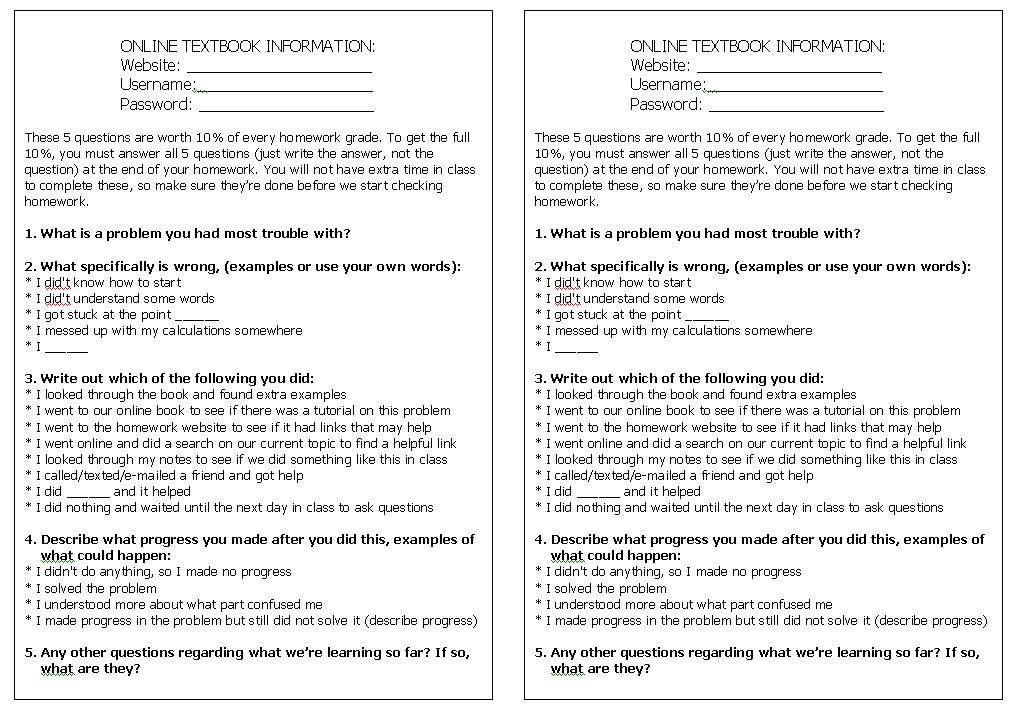
Tuesday, August 17, 2010
Two things I want to do in my classroom this year
I'm thinking if I gave a pop quiz to my high school students with just a variety of clock faces (with hour and second hands) and asked them to write the time, too many (for comfort) would fail. I guess that would mean that even if just one failed that would be too sad for words. Anyway, I came across a picture in an educational book about teaching ideas, and it was probably meant for an elementary classroom, but I'm so going to steal it. The teacher took the little yellow stickies and just to the outside of every number put the correct minutes: 5, 10, 15, 20, ..., 50, 55. I'm thinking that I don't even have to do a lesson on it; it'll just be a silent lesson every time they look at the clock.***
My second idea came from the book, "Eat, Pray, Love". I want to make a poster of it. If I remember correctly, one of the author's friends in Italy said to her after she was berating herself for her language mistakes, "Be polite to yourself when you're learning something new." (or something to that effect). What a nice way to approach the scary waters of unknown math.
*** of course a former student just sent me e-mail about THIS clock, and I bought it, so who knows how good of a "time telling lesson" this will turn out to be.
*** and of course now that I look at each hour, there are 2 I DO NOT LIKE .... but maybe that will spark good discussion in class (cough cough)
My second idea came from the book, "Eat, Pray, Love". I want to make a poster of it. If I remember correctly, one of the author's friends in Italy said to her after she was berating herself for her language mistakes, "Be polite to yourself when you're learning something new." (or something to that effect). What a nice way to approach the scary waters of unknown math.
*** of course a former student just sent me e-mail about THIS clock, and I bought it, so who knows how good of a "time telling lesson" this will turn out to be.
*** and of course now that I look at each hour, there are 2 I DO NOT LIKE .... but maybe that will spark good discussion in class (cough cough)
Monday, August 09, 2010
Group Work
These past few days I've been in a small town in Texas working with people I don't know very well on a job we all had to get done (not work related) and get done accurately. We would only be together for about 3 days, and we had to get along. Well, we didn't have to get along, but it sure made the time more pleasant if we did. Also, we had jobs to do, and all our jobs depended on other people and other people depended on our jobs. Lots of us were new to our tasks, many had done things before and had set ideas on how to do things, many people had strong personalities or weird personalities or quiet personalities, but we still had to work well together.
So that got me to thinking, "group work" just crops up everywhere in life, and the more we get exposed to it in school and the more there are issues that we have to resolve while we're in our groups and the more troubles that arise, then THE BETTER. If you never have the chance to figure out how to solve "group work" problems early on in school and such, then later on when it's not a choice, you'll have a hard time managing, and you'll be part of the problem.
I'm one of those people that inwardly groan when we're assigned groups in an educational setting and think, "I just want to do it by myself". But now I'm thinking, okay, if "bad" things come up (someone doesn't contribute, someone dominates, someone thinks they can do it better themselves (ahem)...), then this will be my opportunity to think of ways to address problems that may come up. Maybe I won't do it perfectly, but I'll try something out and if it doesn't work, then I'll know to try something else next time. ... Now this all sounds like I think I'm the jewel of the group work and never do ANYTHING wrong (it's hard being so perfect), but I don't think that at all. I guess I'm more along the lines of thinking I have to adjust my attitudes about it and maybe even I'm a thorn in the side of the group and don't know it. Viva la group work!
So that got me to thinking, "group work" just crops up everywhere in life, and the more we get exposed to it in school and the more there are issues that we have to resolve while we're in our groups and the more troubles that arise, then THE BETTER. If you never have the chance to figure out how to solve "group work" problems early on in school and such, then later on when it's not a choice, you'll have a hard time managing, and you'll be part of the problem.
I'm one of those people that inwardly groan when we're assigned groups in an educational setting and think, "I just want to do it by myself". But now I'm thinking, okay, if "bad" things come up (someone doesn't contribute, someone dominates, someone thinks they can do it better themselves (ahem)...), then this will be my opportunity to think of ways to address problems that may come up. Maybe I won't do it perfectly, but I'll try something out and if it doesn't work, then I'll know to try something else next time. ... Now this all sounds like I think I'm the jewel of the group work and never do ANYTHING wrong (it's hard being so perfect), but I don't think that at all. I guess I'm more along the lines of thinking I have to adjust my attitudes about it and maybe even I'm a thorn in the side of the group and don't know it. Viva la group work!
Tuesday, August 03, 2010
Old and New Ideas
OLD IDEA:

I was/am Queen of the Sticky Notes. All my to-do lists for school would be scattered about and usually I'd find all of them, but who knows. I saw the teachers at my school carrying around various composition notebooks and such to meetings and recording things. It turned out this was their "Book Of To Do Things". I loved it. I started using one in the middle of the year, and here are the pros:
*portable
*everything is in one place
*you have a record of your year
*portable, portable, portable so you don't have to be at home and stress that you're forgetting something
A To Do List:

Planning My Line Project:

Visual of the End of the Year:

NEW IDEA:
Next year I want to put up a classroom comment board ala Whole Foods. I'll pass out some cards to the kids to keep in their folders, and have a box up front where they can turn them in, with extra cards available. I can respond in writing on the card and post the cards. If at any time during any class a kid notices something or wants to say something, but it's not feasible for whatever reason during class, they can submit a comment. I'm thinking in this way, I'll get a better sense of what's what during class, and I'll promote more of a sense of community, and the other students can read the comments/responses on the board.
Here's what I'll print & cut out to hand the kids:


I was/am Queen of the Sticky Notes. All my to-do lists for school would be scattered about and usually I'd find all of them, but who knows. I saw the teachers at my school carrying around various composition notebooks and such to meetings and recording things. It turned out this was their "Book Of To Do Things". I loved it. I started using one in the middle of the year, and here are the pros:
*portable
*everything is in one place
*you have a record of your year
*portable, portable, portable so you don't have to be at home and stress that you're forgetting something
A To Do List:

Planning My Line Project:

Visual of the End of the Year:

NEW IDEA:
Next year I want to put up a classroom comment board ala Whole Foods. I'll pass out some cards to the kids to keep in their folders, and have a box up front where they can turn them in, with extra cards available. I can respond in writing on the card and post the cards. If at any time during any class a kid notices something or wants to say something, but it's not feasible for whatever reason during class, they can submit a comment. I'm thinking in this way, I'll get a better sense of what's what during class, and I'll promote more of a sense of community, and the other students can read the comments/responses on the board.
Here's what I'll print & cut out to hand the kids:

Sunday, August 01, 2010
Retests
As probably for many other teachers, this is a hot-button topic for me. The first 6 years I taught, I'd never heard of the concept. No students asked for a retest; I didn't know such a situation could exist. My next 6 years of teaching in another state and another type of school, I got indoctrinated. Eventually, I felt I "bowed" to the pressure and allowed retests. I finally worked out a system that sat "okay/well" with me: anyone with all their homework assignments turned in could retest, and your final grade on the test is an average of your 2 tests, so technically, your grade could go down if you did worse on the retest.
One reason I didn't like retests was that I saw too many kids either not studying for them, or not studying for the original test, knowing they could have a do over.
Now that I've moved schools, I gave no retests. You got what you got.
This summer in Philadelphia, I happened across this book, and there was a discussion on retests of some sort. As I felt my hackles rising, I ran across a statement that gave me pause:
If a kid fails a test or does poorly and shows they don't know a particular concept and you just move on, you are in essence saying that you're okay with them not having that knowledge under their belt, that it's okay not to ultimately understand something in your course.
I don't know that I'll move back to retesting as I've done before, but I want to think further on this idea for next year. I know there's been discussion on the blogs on this, and I've been reading it, and I think I need to find something that works for me and is manageable in my classroom and that I buy into; otherwise, obviously, I won't effectively implement it, and it's doomed to fail.
My initial kernel of an idea is to have a list of concepts they need to know, and by each concept I have 2 boxes with a room for the date of success. This may be on box.net or something with each student's name in a chart, and when they have successfully mastered the concept twice (time frame?), then they are good to go. Grading? Haven't thought of that yet. I was thinking more of a general holistic idea because realistically, maybe all kids don't get to all concepts twice. Maybe their final grade will include a percentage based on what they've shown .... but then I'm still saying that I'm okay with them not knowing things .... ARGH .... must ponder more.
One reason I didn't like retests was that I saw too many kids either not studying for them, or not studying for the original test, knowing they could have a do over.
Now that I've moved schools, I gave no retests. You got what you got.
This summer in Philadelphia, I happened across this book, and there was a discussion on retests of some sort. As I felt my hackles rising, I ran across a statement that gave me pause:
If a kid fails a test or does poorly and shows they don't know a particular concept and you just move on, you are in essence saying that you're okay with them not having that knowledge under their belt, that it's okay not to ultimately understand something in your course.
I don't know that I'll move back to retesting as I've done before, but I want to think further on this idea for next year. I know there's been discussion on the blogs on this, and I've been reading it, and I think I need to find something that works for me and is manageable in my classroom and that I buy into; otherwise, obviously, I won't effectively implement it, and it's doomed to fail.
My initial kernel of an idea is to have a list of concepts they need to know, and by each concept I have 2 boxes with a room for the date of success. This may be on box.net or something with each student's name in a chart, and when they have successfully mastered the concept twice (time frame?), then they are good to go. Grading? Haven't thought of that yet. I was thinking more of a general holistic idea because realistically, maybe all kids don't get to all concepts twice. Maybe their final grade will include a percentage based on what they've shown .... but then I'm still saying that I'm okay with them not knowing things .... ARGH .... must ponder more.
Wednesday, July 28, 2010
On My Mind
There's been a running thread of thoughts peeking in and out of my mind all summer, and it seems that lots of things conspire to keep me thinking along the same lines. Or maybe since I'm already thinking of "it", then my devious mind is making connections to various experiences I have.
Start: early in the summer I got a call that a previous colleague had committed suicide in the past few days. Aside from being horrific and so sad, it started the thoughts in my brain. This person seemed fine. This person was a great teacher. This person had tons to contribute. This person seemed happy with life. The public face I saw of this person gave no indication of the turmoil that must have been going on inside.
Now this is not a post about suicide, but I guess more about how we perceive the experience of others' lives. I'm guessing you have interaction(s) with people, and you make a judgment about how you think their lives are going. Many times you think: wow, they have a great life, or how lucky are they, or look how much they have or have it together. I'm wondering what percentage of the time you are wrong, and maybe it's a much higher percentage than you would think.
Next: I don't have cable TV at home for various reasons: husband severely dislikes TV, I don't get home until late, if I had convenient TV, I could see myself sucking away a ton of time channel surfing and watching. Anyway, that's not to say I don't like TV. When I go away on trips where I happen to be alone, one of my treats is to channel surf away late into the night at my heart's desire. On my past trip I came across the MTV show, "If you really knew me". I guess it was episode 101 (from the pictures on the website). Here was another instance on the same theme running through my head. You may see these students daily and know their public persona but not the struggles they're going through.
Next: During the same trip I was reading, "Mrs. Perfect", and the main character looked as if she had a fabulous life, but ..... well you get the picture.
Next: Love math, but also love other non-math blogs and check them either daily, or frequently. On one such blog, I came across a link that AGAIN added to my pile of thoughts on this topic. From browsing her other posts, she's an author and teacher and I picture her as seeming to have a ton going for her. Then you scrape a little deeper and see that she's going through this gut-wrenching continuous heartache.
Finally: I've been to a workshop these past 2 days, and in the course of it got to meet 2 new educators to our school. The first day they seemed outwardly fine about the coming school year. Now I just have to say that my new-to-me-school-of-one-year is an intense school with high expectations of everyone. I only mention this because of what happened the 2nd day of the workshop. I don't know how the conversation got started the 2nd morning, but one of the teachers said, "after yesterday I went home and started panicking and doubting myself about being able to do a good job next year." The second new person heaved a relief sigh and echoed that she had the same thoughts. Now if they hadn't shared this, I'm guessing I'd have continued to see them in a certain light of "everything's fine and functioning as it should be" instead of "take extra care to make sure they're okay".
So while this is continually popping up in my thoughts when I was wandering around Philadelphia, I took time to look at people I passed. There was the usual person type of "I look smashing", "I have it together", "my life is great" mixed in with others. But I have to wonder and most likely, no, they could possibly be going through some painful events and they're just continuing to function.
What do I come away with for all this wondering? I guess more of an awareness and a thought to treat everyone as if they're a precious commodity and not make assumptions as to how excellent things may be going for them (which may lead to me not treating them so gently or making me question my life experience more). For various reasons life is hard many times in different ways for everyone, and though it may not solve everything, hugs and smiles and kind thoughts towards others may help.
Start: early in the summer I got a call that a previous colleague had committed suicide in the past few days. Aside from being horrific and so sad, it started the thoughts in my brain. This person seemed fine. This person was a great teacher. This person had tons to contribute. This person seemed happy with life. The public face I saw of this person gave no indication of the turmoil that must have been going on inside.
Now this is not a post about suicide, but I guess more about how we perceive the experience of others' lives. I'm guessing you have interaction(s) with people, and you make a judgment about how you think their lives are going. Many times you think: wow, they have a great life, or how lucky are they, or look how much they have or have it together. I'm wondering what percentage of the time you are wrong, and maybe it's a much higher percentage than you would think.
Next: I don't have cable TV at home for various reasons: husband severely dislikes TV, I don't get home until late, if I had convenient TV, I could see myself sucking away a ton of time channel surfing and watching. Anyway, that's not to say I don't like TV. When I go away on trips where I happen to be alone, one of my treats is to channel surf away late into the night at my heart's desire. On my past trip I came across the MTV show, "If you really knew me". I guess it was episode 101 (from the pictures on the website). Here was another instance on the same theme running through my head. You may see these students daily and know their public persona but not the struggles they're going through.
Next: During the same trip I was reading, "Mrs. Perfect", and the main character looked as if she had a fabulous life, but ..... well you get the picture.
Next: Love math, but also love other non-math blogs and check them either daily, or frequently. On one such blog, I came across a link that AGAIN added to my pile of thoughts on this topic. From browsing her other posts, she's an author and teacher and I picture her as seeming to have a ton going for her. Then you scrape a little deeper and see that she's going through this gut-wrenching continuous heartache.
Finally: I've been to a workshop these past 2 days, and in the course of it got to meet 2 new educators to our school. The first day they seemed outwardly fine about the coming school year. Now I just have to say that my new-to-me-school-of-one-year is an intense school with high expectations of everyone. I only mention this because of what happened the 2nd day of the workshop. I don't know how the conversation got started the 2nd morning, but one of the teachers said, "after yesterday I went home and started panicking and doubting myself about being able to do a good job next year." The second new person heaved a relief sigh and echoed that she had the same thoughts. Now if they hadn't shared this, I'm guessing I'd have continued to see them in a certain light of "everything's fine and functioning as it should be" instead of "take extra care to make sure they're okay".
So while this is continually popping up in my thoughts when I was wandering around Philadelphia, I took time to look at people I passed. There was the usual person type of "I look smashing", "I have it together", "my life is great" mixed in with others. But I have to wonder and most likely, no, they could possibly be going through some painful events and they're just continuing to function.
What do I come away with for all this wondering? I guess more of an awareness and a thought to treat everyone as if they're a precious commodity and not make assumptions as to how excellent things may be going for them (which may lead to me not treating them so gently or making me question my life experience more). For various reasons life is hard many times in different ways for everyone, and though it may not solve everything, hugs and smiles and kind thoughts towards others may help.
Sunday, July 25, 2010
Home Sweet Home
Phew. We're finally home after a marathon travel session. My husband's Canadian aunt and uncle were celebrating their 50th wedding anniversary (we should all be so lucky), and their children set up a surprise gathering for them. It was so nice to see all their friends and family showering them with love at the party. My husband and I don't have children, so that's one thing I'll miss as we get older - all the offspring and their families and so on all gathered together and being a big party. Of course, if it was my family, we'd probably all be at our separate corners stewing or fighting or not showing up for the party because of issues or dancing drunk on the table tops and embarrassing everyone.
I'm thinking that as the years pass, we have to get a phone chain of our other older, childless friends and call each other every morning, "are you still alive? okay. talk to you tomorrow." or something to that effect. Maybe we can get a commune going and have an on-site nurse.
Then I got to visit with a friend of 13 years (in Pennsylvania) who I haven't seen for 2. She was one of the 1st math teachers I taught with in New Jersey, and I always am thankful that I ended up (by a fluke) at that particular school to learn about teaching with that particular group of people. They're passionate, smart, nice, reflective and just plain old fun to be around.
Before visiting with her, I got to walk around Philadelphia for a day. Love It. Here are some cool things about Philly:
* They have solar compacting trash and recycling units scattered throughout the city.
* They have nice signs on several corners indicating where you are and what might be interesting to see in the area.
* It's uber walker friendly.
* Tons of history you just happen upon by walking.
* Many parks and trees sprinkled throughout that provide shade and places to chat.
* Gourmet groceries that also have a breakfast bar for travelers.
But it's nice to be home and get back into a routine (soon). Here's to gaining weight on vacations and now having to deal with it (did I mention all the frozen yogurt places I was FORCED to frequent in PA?). I guess I'm pretty active during the school year (running (okay jog walking, but running sounds better), yoga, dancing, weights, walking around all day during teaching). But the TRUE me is a couch potato happy to just sit around reading books and doing puzzles and movies and napping. Hello extra summer weight. I basically sat around either on planes or couches or cars the WHOLE trip. One guess as to the effect THAT had on me. Oh well, back to the weight loss drawing board.
I'm thinking that as the years pass, we have to get a phone chain of our other older, childless friends and call each other every morning, "are you still alive? okay. talk to you tomorrow." or something to that effect. Maybe we can get a commune going and have an on-site nurse.
Then I got to visit with a friend of 13 years (in Pennsylvania) who I haven't seen for 2. She was one of the 1st math teachers I taught with in New Jersey, and I always am thankful that I ended up (by a fluke) at that particular school to learn about teaching with that particular group of people. They're passionate, smart, nice, reflective and just plain old fun to be around.
Before visiting with her, I got to walk around Philadelphia for a day. Love It. Here are some cool things about Philly:
* They have solar compacting trash and recycling units scattered throughout the city.
* They have nice signs on several corners indicating where you are and what might be interesting to see in the area.
* It's uber walker friendly.
* Tons of history you just happen upon by walking.
* Many parks and trees sprinkled throughout that provide shade and places to chat.
* Gourmet groceries that also have a breakfast bar for travelers.
But it's nice to be home and get back into a routine (soon). Here's to gaining weight on vacations and now having to deal with it (did I mention all the frozen yogurt places I was FORCED to frequent in PA?). I guess I'm pretty active during the school year (running (okay jog walking, but running sounds better), yoga, dancing, weights, walking around all day during teaching). But the TRUE me is a couch potato happy to just sit around reading books and doing puzzles and movies and napping. Hello extra summer weight. I basically sat around either on planes or couches or cars the WHOLE trip. One guess as to the effect THAT had on me. Oh well, back to the weight loss drawing board.
Wednesday, July 14, 2010
Lucky Traveler
We just got back from Maui, and boy it was beautiful and relaxing. We stayed in a B&B in Haiku and rented a car from a local company and just decided each morning what to do. Lovely. We went to the beach a lot, hiked into the crater, tried paddle boarding, ate too much, and swam. Life's good.
One of the many beaches:

Post paddle boarding ... my shoulders are sore, waves are scary, it's not too bad falling in warm tropical water ... a lot:

A shop where my husband rented his windsurfing equipment:

Growing at our B&B:

Also at our B&B:

One of the many beaches:

Post paddle boarding ... my shoulders are sore, waves are scary, it's not too bad falling in warm tropical water ... a lot:

A shop where my husband rented his windsurfing equipment:

Growing at our B&B:

Also at our B&B:

Tuesday, July 06, 2010
Friendly Reminder
I traveled recently to visit my dad near Lake Tahoe, and I flew Southwest (love them). I don't know if you've flown them lately (I haven't), but they have a great system of boarding. When you check in you're given a letter-number combination, and when it's "time" you stand in a particular place and follow orders to board in an orderly fashion and then get to pick your seat at that time.
Anyway, as I said, it was the first time I'd been through this, and I didn't know what was what and figured I'd wait for the directions from the Southwest employees over the loudspeaker. Obviously, there were no written directions. So here's basically what I heard, "We're ready to begin boarding, people with an A something something something do something and get ready to something and others please something something ....". You get the idea. I heard a bit and then by the time I finished processing it, the next part was already said and moved on, and then of course I couldn't THEN make sense of the following part. Sheesh. Reality check on teaching for me.
I know the kids say I talk too fast (sometimes?). In my mind everything's clear (like I'm sure it is to the Southwest employee who's said the same speech many times), so I'm probably on autopilot (ar ar ar). I guess I need to make myself a poster for next year to hang in the back of the room to remind myself to slow down or to write simultaneously or to give kids processing time more consciously. My sign will probably be: SOUTHWEST INCIDENT!
Yes I figured out what to do, but, no, I still got stuck behind the smelly lady I was trying to avoid.
Anyway, as I said, it was the first time I'd been through this, and I didn't know what was what and figured I'd wait for the directions from the Southwest employees over the loudspeaker. Obviously, there were no written directions. So here's basically what I heard, "We're ready to begin boarding, people with an A something something something do something and get ready to something and others please something something ....". You get the idea. I heard a bit and then by the time I finished processing it, the next part was already said and moved on, and then of course I couldn't THEN make sense of the following part. Sheesh. Reality check on teaching for me.
I know the kids say I talk too fast (sometimes?). In my mind everything's clear (like I'm sure it is to the Southwest employee who's said the same speech many times), so I'm probably on autopilot (ar ar ar). I guess I need to make myself a poster for next year to hang in the back of the room to remind myself to slow down or to write simultaneously or to give kids processing time more consciously. My sign will probably be: SOUTHWEST INCIDENT!
Yes I figured out what to do, but, no, I still got stuck behind the smelly lady I was trying to avoid.
Sunday, July 04, 2010
Randomization
I modified my Excel Slope Quiz program. Now there are extra buttons, so the students can try any number of extra random problems to test their skills. I'm pretty sure it's bug free. And Again, if you want to try it, you have to "enable macros" when you open the Excel file. Thanks Mrs. H for the idea.


Friday, July 02, 2010
Programming Attempt
Well, I don't know if Excel will be the best tool for this, but I sure had fun making the following program. My vision is that eventually I can create several of these and put them on my class website for the kids to practice their skills. I know there are great practice tools on the web, and I do link to those. My thinking in creating this type of program is that the kids will see what I think is important for them to know.
Anyway, it looks like:

It's interactive and provides hints for the tester. When you open the Excel file, you have to enable the macros in order for it to work. Now I have to figure out how to create my Geometry Proof Excel "quizzes".
Anyway, it looks like:

It's interactive and provides hints for the tester. When you open the Excel file, you have to enable the macros in order for it to work. Now I have to figure out how to create my Geometry Proof Excel "quizzes".
Subscribe to:
Posts (Atom)