Like something that still doesn't feel quite done, THE SCHOOL YEAR IS OVER! I gave my last 2 finals. I marveled that my Digital Electronics students actually learned something. I turned in my last grades with literally seconds to spare (over the ceiling intercom, "Ms. ____ are you done yet?"). I contemplated packing up my room and decided to do it later. I went to a last shindig with our juniors who were thanking industry partners for their week-long internship. I celebrated with a dinner out and a reading of a funny book. And now blogging. Woot!
Things I learned or was reminded of again this year:
* people before paper (if someone is vying for your time and you're trapped in your busy work, stop and talk with them; paper can usually wait).
* like all people, kids remember how you make them feel, not how stellar your knowledge was of a particular topic.
* being physically around a group of negative people too much is not healthy for anyone; it feeds on itself.
* change is inevitable.
* kids are still kids, and no matter how mature they act; there are still things they don't know and may appreciate hearing a different perspective on.
* people usually aren't doing the things they do to annoy you; everyone is mostly trying to get by the best way they currently know how; react accordingly.
* no school is perfect; warts happen; you have to know what your deal-breakers are and how to work healthily around things/situations if you can.
Wednesday, May 30, 2012

Thursday, May 24, 2012
Final Exams......
This morning I happened to read some teacher suggestions (a union teacher journal) on writing in the classroom. One teacher mentioned that as she handed out tests to her class, she instructed the students to write an inspiring message on their test. She mentions that they would roll their eyes but do it anyway. Then if she forgot to mention the message on later, future tests, the students reminded her.
I gave some geometry finals today, and as they got ready, I told them to write inspiring messages on their scratch paper. I mentioned that they'd do great, and they have to free up their brain cells from stressing, so they can concentrate on doing math.
I read through their messages after the test:
* Don't overthink it! Relax and everything will be okay.
* Kick butt!
* You are the smartest person in the world!
* You know things .... just try your hardest.
* I'm proud of you.
I gave some geometry finals today, and as they got ready, I told them to write inspiring messages on their scratch paper. I mentioned that they'd do great, and they have to free up their brain cells from stressing, so they can concentrate on doing math.
I read through their messages after the test:
* Don't overthink it! Relax and everything will be okay.
* Kick butt!
* You are the smartest person in the world!
* You know things .... just try your hardest.
* I'm proud of you.
Feet Cubed....
As every high school student OBVIOUSLY knows, "3 feet cubed" is "3x12 inches cubed". Duh! You know, you just multiply by 12 because there are 12 inches in a foot.
Like everyone else, I've tried various ways to dispel this rumor: we've drawn models, we've used models, we've discussed. Seemingly to no avail. This year, I tried yet again with a different tactic.
We started out with a rectangular prism 3' x 2' x 4'. They found the volume in feet cubed. Then I asked them to find the volume in inches cubed, and to a person, they all wrote the wrong answer (24 x 12 = 288). Then without saying they were wrong I had them go back and redraw the prism into the inches equivalent and recalculate the volume, and OH NO, they were wrong with their first "288". Hmmmmm. So, this is stuff I've tried before. Now for the "new" attempt that MAYBE will work.
I had them write: 5 ft^3
Then change to: 5 * ft * ft * ft
Then EACH foot had to be converted to inches, so
= 5 *ft * ft * ft
= 5 * 12in * 12in * 12in
= 8640 in*in*in
= 8640 in^3
Let's see if this one sticks.
Like everyone else, I've tried various ways to dispel this rumor: we've drawn models, we've used models, we've discussed. Seemingly to no avail. This year, I tried yet again with a different tactic.
We started out with a rectangular prism 3' x 2' x 4'. They found the volume in feet cubed. Then I asked them to find the volume in inches cubed, and to a person, they all wrote the wrong answer (24 x 12 = 288). Then without saying they were wrong I had them go back and redraw the prism into the inches equivalent and recalculate the volume, and OH NO, they were wrong with their first "288". Hmmmmm. So, this is stuff I've tried before. Now for the "new" attempt that MAYBE will work.
I had them write: 5 ft^3
Then change to: 5 * ft * ft * ft
Then EACH foot had to be converted to inches, so
= 5 *
= 5 * 12in * 12in * 12in
= 8640 in*in*in
= 8640 in^3
Let's see if this one sticks.
Sunday, May 20, 2012
Solar Eclipse Video

Monday, May 14, 2012
Slow Learner
Today in discussing Surface Area and Volume of 3D figures, I found out why textbooks choose to flatten out a cylinder in this way:

as opposed to this way:

I was "not on the ball" when I was talking while simultaneously drawing it the "bad" way.
Oy!
Second, I think I've jumped on the "be bossy in how you accept homework" wagon. I strongly suggested in the past that students show work neatly when they do their homework or tests. I never went further than that. I've seen too many instances now where they or I can't follow their work and when there's a mistake, you have to do extra work to track it down.
Because we're doing SA and LA and V of 3D figures today, and because I've seen so many mistakes in the past (and made them!) just from sloppiness, I laid down the law today. I had a small discussion about how they're not just doing a problem, but they're communicating a process. If the reader has to question you about what you're doing, then you've failed as a communicator. If you have to track down your work later on, and it takes you longer because you're jumping around all the work and can't follow the thought process, then you've failed as a communicator.
I'm making them write things DOWN IN COLUMNS and drawing and labeling neat pictures and indicating what they're finding for each step. With lots of (good-natured) grumbling (see, I'm in denial), they got to work and the beginnings of things looked promising.
I think I want to start off next year as BOSSY PANTS in this manner.
Also, SO excited! I found out what I'm teaching next year (95% sure):
Precalculus preAP
AP Calculus AB
AP Computer Science
Digital Electronics
Woot! Who's going to be busy this summer? I'm going to miss the enthusiastic 8th and 9th graders, but I'll be excited to challenge my brain in a different way.

as opposed to this way:

I was "not on the ball" when I was talking while simultaneously drawing it the "bad" way.
Oy!
Second, I think I've jumped on the "be bossy in how you accept homework" wagon. I strongly suggested in the past that students show work neatly when they do their homework or tests. I never went further than that. I've seen too many instances now where they or I can't follow their work and when there's a mistake, you have to do extra work to track it down.
Because we're doing SA and LA and V of 3D figures today, and because I've seen so many mistakes in the past (and made them!) just from sloppiness, I laid down the law today. I had a small discussion about how they're not just doing a problem, but they're communicating a process. If the reader has to question you about what you're doing, then you've failed as a communicator. If you have to track down your work later on, and it takes you longer because you're jumping around all the work and can't follow the thought process, then you've failed as a communicator.
I'm making them write things DOWN IN COLUMNS and drawing and labeling neat pictures and indicating what they're finding for each step. With lots of (good-natured) grumbling (see, I'm in denial), they got to work and the beginnings of things looked promising.
I think I want to start off next year as BOSSY PANTS in this manner.
Also, SO excited! I found out what I'm teaching next year (95% sure):
Precalculus preAP
AP Calculus AB
AP Computer Science
Digital Electronics
Woot! Who's going to be busy this summer? I'm going to miss the enthusiastic 8th and 9th graders, but I'll be excited to challenge my brain in a different way.
Tuesday, May 08, 2012
Stacks & Queues
In Computer Programming we learned something about various data structures, two being "stacks" and "queues".
Stacks can be thought of like a pile of plates. You keep adding to your list (or plates that are stacked on a table), and when you want to remove one, you remove the top-most one (or the last thing you put on). You can liken it to "last on first out".
Queues are like movie lines - first one in is the first one out. So you can add to the end of a list, and then when things are removed, they peel off from the start of the list.
I thought about that today when I was teaching for two reasons. There are all these "extra" things we have to remember in addition to teaching our content:
* put kids on "mandatorials" if they fail for a grading period
* check in and make sure they're coming to tutorials
* don't forget to update your money log if you're a sponsor of a club
* check in with kids emotionally to see if anyone is acting "off" from their normal selves
* if you're a team leader, check in with other people teaching in your grade level
* do your 5? 6? observations of other teachers throughout the year
* have you planned for an interdisciplinary unit?
* what about a flipped class?
* check in before every test you give to make sure kids know how to study for tests or need extra help
* kids stressed? don't forget that extra activity you did that was short and sweet and was a temporary relief for them
* make sure you connect with the students
* there are no stupid questions, so get that look off your face and answer patiently (it's the FIRST time this kid is asking)
etc.
So this came to light today when I realized that I'd totally forgotten to do one of those things (more?) that should have been ingrained in my mind - the "check that they know how to set up a study schedule for learning" .... (because most of them have never learned how to study for math tests before). Then I thought, I'm like a "queue". I have so many more things popping onto my to-do list, that the old/first stuff falls off my radar while I'm concentrating on the "new fires".
Maybe I need a bunch of charts hanging around my room or somewhere I can see them and the kids can't. That way I can take a quick glance and see if anything needs to be addressed currently. ..... But then I'm thinking, the list would probably be SO long I wouldn't have space to hang it :).
Stacks can be thought of like a pile of plates. You keep adding to your list (or plates that are stacked on a table), and when you want to remove one, you remove the top-most one (or the last thing you put on). You can liken it to "last on first out".
Queues are like movie lines - first one in is the first one out. So you can add to the end of a list, and then when things are removed, they peel off from the start of the list.
I thought about that today when I was teaching for two reasons. There are all these "extra" things we have to remember in addition to teaching our content:
* put kids on "mandatorials" if they fail for a grading period
* check in and make sure they're coming to tutorials
* don't forget to update your money log if you're a sponsor of a club
* check in with kids emotionally to see if anyone is acting "off" from their normal selves
* if you're a team leader, check in with other people teaching in your grade level
* do your 5? 6? observations of other teachers throughout the year
* have you planned for an interdisciplinary unit?
* what about a flipped class?
* check in before every test you give to make sure kids know how to study for tests or need extra help
* kids stressed? don't forget that extra activity you did that was short and sweet and was a temporary relief for them
* make sure you connect with the students
* there are no stupid questions, so get that look off your face and answer patiently (it's the FIRST time this kid is asking)
etc.
So this came to light today when I realized that I'd totally forgotten to do one of those things (more?) that should have been ingrained in my mind - the "check that they know how to set up a study schedule for learning" .... (because most of them have never learned how to study for math tests before). Then I thought, I'm like a "queue". I have so many more things popping onto my to-do list, that the old/first stuff falls off my radar while I'm concentrating on the "new fires".
Maybe I need a bunch of charts hanging around my room or somewhere I can see them and the kids can't. That way I can take a quick glance and see if anything needs to be addressed currently. ..... But then I'm thinking, the list would probably be SO long I wouldn't have space to hang it :).
Sunday, May 06, 2012
EOY Wrap Up
Only 3 weeks and 2 extra days of teaching this year. Oy! As always when I come to this part of the year, I shake my head at how fast it went and what all I still have to do and how there's not enough time and too many testing interruptions to finish up strongly and and and ....Then I also start to get excited about next year. I think about the potential classes I'll teach (not 100% sure yet) and then I don't want to jinx anything, so I make myself THINK it'll be okay if I don't teach a particular course (you know, lie to myself). Then I get nervous because it seems 99.9% sure I will be teaching certain courses, then I wonder how it will all work out. Maybe all this mental gymnastics is just a smoke screen to bend my mind away from the fact that THERE'S HARDLY ENOUGH TIME LEFT THIS YEAR.
Anyway, I was out doing chores today and was at Barnes & Noble and picked up Ron Clark's new book. I did not know he started a new academy. I find his enthusiasm and energy and good thoughts and "can do" attitude and belief and vision so inspiring. Just the jolt I need to end the year. I think his school is 5th-8th, and I teach mostly high schoolers, but I still found many things I want to think on and mold and implement.
Next year, we'll have our 1st senior class. This will be the class that were freshmen when I started teaching at my "new" school. This is the class that in my first year caused me much grief and stress and joy and frustration and laughter. It will be sad and exciting to see them graduate, and it will feel like a different school without them in 2 years.
Fun things this past year:
1. Digital Electronics. At the start of the year, I had my students write on index cards what they were worried about for the coming year in DE. I clipped them together and put them away. Just recently, I found them and as a class we had a giggle reading them. We were all "I hope I don't get electrocuted!" ... "I hope it's not too hard!" ... "I won't know what to do!" And now for the most part, we're bread boarding geniuses, we can work with our BoeBot and circuits and K-Mapping and State Machines and such.
2. My online AP Computer Science class from Mizzou. I took it to "help" one of our students that wanted to take the course but didn't want to take it alone. I ended up learning a lot about the student's point of view in an AP class and trying to balance the work load all the while juggling the ton of other things that make up life. It was also interesting to take an AP class from a college course perspective.
3. Overloading of Duties/Happenings. Okay, not so fun in the stress department, but it's always fun to tackle new challenges. I: was NHS cosponsor, one of 3 HS team leaders, agreed to cosponsor an "inventing team" for next year (that started this year), sat in on TONS of interviews and learned TONS, taught a 1/2 hour weekly yoga class to our sometimes-unwilling students, tried a cross-country geometry project, had several guest speakers in DE (a mix of successful and not).
I'm eager for summer to start for the longer periods of R&R that I'll get and also for the workshops and such I'll get to attend and the planning for 2 new courses I'll be teaching (most likely) and the vow to myself not to sit so much and to get up and move.
Anyway, I was out doing chores today and was at Barnes & Noble and picked up Ron Clark's new book. I did not know he started a new academy. I find his enthusiasm and energy and good thoughts and "can do" attitude and belief and vision so inspiring. Just the jolt I need to end the year. I think his school is 5th-8th, and I teach mostly high schoolers, but I still found many things I want to think on and mold and implement.
Next year, we'll have our 1st senior class. This will be the class that were freshmen when I started teaching at my "new" school. This is the class that in my first year caused me much grief and stress and joy and frustration and laughter. It will be sad and exciting to see them graduate, and it will feel like a different school without them in 2 years.
Fun things this past year:
1. Digital Electronics. At the start of the year, I had my students write on index cards what they were worried about for the coming year in DE. I clipped them together and put them away. Just recently, I found them and as a class we had a giggle reading them. We were all "I hope I don't get electrocuted!" ... "I hope it's not too hard!" ... "I won't know what to do!" And now for the most part, we're bread boarding geniuses, we can work with our BoeBot and circuits and K-Mapping and State Machines and such.
2. My online AP Computer Science class from Mizzou. I took it to "help" one of our students that wanted to take the course but didn't want to take it alone. I ended up learning a lot about the student's point of view in an AP class and trying to balance the work load all the while juggling the ton of other things that make up life. It was also interesting to take an AP class from a college course perspective.
3. Overloading of Duties/Happenings. Okay, not so fun in the stress department, but it's always fun to tackle new challenges. I: was NHS cosponsor, one of 3 HS team leaders, agreed to cosponsor an "inventing team" for next year (that started this year), sat in on TONS of interviews and learned TONS, taught a 1/2 hour weekly yoga class to our sometimes-unwilling students, tried a cross-country geometry project, had several guest speakers in DE (a mix of successful and not).
I'm eager for summer to start for the longer periods of R&R that I'll get and also for the workshops and such I'll get to attend and the planning for 2 new courses I'll be teaching (most likely) and the vow to myself not to sit so much and to get up and move.
Monday, April 30, 2012
More Enlightening Conversations...
The more this year goes on, the more I wonder about what I don't know about students' misunderstandings. My geometry students were practicing today for our Geometry EOC test. I found some great resources online from Texas and North Carolina (whose problems I liked better). One problem gave the coordinates of the 3 vertices of a triangle and asked for the equation of the line that's the perpendicular bisector of one triangle side.
A student calls me over and asks me to refresh her memory on parallel and perpendicular lines. Okay. I asked her what was the same and what was different about 2 parallel lines. She got that the slopes were the same, but hesitated on whether the y-intercepts were the same. So I had her draw an xy-plane and draw me 2 parallel lines. I got this:

And with some prodding she said that the y-intercepts were not the same. Great. So I asked her what was true about perpendicular lines. She got that the slopes were opposite reciprocals. Great. I asked her if the y-intercepts were the same or different, expecting this to be a gimme. Now this is where it started to get enlightening. She couldn't tell me if the y-intercepts of 2 perpendicular lines were the same or different. So I thought, "great! the drawing helped before, so it'll help again." I asked her to use one of the lines before and draw a line that's perpendicular to it. I got this:

Slight alarm bells go off. I ask, "what's true about perpendicular lines?". She quickly states that they form 90 degree angles. So then I thought the x and y axes were throwing her off. So I made her draw a tilted line without the axes and put the perpendicular line on it somewhere. I got this:

Then I thought, well what if we start over and the 2nd line is her pencil that she can just move around to get perpendicular. I got this:

Then we had a LONG discussion (note that there are 23 other people in class practicing and thankfully none was too needy or off task) ... also note that the quiet girl next to this student was surreptitiously eavesdropping like she needed this information, too ... which made me nervous because I started thinking how many OTHER quiet strugglers are there out there? ... Anyway, I got it down to that IF the perpendicular lines form 90 degree angles (which she got), and the angles were supplementary (which she got), then the 2 angles should LOOK congruent. So next I got this:

And then this:

So what's the point of this story? I guess I always have in the back of my mind that if the student is not understanding something, they'll ask for help. But what if what they are not understanding is such a basic concept that it does not even come up in the scope of the course other than something that's used as a tool for the course (i.e. how do perpendicular lines look like when you draw them? what makes a shadow and how do shadows work) that the kid doesn't think or know to ask. And what if there's so much information and so many students to teach that you're going to miss these critical gaps. ... I won't always have the luxury of spending 5-8 minutes with one student and multiply that by the number of students.
Maybe I need some EXTRA problems on homework or class practice that can be a diagnosis of basics for each concept, and then I have to go over them very carefully to probe kids that may be missing elementary things that are holding them back and remediate further.
A student calls me over and asks me to refresh her memory on parallel and perpendicular lines. Okay. I asked her what was the same and what was different about 2 parallel lines. She got that the slopes were the same, but hesitated on whether the y-intercepts were the same. So I had her draw an xy-plane and draw me 2 parallel lines. I got this:

And with some prodding she said that the y-intercepts were not the same. Great. So I asked her what was true about perpendicular lines. She got that the slopes were opposite reciprocals. Great. I asked her if the y-intercepts were the same or different, expecting this to be a gimme. Now this is where it started to get enlightening. She couldn't tell me if the y-intercepts of 2 perpendicular lines were the same or different. So I thought, "great! the drawing helped before, so it'll help again." I asked her to use one of the lines before and draw a line that's perpendicular to it. I got this:
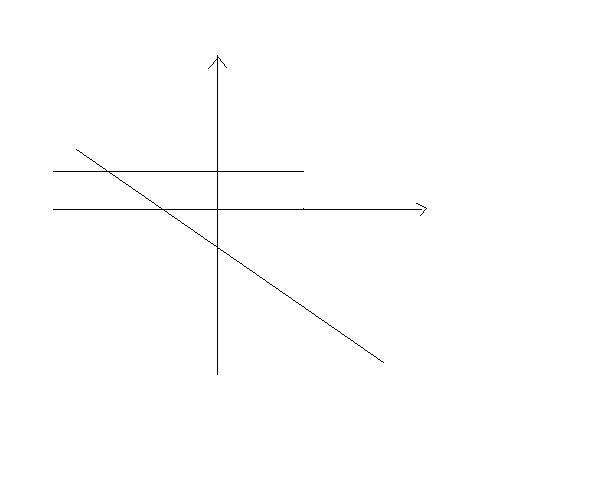
Slight alarm bells go off. I ask, "what's true about perpendicular lines?". She quickly states that they form 90 degree angles. So then I thought the x and y axes were throwing her off. So I made her draw a tilted line without the axes and put the perpendicular line on it somewhere. I got this:

Then I thought, well what if we start over and the 2nd line is her pencil that she can just move around to get perpendicular. I got this:

Then we had a LONG discussion (note that there are 23 other people in class practicing and thankfully none was too needy or off task) ... also note that the quiet girl next to this student was surreptitiously eavesdropping like she needed this information, too ... which made me nervous because I started thinking how many OTHER quiet strugglers are there out there? ... Anyway, I got it down to that IF the perpendicular lines form 90 degree angles (which she got), and the angles were supplementary (which she got), then the 2 angles should LOOK congruent. So next I got this:

And then this:

So what's the point of this story? I guess I always have in the back of my mind that if the student is not understanding something, they'll ask for help. But what if what they are not understanding is such a basic concept that it does not even come up in the scope of the course other than something that's used as a tool for the course (i.e. how do perpendicular lines look like when you draw them? what makes a shadow and how do shadows work) that the kid doesn't think or know to ask. And what if there's so much information and so many students to teach that you're going to miss these critical gaps. ... I won't always have the luxury of spending 5-8 minutes with one student and multiply that by the number of students.
Maybe I need some EXTRA problems on homework or class practice that can be a diagnosis of basics for each concept, and then I have to go over them very carefully to probe kids that may be missing elementary things that are holding them back and remediate further.
Thursday, April 26, 2012
Algebra Algebra Algebra
I don't know why I'm surprised. I knew that from teaching calculus a long time ago, that it always seemed to be the pesky algebra that mostly tripped kids up. I guess I thought it would be different with my current crop of precalculus kids. They're different, I told myself. They're more savvy, I said. They won't have the standard problems, I lied to me. No. They're not and not and they will. And I hesitate to say "algebra". More like "simplifying rational expressions".
We're going over algebraic manipulations of limits, and I gave them basic polynomials and basic "single numerator / single denominator" expressions. They did fine. They were all impressed with themselves that they could chat up limits like they owned the place. And then WHOA. We delved into fractions imbedded in fractions. Huh! What do you mean I have one over "w+4" minus 1/4 ALL over w? What would I do with that? What? Common denom whozits?
Oh! So to get the common denominator of "1 over 'w+4'" and "1/4", I can just add 4 to the top and bottom of 1/4! Who knew!
Or! Once I get that sorted out, when I then have to simplify dividing by w ...... oh! I can just bring it to the "top" and multiply by w, right?
Oy!
And in another problem, the numerator was "9 - v" and the denominator was "(v - 9)(.......)". The student didn't see the connection of how to easily and correctly manipulate the two. It seemed like cheating to her when I mentioned how.
I guess it's a never-ending refreshing of their memory and of practicing and going over concepts. They're so used to JUST dealing with fractions involving ONLY numbers that this may have been too much of a leap for them. Now I'm debating whether to delve into derivatives or to just sprinkle in more intensive algebra and unit circle refreshers in hopes that they'll have an easier time next year in calculus.
Thursday, April 19, 2012
The Limit Does Not Exist
I'm at that (one of many) fun part of precalculus where we talk about limits. We do a day on finding limits graphically. I have them choral chant and watch my bouncing finger run over the notation, "the limit of f of x as x approaches ____ is...". Then on the 2nd day we talk about finding limits algebraically. I usually have skeleton notes and am done with it. This year, I went a step further and made a final chart for them to paste in their notebooks.

It's also one of my favorite topics because I get to use my "spit in the ocean" phrase. When we talk about limits of f(x) as x approaches infinity, and I tell them to only look at the highest powered terms in each of the numerator and denominator, and we test examples on the graphing calculator ...... I describe the largest term like the ocean and everything else as spit. The spit does not change the volume of the ocean significantly.
And without fail, every year someone brings up "Mean Girls".

It's also one of my favorite topics because I get to use my "spit in the ocean" phrase. When we talk about limits of f(x) as x approaches infinity, and I tell them to only look at the highest powered terms in each of the numerator and denominator, and we test examples on the graphing calculator ...... I describe the largest term like the ocean and everything else as spit. The spit does not change the volume of the ocean significantly.
And without fail, every year someone brings up "Mean Girls".
Sunday, April 15, 2012
Perfecting Recipes...
Totally off topic, but one of my latest obsessions: the perfect chocolate chip cookie recipe.
I like to bake, and I like home-baked goodies (and I need to lose some pounds .... connection?). I'm a wee bit snobby about store-bought because when I see all those extra ingredients listed on the label, it does not sound appealing at all. And once you've tasted home-cooked, store bought just doesn't taste the same. Does that mean I'll turn my nose up at an Oreo? Heck no. I'm talking about those hard-plastic-encased "fresh made" stuff from the bakery section. I'll imbibe my extra calories the old-fashioned way, thank you very much.
Anyway, I thought I had a good thing going with my chocolate-chip cookie recipe. I like to add spices to it and increase the vanilla extract and put oatmeal flakes in the dough. I scooped them up with a tablespoon, and poof! we had delicious cookies.
Then a person had generously baked LARGE cookies and brought them to me twice. HUGE. I asked, and this person used a quarter cup measuring cup to put the dough on the cookie sheet. The texture was great, the size was great. Home-made cookies. Delicious.
Now this part is totally NOT sour grapes, but the flavor .... eh! It was a bit too bland and too sweet for me, but did I scarf them all down? Why, yes I did.
So a few weeks ago, I attempted to make these 1/4 cup sized cookies with one of my recipes, but I didn't know what temperature to bake them at or how long to cook them. The flavor came out great, but they were hard as rocks and the texture was too floury. I jokingly wrote a note to the above-mentioned person and nicely asked for her recipe. I figured I could tweak it with my flavorings and happily chomp away.
I was refused. Refused! What kind of person doesn't share a recipe? Maybe this is more common than I know. I'm always willing to share, and I'm happy to share and am flattered that someone wants a recipe. It's not like it's my own creation. It's not like my food will taste any less delicious if someone else is making them. Sheesh. The person was a bit apologetic and said, "I don't even share this recipe with my closest friends". Oy!
Game on girlie. I've since then been testing out recipes, and have finally found one that has the right sweetness level. I also like to add cinnamon and cardamom and cloves and nutmeg and oatmeal. I'm going to experiment with orange rind after a coworker mentioned she did that in a cookie that was delicious. I still don't like the texture of my latest batch, so I have to adjust that.
One interesting note. I'm wondering if everyone's vision of the "perfect" c.c. cookie is akin to everyone's idea of the perfect banana. You know how there's a tiny window when a banana's taste is JUST right? And how everyone has a different idea of when that window is? Well, after testing my cookies out on various people, I think this is the same with c.c. cookies. I've had conflicting suggestions on what would make the perfect texture/flavor/size from a variety of people. Everyone has installed their own window of "acceptability" of a c.c. cookie.
I do think that I have to not test these recipes but once a month or less. Unless I want to totally have to go buy new clothes. But I will create my cookie, and I will share.
I like to bake, and I like home-baked goodies (and I need to lose some pounds .... connection?). I'm a wee bit snobby about store-bought because when I see all those extra ingredients listed on the label, it does not sound appealing at all. And once you've tasted home-cooked, store bought just doesn't taste the same. Does that mean I'll turn my nose up at an Oreo? Heck no. I'm talking about those hard-plastic-encased "fresh made" stuff from the bakery section. I'll imbibe my extra calories the old-fashioned way, thank you very much.
Anyway, I thought I had a good thing going with my chocolate-chip cookie recipe. I like to add spices to it and increase the vanilla extract and put oatmeal flakes in the dough. I scooped them up with a tablespoon, and poof! we had delicious cookies.
Then a person had generously baked LARGE cookies and brought them to me twice. HUGE. I asked, and this person used a quarter cup measuring cup to put the dough on the cookie sheet. The texture was great, the size was great. Home-made cookies. Delicious.
Now this part is totally NOT sour grapes, but the flavor .... eh! It was a bit too bland and too sweet for me, but did I scarf them all down? Why, yes I did.
So a few weeks ago, I attempted to make these 1/4 cup sized cookies with one of my recipes, but I didn't know what temperature to bake them at or how long to cook them. The flavor came out great, but they were hard as rocks and the texture was too floury. I jokingly wrote a note to the above-mentioned person and nicely asked for her recipe. I figured I could tweak it with my flavorings and happily chomp away.
I was refused. Refused! What kind of person doesn't share a recipe? Maybe this is more common than I know. I'm always willing to share, and I'm happy to share and am flattered that someone wants a recipe. It's not like it's my own creation. It's not like my food will taste any less delicious if someone else is making them. Sheesh. The person was a bit apologetic and said, "I don't even share this recipe with my closest friends". Oy!
Game on girlie. I've since then been testing out recipes, and have finally found one that has the right sweetness level. I also like to add cinnamon and cardamom and cloves and nutmeg and oatmeal. I'm going to experiment with orange rind after a coworker mentioned she did that in a cookie that was delicious. I still don't like the texture of my latest batch, so I have to adjust that.
One interesting note. I'm wondering if everyone's vision of the "perfect" c.c. cookie is akin to everyone's idea of the perfect banana. You know how there's a tiny window when a banana's taste is JUST right? And how everyone has a different idea of when that window is? Well, after testing my cookies out on various people, I think this is the same with c.c. cookies. I've had conflicting suggestions on what would make the perfect texture/flavor/size from a variety of people. Everyone has installed their own window of "acceptability" of a c.c. cookie.
I do think that I have to not test these recipes but once a month or less. Unless I want to totally have to go buy new clothes. But I will create my cookie, and I will share.
Wednesday, April 11, 2012
Interviews...
This year provides another first for me. I'm on the "interviewer" side of conducting interviews for possible openings next year. I'm not the only one asking questions, thank goodness, because it's good to get varied feedback and reactions to candidates. But here are some surprising things that seem to be a running theme. And by surprising, I mean, "have you not gone to basic interview 101 school, people?"
When you are asked, "do you have any questions?", here possibly are not good responses:
* No, I really can't think of any.
* Um, what time is your school day over?
* No, but you know, people always seem to ask that.
* Do you have to tutor a lot?
When asked about your career goals, you may not want to mention that in a year or two you plan on doing something else.
When showing up, if you haven't brought any samples of your work, why not?
When asked why you want to work at this particular school, hopefully your answer shows that you've researched us and can say something beyond words that imply, "I want to work with an easy population". First off, there's what SEEMS to be true and then there's reality. And also you don't just say you want a change from where you are, and that's it.
Oh, and maybe you can show up on time.
And maybe you want to wear something other than your sloppy work clothes.
Just saying.
Anyway, very interesting.
When you are asked, "do you have any questions?", here possibly are not good responses:
* No, I really can't think of any.
* Um, what time is your school day over?
* No, but you know, people always seem to ask that.
* Do you have to tutor a lot?
When asked about your career goals, you may not want to mention that in a year or two you plan on doing something else.
When showing up, if you haven't brought any samples of your work, why not?
When asked why you want to work at this particular school, hopefully your answer shows that you've researched us and can say something beyond words that imply, "I want to work with an easy population". First off, there's what SEEMS to be true and then there's reality. And also you don't just say you want a change from where you are, and that's it.
Oh, and maybe you can show up on time.
And maybe you want to wear something other than your sloppy work clothes.
Just saying.
Anyway, very interesting.
Sunday, April 01, 2012
Triangle Inequalities
On Saturday we went to see a show by this company (amazing tap dancing) and here's some footage from a past show. And as I was sitting in my seat fidgeting with the ticket stub, I got what I think was a great idea. Then I thought, oh surely other people already do this, and I just missed the boat. And now, maybe I'll never sail on that boat again for a while because I may not be teaching geometry next year. And then I went back to fiddling and thinking with my ticket stub.
I was thinking about the lesson on the restrictions on the 3 side lengths that can potentially make a triangle - how any 2 sides of the triangle have to sum up to more than the length of the 3rd. I've taught it various ways. We always explore with a variety of things. BUT. I've never used anything I'm completely satisfied with:
- spaghetti: messy, hard to measure, the thickness may allow students to think it's still possible, hard to get the situation where 2 of the shapes EXACTLY add to the 3rd.
- linking cubes: too thick, and sometimes students would still think they could make a triangle when they couldn't.
- cut strips of paper: see above
- drawing the triangles using compasses set at various lengths: too cumbersome.
PAPER SHOW TICKET to the rescue! Here's my idea. Cut some long strips of thickish paper (cardboard/stock paper?), or have them cut them. Maybe give one or a few to each student. Then have the students experiment with laying it flat on the desk and folding in from the two ends. They can write down all the situations they tried and measure the three resulting sides in centimeters and see what sorts of situations allow them to make a triangle from the resulting 3 sections of the strip. You may even have guiding questions about: "what 3 lengths are not even in the running and why not?" .... "what 3 lengths ALMOST look like they'll make it, but don't?" ... something to that effect.
I think this will be much better than my old props: easy, able to try a variety of cases, cheap, effective.
I was thinking about the lesson on the restrictions on the 3 side lengths that can potentially make a triangle - how any 2 sides of the triangle have to sum up to more than the length of the 3rd. I've taught it various ways. We always explore with a variety of things. BUT. I've never used anything I'm completely satisfied with:
- spaghetti: messy, hard to measure, the thickness may allow students to think it's still possible, hard to get the situation where 2 of the shapes EXACTLY add to the 3rd.
- linking cubes: too thick, and sometimes students would still think they could make a triangle when they couldn't.
- cut strips of paper: see above
- drawing the triangles using compasses set at various lengths: too cumbersome.
PAPER SHOW TICKET to the rescue! Here's my idea. Cut some long strips of thickish paper (cardboard/stock paper?), or have them cut them. Maybe give one or a few to each student. Then have the students experiment with laying it flat on the desk and folding in from the two ends. They can write down all the situations they tried and measure the three resulting sides in centimeters and see what sorts of situations allow them to make a triangle from the resulting 3 sections of the strip. You may even have guiding questions about: "what 3 lengths are not even in the running and why not?" .... "what 3 lengths ALMOST look like they'll make it, but don't?" ... something to that effect.
I think this will be much better than my old props: easy, able to try a variety of cases, cheap, effective.
Friday, March 30, 2012
Whew! Almost the Weekend
This week had cr*ppy written all over it. So I'm just going to detox and purge the "bad" stuff:
* Tired from too little sleep.
* Drink too much coffee to make up for it.
* Can't sleep the following night because of the excess caffeine.
* Rinse. Repeat.
* Patience at an all time low due to sleep issues.
* Weird Schedules due to state testing.
* Don't read one of the bazillion e-mails about the schedule and get called out for it.
* Snap at children due to lack of patience.
* Feel bad and remember I don't have to say EVERYTHING I'm thinking.
* Have conversations in my head saying the sleep-deprived snotty things I shouldn't verbalize (also visualize snotty facial expressions I'd make with words).
* Skip yoga and tap and Lindy Hop due to sleepiness.
* Feel worse physically due to less exercise.
* Make up for "stuff" by mainlining huge chocolate chip cookies.
* Feel worse physically due to bad eating habits.
* Take on more work for next year in the form of an "inventing 'contest'".
* Hear about various ones of our/my students putting down our school.
* Take it personally.
* Wake up at 3am Friday to make a test I have to give today.
* Excited about the faculty meeting this morning taking up 1 hour of my planning time.
* Excited about being "tired stupid" today.
Off to go "running" at 4:30am before I get ready for work. Woot! At least I got my geometry test done. I envision caffeine and a cookie in my near future. Breakfast?
* Tired from too little sleep.
* Drink too much coffee to make up for it.
* Can't sleep the following night because of the excess caffeine.
* Rinse. Repeat.
* Patience at an all time low due to sleep issues.
* Weird Schedules due to state testing.
* Don't read one of the bazillion e-mails about the schedule and get called out for it.
* Snap at children due to lack of patience.
* Feel bad and remember I don't have to say EVERYTHING I'm thinking.
* Have conversations in my head saying the sleep-deprived snotty things I shouldn't verbalize (also visualize snotty facial expressions I'd make with words).
* Skip yoga and tap and Lindy Hop due to sleepiness.
* Feel worse physically due to less exercise.
* Make up for "stuff" by mainlining huge chocolate chip cookies.
* Feel worse physically due to bad eating habits.
* Take on more work for next year in the form of an "inventing 'contest'".
* Hear about various ones of our/my students putting down our school.
* Take it personally.
* Wake up at 3am Friday to make a test I have to give today.
* Excited about the faculty meeting this morning taking up 1 hour of my planning time.
* Excited about being "tired stupid" today.
Off to go "running" at 4:30am before I get ready for work. Woot! At least I got my geometry test done. I envision caffeine and a cookie in my near future. Breakfast?
Saturday, March 24, 2012
Logarithmic Graphing
In precalculus we finished our unit on logarithms by seeing what/why/how log graph paper is used. I showed them the crazy-uneven-looking paper and we got to it with:
this sheet.
Things that came up: name of our galaxy, how to do the work for the 2nd blank, giggling about Uranus, caution and care of units when you just see "58", number of feet in a mile, how much is a billion, how many millions in a billion, ...
I also love the type of examples that we used. Their homework that night was to find a sort of "show and tell" example about anything to do with astronomy. They came back with some cool facts, and we had fun sharing and being amazed at it all.
this sheet.
Things that came up: name of our galaxy, how to do the work for the 2nd blank, giggling about Uranus, caution and care of units when you just see "58", number of feet in a mile, how much is a billion, how many millions in a billion, ...
I also love the type of examples that we used. Their homework that night was to find a sort of "show and tell" example about anything to do with astronomy. They came back with some cool facts, and we had fun sharing and being amazed at it all.
Tuesday, March 20, 2012
Trigonometry Word Problems
We finally got to the cool section in geometry where the students FINALLY can figure out what those crazy "sin" "cos" and "tan" buttons are on the calculator. After practicing *basic* problems in class, I assigned this "word problem" homework.
A sample problem is:
1. For a 50 foot pole to be stable, engineers have decided that 3 equally-spaced guide wires (running from the top of the pole to the ground) have to create a 75deg angle with the ground.
a. How much total wire should they plan for?
b. How far from the pole should each wire be attached to the ground?
I tried to make "sensible" problems that weren't of the "shadow" or "kite" variety ... because at the end of the day, I guess I don't care how far out the kite is or why I would even want to know my shadow's length (and you know, students don't grasp this whole shadow thing anyway :) ).
Also, I found it was a good idea NOT TO ASSUME they knew what sonar was or what guide wires looked like, so we had a discussion before the end of class as to what the pictures might look like (with them doing most of the work, of course).
Also, spring break? why si, I did enjoy it, gracie.


A sample problem is:
1. For a 50 foot pole to be stable, engineers have decided that 3 equally-spaced guide wires (running from the top of the pole to the ground) have to create a 75deg angle with the ground.
a. How much total wire should they plan for?
b. How far from the pole should each wire be attached to the ground?
I tried to make "sensible" problems that weren't of the "shadow" or "kite" variety ... because at the end of the day, I guess I don't care how far out the kite is or why I would even want to know my shadow's length (and you know, students don't grasp this whole shadow thing anyway :) ).
Also, I found it was a good idea NOT TO ASSUME they knew what sonar was or what guide wires looked like, so we had a discussion before the end of class as to what the pictures might look like (with them doing most of the work, of course).
Also, spring break? why si, I did enjoy it, gracie.


Friday, March 09, 2012
Shadows on Planet Earth....
We just finished our unit on similar triangles, and as par for the course, there were the typical shadow problems. I know from past experience that students have problems with these: they draw shadows going in 2 different directions .... they don't know how to set things up .... etc. BUT. I thought it was a geometry misconception problem. No. From deeper questioning of various students today, I see that some students have no concept of shadows.
Various questions/answers:
* What makes a shadow ... or how is it made?
- shrug.
* How would you make your shadow longer if it's coming from a light post?
- move closer to the light?
* Draw the picture and point to the shadow.
- points to the hypotenuse.
How did I miss this scary fact in 12 years of teaching geometry? I guess I just made assumptions on why they were struggling, and didn't probe deeper.
Various questions/answers:
* What makes a shadow ... or how is it made?
- shrug.
* How would you make your shadow longer if it's coming from a light post?
- move closer to the light?
* Draw the picture and point to the shadow.
- points to the hypotenuse.
How did I miss this scary fact in 12 years of teaching geometry? I guess I just made assumptions on why they were struggling, and didn't probe deeper.
Thursday, March 08, 2012
Eavesdropping Assumptions
In geometry we are learning the special right triangles, and I wanted to give the students time to come up with memory tools for remembering which ratios went where on the 2 triangles. Having taught geometry for 12 years, most of the tools are repeats for me, but every so often I get some surprises that stick in my head.
I gave the students time to discuss, and it was a class late in the day, and I was observing who was doing what. I eavesdropped on 2 students and thought I overheard, "she was hung over, so that's why she didn't come to school". And then they both snickered and continued talking. "Great!" I thought. First of all someone is drinking, second of all these kids are off task. Third .... who's absent today ??? Fourth, do I make a big deal of it? Which part? The drinking or (more seriously :)) NOT talking geometry when they should be.
Then I asked for volunteers to share their memory tools. Here are some repeats (for me) and some refreshing new ones:
* The 30-60-90 has 3 different angles, so that's the one with 3 different numbers (1, 2, root 3).
* The 45-45-90 has twin angles, so the parents are the x's and the root 2 are the twins
* For each of them, the hy-pot-TWO-nuse has a 2 involved on the hypotenuse side.
* the root 3 is by the 30
Then one of the "drunk talker" students raised her hand:
* On the 30-60-90 triangle, the bottom one has one X boyfriend, one has 2 X boyfriends, and one has 3 X boyfriends, and she's still HUNG OVER HIM, so that's why there's a radical hanging over the 3.
I clarified that she really meant "hung up" on him, and I was the only lush thinking about alcohol, but then I had to laugh at myself for assuming the students weren't doing what I'd asked them to do when all along they were.
I gave the students time to discuss, and it was a class late in the day, and I was observing who was doing what. I eavesdropped on 2 students and thought I overheard, "she was hung over, so that's why she didn't come to school". And then they both snickered and continued talking. "Great!" I thought. First of all someone is drinking, second of all these kids are off task. Third .... who's absent today ??? Fourth, do I make a big deal of it? Which part? The drinking or (more seriously :)) NOT talking geometry when they should be.
Then I asked for volunteers to share their memory tools. Here are some repeats (for me) and some refreshing new ones:
* The 30-60-90 has 3 different angles, so that's the one with 3 different numbers (1, 2, root 3).
* The 45-45-90 has twin angles, so the parents are the x's and the root 2 are the twins
* For each of them, the hy-pot-TWO-nuse has a 2 involved on the hypotenuse side.
* the root 3 is by the 30
Then one of the "drunk talker" students raised her hand:
* On the 30-60-90 triangle, the bottom one has one X boyfriend, one has 2 X boyfriends, and one has 3 X boyfriends, and she's still HUNG OVER HIM, so that's why there's a radical hanging over the 3.
I clarified that she really meant "hung up" on him, and I was the only lush thinking about alcohol, but then I had to laugh at myself for assuming the students weren't doing what I'd asked them to do when all along they were.
Thursday, March 01, 2012
Logarithm Applications
I shuffled around my precalculus curriculum (was eager to get to intense trigonometry in the fall) and am JUST almost through logs and ln and e. My class spent a day on applications, and we had some fun conversations about the following scenarios. My last day will be spent showing them log graphing paper and log-log and semi-log and 1-cycle and "how do they get the partitions" and why would someone graph on log graph paper and all that. Sheesh! The year (as always) is whizzing by.
Here's what we did (heavily borrowed from a TON of math books:


Here's what we did (heavily borrowed from a TON of math books:


Tuesday, February 28, 2012
Class Time Stories
Who says children aren't ready for the more Grimm of the Grimm Fairy Tales? Today I introduced the special right triangles, but I wanted to quickly show my students where the crazy ratios came from. The story I'm about to repeat to you started with "they got divorced", and one student asked, "why does it always have to be about divorce? Why not an assassin?"... And so I give you the final story (picture all the geometry figures that go along with it).
Once upon a time there was this square. He was EVERY SQUARE, so his sides were of length "x" to stand for EVERY SQUARE. Life was grand. Suddenly! An assassin came along and PHSHWOOT sliced that square in half right through the diagonal and ran away with 1/2 the square laughing maniacally. The square was a broken man. He was half the man he used to be. (draw right triangle). What are his angles? (place a big question mark on the hypotenuse). The townspeople were not compassionate about the "square" after the tragic incident. They were more curious as to the length of his scar. (go through process of finding the hypotenuse in terms of x). The End. Or is it?
But wait, no one ever caught the assassin. Over in Equilateral Triangle Land, a hapless EVERY EQUILATERAL was innocently going about his days. His side lengths were 2x. Cue in the music. PHSHWOOT, the assassin strikes again ...... etc, etc. .... The end....
Once upon a time there was this square. He was EVERY SQUARE, so his sides were of length "x" to stand for EVERY SQUARE. Life was grand. Suddenly! An assassin came along and PHSHWOOT sliced that square in half right through the diagonal and ran away with 1/2 the square laughing maniacally. The square was a broken man. He was half the man he used to be. (draw right triangle). What are his angles? (place a big question mark on the hypotenuse). The townspeople were not compassionate about the "square" after the tragic incident. They were more curious as to the length of his scar. (go through process of finding the hypotenuse in terms of x). The End. Or is it?
But wait, no one ever caught the assassin. Over in Equilateral Triangle Land, a hapless EVERY EQUILATERAL was innocently going about his days. His side lengths were 2x. Cue in the music. PHSHWOOT, the assassin strikes again ...... etc, etc. .... The end....
Subscribe to:
Posts (Atom)