Before school started I was talking with a middle school English teacher, and she mentioned that one of her 1st assignments is to have the kids keep a log for a little while on where and when they read and what effect it has on their reading. They read in 4 different types of situations and answer some questions about how it went.
I'm thinking that's a great homework assignment for my math students. Something to the effect of:
For the next 4 weeks, attempt doing your homework in a variety of locations and situations and discuss the effect this had on the success of your work.
Examples of place: at the kitchen table, on my bed, in the cafeteria, in the library, on the couch, ...
Examples of time: the night before it's due, the night it's assigned, the same day it's due, 5pm, 8pm, 11pm, first hwk I do, last hwk I do (from various classes),...
Examples of situation: while watching TV, while listening to the radio, while texting friends, in silence, while my family is noisy about me.
Make sure you write about at least 3-4 different combinations of the above, and make sure you analyze how it went in terms of being able to successfully think about and concentrate on your homework.
I'm curious if they've already figured out what's best for them, but I'm guessing that since their lives are so jam packed and they're teens and they want to talk with friends and leave things until the last minute, that maybe they haven't played around with changing things up to see if they can do better.
Sunday, September 19, 2010

Friday, September 17, 2010
Homework Questions Update
Oy what a day, but I think by working through the struggle, I had a new and improved idea I want to try.
Before school started this year, I pondered how to get my "average" students to start going beyond the homework problems that they could INSTANTLY understand and do because they remembered from class, or we did something EXACTLY like it or it was EASY. So my initial thought was this idea.
Then as things do, I made sure to pass it through to my department chair, and it sort of morphed to a "homework completion grade rubric" that the whole department was strongly encouraged to follow (which included my original questions, but my main idea was embedded in other things).
Flash forward to 4 weeks into school. I've had hit or miss success with it. Some kids (literally a handful) buy into it and use it to their advantage and make progress on problems they can't originally do. Most kids either ignore it or just pay lip service to it.
One conversation I had a week ago:
Average Girl In Class (AGIS) while we're going over the previous day's hwk: I didn't get that. We didn't do anything like that in class.
Me: Okay, so what did you do about it to make progress?
AGIS: I wrote the answers to the "extra" questions.
Me: what did you write?
AGIS: "I didn't know how to start. We didn't cover this in class."
Me: okay, so then what did you do.
AGIS: blank stare.
Me: pause.
AGIS: still staring.
Me: It doesn't help you just to answer the question, you actually have to put forth an effort to make progress beyond your original stumbling block.
AGIS: wide-eyed and silent.
Me: (I got nothing!)
So, flash forward to today. I taught 3 classes of "average" geometry students. During the 1st class when they started in on the "those last problems were hard", and "we didn't do anything like that in class", I gave them an analogy. I said, suppose you wanted to run the mile and had never run it before. Do you think you'd be successful your 1st time out? No. You'd fail and fail again, but you'd keep trying and eventually your progress would eek you towards your goal. With the hard problems in math, if you just look at a hard homework problem and then give up immediately, then it's like you're taking off your running shoes and not even practicing on the track. You can never do hard problems unless you attempt hard problems.
Okay, so then I was all strutting my stuff and proud of myself for my little motivational speech. Then my 2nd class comes. I trot out the same story (except for some reason it morphed to a 10K race, but ....). Then my subconscious must have been working because I added while we were going over a hwk problem that they did NOT get: okay, say you are at home and attempted this problem. I'm guessing you just sit there and stare at it with big question marks. Here's the question I want you to ask yourself: okay, I may not know how to solve the problem, but what DO I KNOW about ANYTHING in this problem? Then I had them discuss in their groups and brainstorm about anything they knew. Then I just called on people, and we got a ton of ideas down. Then with a wee bit of guidance, and me continually prodding them about what they knew, they started to be all, "OHHHHHH, then I can do this, or this....", and we eventually solved the problem.
Then my 3rd class came. This spiel morphed into not just the 10K, but potentially throwing free throws or playing the guitar or whatever. Did the same questioning and such with 3 problems. But now I added the story of: even I'm continually learning. I wanted you to be able to do hard problems on your own, and I attempted something, and now I see it's not working well, so I have to go back to the drawing board and ask myself, what do I know? what can I change? etc.
Bla bla bla. Who knows if it'll get through, but maybe I'll soon have a homework for them that includes 5 HARD problems. And I'll stipulate that I don't even want them to solve them if they can't, but to get ANY CREDIT beyond a ZERO, they have to brainstorm and answer the questions:
well, what do I know about this?
what do the words mean?
what formulas might apply and why?
here are some calculations, I don't know if it'll work, but I'll do them anyway .....
FYI here were the stumping 3 problems for them:
1. AB is parallel to CD. A, B, C points are given. D is on the x-axis. Find D.
2. EF is perpendicular to GH. E, F, and G are given, and H is (5, y). Find y.
3. J,K,L are given points. Is triangle JKL a right triangle?
To be continued...
Before school started this year, I pondered how to get my "average" students to start going beyond the homework problems that they could INSTANTLY understand and do because they remembered from class, or we did something EXACTLY like it or it was EASY. So my initial thought was this idea.
Then as things do, I made sure to pass it through to my department chair, and it sort of morphed to a "homework completion grade rubric" that the whole department was strongly encouraged to follow (which included my original questions, but my main idea was embedded in other things).
Flash forward to 4 weeks into school. I've had hit or miss success with it. Some kids (literally a handful) buy into it and use it to their advantage and make progress on problems they can't originally do. Most kids either ignore it or just pay lip service to it.
One conversation I had a week ago:
Average Girl In Class (AGIS) while we're going over the previous day's hwk: I didn't get that. We didn't do anything like that in class.
Me: Okay, so what did you do about it to make progress?
AGIS: I wrote the answers to the "extra" questions.
Me: what did you write?
AGIS: "I didn't know how to start. We didn't cover this in class."
Me: okay, so then what did you do.
AGIS: blank stare.
Me: pause.
AGIS: still staring.
Me: It doesn't help you just to answer the question, you actually have to put forth an effort to make progress beyond your original stumbling block.
AGIS: wide-eyed and silent.
Me: (I got nothing!)
So, flash forward to today. I taught 3 classes of "average" geometry students. During the 1st class when they started in on the "those last problems were hard", and "we didn't do anything like that in class", I gave them an analogy. I said, suppose you wanted to run the mile and had never run it before. Do you think you'd be successful your 1st time out? No. You'd fail and fail again, but you'd keep trying and eventually your progress would eek you towards your goal. With the hard problems in math, if you just look at a hard homework problem and then give up immediately, then it's like you're taking off your running shoes and not even practicing on the track. You can never do hard problems unless you attempt hard problems.
Okay, so then I was all strutting my stuff and proud of myself for my little motivational speech. Then my 2nd class comes. I trot out the same story (except for some reason it morphed to a 10K race, but ....). Then my subconscious must have been working because I added while we were going over a hwk problem that they did NOT get: okay, say you are at home and attempted this problem. I'm guessing you just sit there and stare at it with big question marks. Here's the question I want you to ask yourself: okay, I may not know how to solve the problem, but what DO I KNOW about ANYTHING in this problem? Then I had them discuss in their groups and brainstorm about anything they knew. Then I just called on people, and we got a ton of ideas down. Then with a wee bit of guidance, and me continually prodding them about what they knew, they started to be all, "OHHHHHH, then I can do this, or this....", and we eventually solved the problem.
Then my 3rd class came. This spiel morphed into not just the 10K, but potentially throwing free throws or playing the guitar or whatever. Did the same questioning and such with 3 problems. But now I added the story of: even I'm continually learning. I wanted you to be able to do hard problems on your own, and I attempted something, and now I see it's not working well, so I have to go back to the drawing board and ask myself, what do I know? what can I change? etc.
Bla bla bla. Who knows if it'll get through, but maybe I'll soon have a homework for them that includes 5 HARD problems. And I'll stipulate that I don't even want them to solve them if they can't, but to get ANY CREDIT beyond a ZERO, they have to brainstorm and answer the questions:
well, what do I know about this?
what do the words mean?
what formulas might apply and why?
here are some calculations, I don't know if it'll work, but I'll do them anyway .....
FYI here were the stumping 3 problems for them:
1. AB is parallel to CD. A, B, C points are given. D is on the x-axis. Find D.
2. EF is perpendicular to GH. E, F, and G are given, and H is (5, y). Find y.
3. J,K,L are given points. Is triangle JKL a right triangle?
To be continued...
Tuesday, September 14, 2010
My Dream Teaching Gig...
I would love to have the freedom (or feel I have the freedom) to drastically adjust the speed and amount of content of my classes. For example, this year, I just graded a geometry test, and let's just say that there was a ton of creative algebra flowing around. Did you know that if 2x + 13 = 8x - 7 needs to be simplified, why you can simply divide the 2x and the 8x by 2! That pesky 13 and 7 don't mind. Oh! and did you know that if a ridiculous x squared is embedded in a problem, why, poof, you can separately take the square root of each individual term on each side (or even just the terms that are squared). AND, that's not all folks, sqrt(2x*x) = .... you guessed it 2x.
What I would like is to at this point, stop what we're doing for a day or so and concentrate on attempting another pass at teaching these concepts. Or let's say that the kids get intrigued by fractals by the slight mention of it, then I can plan a mini unit on the spot. But if this happened throughout the year, then there's a ton of geometry I wouldn't cover. I semi see the problem, but I also see that I could make some adjustments that wouldn't be too troublesome (transformations, eh, they've done them before, so if they happened not to see it again this year in a deeper form, not too much of a hindrance).
Anyhow, maybe in lieu of this, I'll plan a self-teaching homework assignment to touch on these algebra concepts, or I'll piecemeal work them into my problems, or something.
Okay, when I'm queen, things are going to be a wee bit different around here. Via la nap time!
What I would like is to at this point, stop what we're doing for a day or so and concentrate on attempting another pass at teaching these concepts. Or let's say that the kids get intrigued by fractals by the slight mention of it, then I can plan a mini unit on the spot. But if this happened throughout the year, then there's a ton of geometry I wouldn't cover. I semi see the problem, but I also see that I could make some adjustments that wouldn't be too troublesome (transformations, eh, they've done them before, so if they happened not to see it again this year in a deeper form, not too much of a hindrance).
Anyhow, maybe in lieu of this, I'll plan a self-teaching homework assignment to touch on these algebra concepts, or I'll piecemeal work them into my problems, or something.
Okay, when I'm queen, things are going to be a wee bit different around here. Via la nap time!
Saturday, September 11, 2010
My 1st foldable of the year
My geometry students had a test at the end of this week, and I didn't want to waste the remaining 30 minutes of my block schedule, so I had them take notes on congruent and bisector and the symbols involved. But wait! We can make this "fun" by creating a foldable to glue/tape into their composition notebook and they'll just CLAMOR to study these new words. I even told them that if they got bored over the weekend, and their parents asked them what they wanted to do, they could suggest that as a family, they study and test each other with the foldable. Hours of enjoyment.
Funny side note. As you'll see on my pictures, I had and issue with spelling "length" and I had no "yellow out" and had to refer back to my personal friend "white out". It bothers me, but I've moved on with my life. The story is that I have this student in class that wants to do EVERYTHING perfectly, and when we first started cutting the flaps, she was being very precise with her cuts, and shockingly she wasn't ready when the rest of us started writing and she wanted us to stop and wait for her and oh no I'll be behind and oh this rushing is going to make me mess up and ..... Phew! That's going to be a hindrance to her, the such strong need to be perfect that she doesn't efficiently get her work done. We'll work on it (or she'll develop a nervous tic from my class) one or the other or both.


Funny side note. As you'll see on my pictures, I had and issue with spelling "length" and I had no "yellow out" and had to refer back to my personal friend "white out". It bothers me, but I've moved on with my life. The story is that I have this student in class that wants to do EVERYTHING perfectly, and when we first started cutting the flaps, she was being very precise with her cuts, and shockingly she wasn't ready when the rest of us started writing and she wanted us to stop and wait for her and oh no I'll be behind and oh this rushing is going to make me mess up and ..... Phew! That's going to be a hindrance to her, the such strong need to be perfect that she doesn't efficiently get her work done. We'll work on it (or she'll develop a nervous tic from my class) one or the other or both.


Thursday, September 09, 2010
Nibbling at the Elephant
Phew! Who stole summer and plopped a ton of to-do-list items on my life? After 3 weeks there are still "beginning of the year" tasks I haven't done, and in addition, I have to keep all the altered schedules and field trips and extra responsibilities in order without going bonkers.
I don't know why, but there's one phrase that has been keeping me sane (and I find it funny that I like it since I'm a vegetarian):
"How do you eat an elephant? One bite at a time."
I'm putting my blinders on and just focusing on the next "emergency", and keep repeating to myself, "one bite at a time" while envisioning a large elephant, and shockingly, things get done. ... okay, p.s. (that's not really a post script but anyway), someone told me a story (and I'm choosing to believe it without checking), that there's a gentleman that wanted to get into some "book of records" for eating an airplane, so he would systematically grind/break down (whatever) the metal into "manageable bites" and in some long period of time, ate the whole airplane. ... Makes me feel better about my life choices. And even if it's not true, I STILL have my superiority thing going by comparing myself to the person who made up the story. And no comments about people who choose to believe such stories (cough cough).
I don't know why, but there's one phrase that has been keeping me sane (and I find it funny that I like it since I'm a vegetarian):
"How do you eat an elephant? One bite at a time."
I'm putting my blinders on and just focusing on the next "emergency", and keep repeating to myself, "one bite at a time" while envisioning a large elephant, and shockingly, things get done. ... okay, p.s. (that's not really a post script but anyway), someone told me a story (and I'm choosing to believe it without checking), that there's a gentleman that wanted to get into some "book of records" for eating an airplane, so he would systematically grind/break down (whatever) the metal into "manageable bites" and in some long period of time, ate the whole airplane. ... Makes me feel better about my life choices. And even if it's not true, I STILL have my superiority thing going by comparing myself to the person who made up the story. And no comments about people who choose to believe such stories (cough cough).
Saturday, September 04, 2010
Almost time for 1st Geometry Test
My geometry class practiced current concepts in class last time, and boy did they need it. I'm trying to get them to be more reflective this year as students and making them answer such questions in their notebook about how they're doing so far and what they need to do to learn. No matter what year I teach, I always feel like I'm in a rush to cover stuff. Rush, rush, rush. This makes me not want to "take a day" to have them practice in class. Ridiculous because most times I have them practice in class and just walk around, I hear great conversations and errors in thinking resolved and such. I must be a slow learner because I'm sure later on this year I'll be all, "oh! can't take a day to just practice. MUST. MOVE. ON." Oh well, maybe I can get an IEP for this and have a helper remind me periodically that it's REALLY not a race.
Here's what they practiced with in class:

Here's what they practiced with in class:

Tuesday, August 31, 2010
Beginning Geometry Postulates
Today was the first day my geometry students would see postulates. The book starts with the standard "through any 2 points there is exactly one line", etc. I didn't want to just present them and state their significance, so I tried something new. I handed out this True/False sheet and had the students work in their groups to determine which statements were true or false while I walked around. I heard some great discussion, and I gave them about 7-10 minutes. Not every student got every one right, so that makes me glad I did this. I'm guessing if I just presented the postulates and explained them, I'd get a bunch of nods and, "oh yes, we get it" expressions when in reality, maybe they didn't.
Here's the sheet:

By the way, 5 of them are True and the rest False (as if you didn't know :) ).
Here's the sheet:

By the way, 5 of them are True and the rest False (as if you didn't know :) ).
Sunday, August 29, 2010
Friday, August 27, 2010
One Week Into It...
Phwoosh! Bu-bye well-rested person with time to spare. Hello, person who wakes up at 3am or 4am or goes to sleep at 11pm and is already starting to see circles under the eyes.
I've moved rooms this year, I still have to set up my "second" room which is for the engineering (PLTW) class, I still have a ton-o-boxes to unpack, and dates to write down in my calendar for the bazillion "change of schedule" and "meetings" and "special" days, oh, and planning ... you, know, business as usual.
This year, I'm teaching 3 classes of 10th grade geometry, 2 classes of 8th/9th grade geometry, and 1 class of engineering for 9th graders. Part of my homework 2 nights ago for my geometry students was to find 3 interesting facts about geometry and write them down in their 1st page of their comp notebook which I dubbed "Ode to Geometry". I had already discussed how geometry was so cool and why (one of the oldest math disciplines, one of the only places in HS where you learn reasoning and logic and proofs and why that's important, one of the math topics that's most clearly everywhere: buildings, banked roads, pyramids, ...). They came back with some good stuff (mixed with other, of course): on spheres, the sum of the angles of a triangle are not 180 degrees, in England, they call trapezoids trapeziums, a 15-sided figure is called a pentadecagon,...
Here's something I want to work on this year. The week went great (for a 1st week). Last period of the day, on Friday, sheesh. You can imagine the weariness of the kids, and me, the chattiness of them, the "oh my god can you be quiet so I can actually get through a sentence" scenario. I read somewhere (and I "know" it, but I don't adjust for it much) that you can't teach the last period of the day like you teach the 1st period of the day. The kids are physically and mentally in a different zone. I literally got at MOST 2/3 or 3/4 done in class of what I got done the other periods. This cannot continue. I have to reflect on a way to teach the same amount of material in a way that's effective for last-period-itis kids.
I've moved rooms this year, I still have to set up my "second" room which is for the engineering (PLTW) class, I still have a ton-o-boxes to unpack, and dates to write down in my calendar for the bazillion "change of schedule" and "meetings" and "special" days, oh, and planning ... you, know, business as usual.
This year, I'm teaching 3 classes of 10th grade geometry, 2 classes of 8th/9th grade geometry, and 1 class of engineering for 9th graders. Part of my homework 2 nights ago for my geometry students was to find 3 interesting facts about geometry and write them down in their 1st page of their comp notebook which I dubbed "Ode to Geometry". I had already discussed how geometry was so cool and why (one of the oldest math disciplines, one of the only places in HS where you learn reasoning and logic and proofs and why that's important, one of the math topics that's most clearly everywhere: buildings, banked roads, pyramids, ...). They came back with some good stuff (mixed with other, of course): on spheres, the sum of the angles of a triangle are not 180 degrees, in England, they call trapezoids trapeziums, a 15-sided figure is called a pentadecagon,...
Here's something I want to work on this year. The week went great (for a 1st week). Last period of the day, on Friday, sheesh. You can imagine the weariness of the kids, and me, the chattiness of them, the "oh my god can you be quiet so I can actually get through a sentence" scenario. I read somewhere (and I "know" it, but I don't adjust for it much) that you can't teach the last period of the day like you teach the 1st period of the day. The kids are physically and mentally in a different zone. I literally got at MOST 2/3 or 3/4 done in class of what I got done the other periods. This cannot continue. I have to reflect on a way to teach the same amount of material in a way that's effective for last-period-itis kids.
Saturday, August 21, 2010
Extra Homework Component
The kids are coming Monday, and shockingly, I'm still not ready. This past week we've been doing teacher prep and district-wide math in-service. Last Monday I found out that I'd be switching rooms, so the afternoon was devoted to rolling all my things from one end of 2nd floor to the other to get to the elevator, then down to 1st floor, then roll roll roll all the way to the other end of the building to my new classroom. My body was in shock after an alluring summer of sitting most of the day.
Wednesday we went to break out sessions for various math components. I learned 2 interesting things that I want to explore this year. The first is THIS WEBSITE. I really liked his "reading and sketching graphs" sheet, so maybe the others are as useful. The second was the idea of Webquests. I've never done such a thing, and apparently there's a ton of them already made up for us to choose from. The instructor said she'd e-mail us the link ... you know, in her free time between getting ready for the school year.
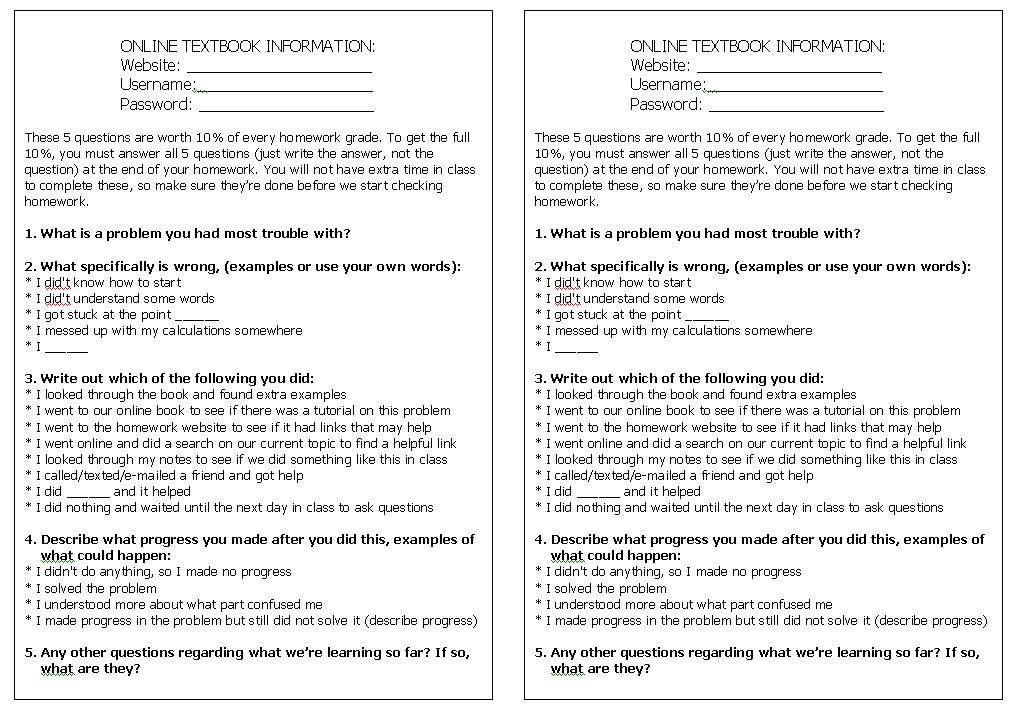
I also formalized the extra component I want the kids to do on each homework assignment. I'll have them cut out this sheet and paste it to the front cover of their composition books for a quick reference. I'm eager to see if it improves their work habits (if they need it). I like question 5 because it's another avenue for them to communicate with me if they have questions and may possibly forget the next day. The sheet looks like:

Wednesday we went to break out sessions for various math components. I learned 2 interesting things that I want to explore this year. The first is THIS WEBSITE. I really liked his "reading and sketching graphs" sheet, so maybe the others are as useful. The second was the idea of Webquests. I've never done such a thing, and apparently there's a ton of them already made up for us to choose from. The instructor said she'd e-mail us the link ... you know, in her free time between getting ready for the school year.
I also formalized the extra component I want the kids to do on each homework assignment. I'll have them cut out this sheet and paste it to the front cover of their composition books for a quick reference. I'm eager to see if it improves their work habits (if they need it). I like question 5 because it's another avenue for them to communicate with me if they have questions and may possibly forget the next day. The sheet looks like:
Tuesday, August 17, 2010
Two things I want to do in my classroom this year
I'm thinking if I gave a pop quiz to my high school students with just a variety of clock faces (with hour and second hands) and asked them to write the time, too many (for comfort) would fail. I guess that would mean that even if just one failed that would be too sad for words. Anyway, I came across a picture in an educational book about teaching ideas, and it was probably meant for an elementary classroom, but I'm so going to steal it. The teacher took the little yellow stickies and just to the outside of every number put the correct minutes: 5, 10, 15, 20, ..., 50, 55. I'm thinking that I don't even have to do a lesson on it; it'll just be a silent lesson every time they look at the clock.***
My second idea came from the book, "Eat, Pray, Love". I want to make a poster of it. If I remember correctly, one of the author's friends in Italy said to her after she was berating herself for her language mistakes, "Be polite to yourself when you're learning something new." (or something to that effect). What a nice way to approach the scary waters of unknown math.
*** of course a former student just sent me e-mail about THIS clock, and I bought it, so who knows how good of a "time telling lesson" this will turn out to be.
*** and of course now that I look at each hour, there are 2 I DO NOT LIKE .... but maybe that will spark good discussion in class (cough cough)
My second idea came from the book, "Eat, Pray, Love". I want to make a poster of it. If I remember correctly, one of the author's friends in Italy said to her after she was berating herself for her language mistakes, "Be polite to yourself when you're learning something new." (or something to that effect). What a nice way to approach the scary waters of unknown math.
*** of course a former student just sent me e-mail about THIS clock, and I bought it, so who knows how good of a "time telling lesson" this will turn out to be.
*** and of course now that I look at each hour, there are 2 I DO NOT LIKE .... but maybe that will spark good discussion in class (cough cough)
Monday, August 09, 2010
Group Work
These past few days I've been in a small town in Texas working with people I don't know very well on a job we all had to get done (not work related) and get done accurately. We would only be together for about 3 days, and we had to get along. Well, we didn't have to get along, but it sure made the time more pleasant if we did. Also, we had jobs to do, and all our jobs depended on other people and other people depended on our jobs. Lots of us were new to our tasks, many had done things before and had set ideas on how to do things, many people had strong personalities or weird personalities or quiet personalities, but we still had to work well together.
So that got me to thinking, "group work" just crops up everywhere in life, and the more we get exposed to it in school and the more there are issues that we have to resolve while we're in our groups and the more troubles that arise, then THE BETTER. If you never have the chance to figure out how to solve "group work" problems early on in school and such, then later on when it's not a choice, you'll have a hard time managing, and you'll be part of the problem.
I'm one of those people that inwardly groan when we're assigned groups in an educational setting and think, "I just want to do it by myself". But now I'm thinking, okay, if "bad" things come up (someone doesn't contribute, someone dominates, someone thinks they can do it better themselves (ahem)...), then this will be my opportunity to think of ways to address problems that may come up. Maybe I won't do it perfectly, but I'll try something out and if it doesn't work, then I'll know to try something else next time. ... Now this all sounds like I think I'm the jewel of the group work and never do ANYTHING wrong (it's hard being so perfect), but I don't think that at all. I guess I'm more along the lines of thinking I have to adjust my attitudes about it and maybe even I'm a thorn in the side of the group and don't know it. Viva la group work!
So that got me to thinking, "group work" just crops up everywhere in life, and the more we get exposed to it in school and the more there are issues that we have to resolve while we're in our groups and the more troubles that arise, then THE BETTER. If you never have the chance to figure out how to solve "group work" problems early on in school and such, then later on when it's not a choice, you'll have a hard time managing, and you'll be part of the problem.
I'm one of those people that inwardly groan when we're assigned groups in an educational setting and think, "I just want to do it by myself". But now I'm thinking, okay, if "bad" things come up (someone doesn't contribute, someone dominates, someone thinks they can do it better themselves (ahem)...), then this will be my opportunity to think of ways to address problems that may come up. Maybe I won't do it perfectly, but I'll try something out and if it doesn't work, then I'll know to try something else next time. ... Now this all sounds like I think I'm the jewel of the group work and never do ANYTHING wrong (it's hard being so perfect), but I don't think that at all. I guess I'm more along the lines of thinking I have to adjust my attitudes about it and maybe even I'm a thorn in the side of the group and don't know it. Viva la group work!
Tuesday, August 03, 2010
Old and New Ideas
OLD IDEA:

I was/am Queen of the Sticky Notes. All my to-do lists for school would be scattered about and usually I'd find all of them, but who knows. I saw the teachers at my school carrying around various composition notebooks and such to meetings and recording things. It turned out this was their "Book Of To Do Things". I loved it. I started using one in the middle of the year, and here are the pros:
*portable
*everything is in one place
*you have a record of your year
*portable, portable, portable so you don't have to be at home and stress that you're forgetting something
A To Do List:

Planning My Line Project:

Visual of the End of the Year:

NEW IDEA:
Next year I want to put up a classroom comment board ala Whole Foods. I'll pass out some cards to the kids to keep in their folders, and have a box up front where they can turn them in, with extra cards available. I can respond in writing on the card and post the cards. If at any time during any class a kid notices something or wants to say something, but it's not feasible for whatever reason during class, they can submit a comment. I'm thinking in this way, I'll get a better sense of what's what during class, and I'll promote more of a sense of community, and the other students can read the comments/responses on the board.
Here's what I'll print & cut out to hand the kids:


I was/am Queen of the Sticky Notes. All my to-do lists for school would be scattered about and usually I'd find all of them, but who knows. I saw the teachers at my school carrying around various composition notebooks and such to meetings and recording things. It turned out this was their "Book Of To Do Things". I loved it. I started using one in the middle of the year, and here are the pros:
*portable
*everything is in one place
*you have a record of your year
*portable, portable, portable so you don't have to be at home and stress that you're forgetting something
A To Do List:

Planning My Line Project:

Visual of the End of the Year:

NEW IDEA:
Next year I want to put up a classroom comment board ala Whole Foods. I'll pass out some cards to the kids to keep in their folders, and have a box up front where they can turn them in, with extra cards available. I can respond in writing on the card and post the cards. If at any time during any class a kid notices something or wants to say something, but it's not feasible for whatever reason during class, they can submit a comment. I'm thinking in this way, I'll get a better sense of what's what during class, and I'll promote more of a sense of community, and the other students can read the comments/responses on the board.
Here's what I'll print & cut out to hand the kids:

Sunday, August 01, 2010
Retests
As probably for many other teachers, this is a hot-button topic for me. The first 6 years I taught, I'd never heard of the concept. No students asked for a retest; I didn't know such a situation could exist. My next 6 years of teaching in another state and another type of school, I got indoctrinated. Eventually, I felt I "bowed" to the pressure and allowed retests. I finally worked out a system that sat "okay/well" with me: anyone with all their homework assignments turned in could retest, and your final grade on the test is an average of your 2 tests, so technically, your grade could go down if you did worse on the retest.
One reason I didn't like retests was that I saw too many kids either not studying for them, or not studying for the original test, knowing they could have a do over.
Now that I've moved schools, I gave no retests. You got what you got.
This summer in Philadelphia, I happened across this book, and there was a discussion on retests of some sort. As I felt my hackles rising, I ran across a statement that gave me pause:
If a kid fails a test or does poorly and shows they don't know a particular concept and you just move on, you are in essence saying that you're okay with them not having that knowledge under their belt, that it's okay not to ultimately understand something in your course.
I don't know that I'll move back to retesting as I've done before, but I want to think further on this idea for next year. I know there's been discussion on the blogs on this, and I've been reading it, and I think I need to find something that works for me and is manageable in my classroom and that I buy into; otherwise, obviously, I won't effectively implement it, and it's doomed to fail.
My initial kernel of an idea is to have a list of concepts they need to know, and by each concept I have 2 boxes with a room for the date of success. This may be on box.net or something with each student's name in a chart, and when they have successfully mastered the concept twice (time frame?), then they are good to go. Grading? Haven't thought of that yet. I was thinking more of a general holistic idea because realistically, maybe all kids don't get to all concepts twice. Maybe their final grade will include a percentage based on what they've shown .... but then I'm still saying that I'm okay with them not knowing things .... ARGH .... must ponder more.
One reason I didn't like retests was that I saw too many kids either not studying for them, or not studying for the original test, knowing they could have a do over.
Now that I've moved schools, I gave no retests. You got what you got.
This summer in Philadelphia, I happened across this book, and there was a discussion on retests of some sort. As I felt my hackles rising, I ran across a statement that gave me pause:
If a kid fails a test or does poorly and shows they don't know a particular concept and you just move on, you are in essence saying that you're okay with them not having that knowledge under their belt, that it's okay not to ultimately understand something in your course.
I don't know that I'll move back to retesting as I've done before, but I want to think further on this idea for next year. I know there's been discussion on the blogs on this, and I've been reading it, and I think I need to find something that works for me and is manageable in my classroom and that I buy into; otherwise, obviously, I won't effectively implement it, and it's doomed to fail.
My initial kernel of an idea is to have a list of concepts they need to know, and by each concept I have 2 boxes with a room for the date of success. This may be on box.net or something with each student's name in a chart, and when they have successfully mastered the concept twice (time frame?), then they are good to go. Grading? Haven't thought of that yet. I was thinking more of a general holistic idea because realistically, maybe all kids don't get to all concepts twice. Maybe their final grade will include a percentage based on what they've shown .... but then I'm still saying that I'm okay with them not knowing things .... ARGH .... must ponder more.
Wednesday, July 28, 2010
On My Mind
There's been a running thread of thoughts peeking in and out of my mind all summer, and it seems that lots of things conspire to keep me thinking along the same lines. Or maybe since I'm already thinking of "it", then my devious mind is making connections to various experiences I have.
Start: early in the summer I got a call that a previous colleague had committed suicide in the past few days. Aside from being horrific and so sad, it started the thoughts in my brain. This person seemed fine. This person was a great teacher. This person had tons to contribute. This person seemed happy with life. The public face I saw of this person gave no indication of the turmoil that must have been going on inside.
Now this is not a post about suicide, but I guess more about how we perceive the experience of others' lives. I'm guessing you have interaction(s) with people, and you make a judgment about how you think their lives are going. Many times you think: wow, they have a great life, or how lucky are they, or look how much they have or have it together. I'm wondering what percentage of the time you are wrong, and maybe it's a much higher percentage than you would think.
Next: I don't have cable TV at home for various reasons: husband severely dislikes TV, I don't get home until late, if I had convenient TV, I could see myself sucking away a ton of time channel surfing and watching. Anyway, that's not to say I don't like TV. When I go away on trips where I happen to be alone, one of my treats is to channel surf away late into the night at my heart's desire. On my past trip I came across the MTV show, "If you really knew me". I guess it was episode 101 (from the pictures on the website). Here was another instance on the same theme running through my head. You may see these students daily and know their public persona but not the struggles they're going through.
Next: During the same trip I was reading, "Mrs. Perfect", and the main character looked as if she had a fabulous life, but ..... well you get the picture.
Next: Love math, but also love other non-math blogs and check them either daily, or frequently. On one such blog, I came across a link that AGAIN added to my pile of thoughts on this topic. From browsing her other posts, she's an author and teacher and I picture her as seeming to have a ton going for her. Then you scrape a little deeper and see that she's going through this gut-wrenching continuous heartache.
Finally: I've been to a workshop these past 2 days, and in the course of it got to meet 2 new educators to our school. The first day they seemed outwardly fine about the coming school year. Now I just have to say that my new-to-me-school-of-one-year is an intense school with high expectations of everyone. I only mention this because of what happened the 2nd day of the workshop. I don't know how the conversation got started the 2nd morning, but one of the teachers said, "after yesterday I went home and started panicking and doubting myself about being able to do a good job next year." The second new person heaved a relief sigh and echoed that she had the same thoughts. Now if they hadn't shared this, I'm guessing I'd have continued to see them in a certain light of "everything's fine and functioning as it should be" instead of "take extra care to make sure they're okay".
So while this is continually popping up in my thoughts when I was wandering around Philadelphia, I took time to look at people I passed. There was the usual person type of "I look smashing", "I have it together", "my life is great" mixed in with others. But I have to wonder and most likely, no, they could possibly be going through some painful events and they're just continuing to function.
What do I come away with for all this wondering? I guess more of an awareness and a thought to treat everyone as if they're a precious commodity and not make assumptions as to how excellent things may be going for them (which may lead to me not treating them so gently or making me question my life experience more). For various reasons life is hard many times in different ways for everyone, and though it may not solve everything, hugs and smiles and kind thoughts towards others may help.
Start: early in the summer I got a call that a previous colleague had committed suicide in the past few days. Aside from being horrific and so sad, it started the thoughts in my brain. This person seemed fine. This person was a great teacher. This person had tons to contribute. This person seemed happy with life. The public face I saw of this person gave no indication of the turmoil that must have been going on inside.
Now this is not a post about suicide, but I guess more about how we perceive the experience of others' lives. I'm guessing you have interaction(s) with people, and you make a judgment about how you think their lives are going. Many times you think: wow, they have a great life, or how lucky are they, or look how much they have or have it together. I'm wondering what percentage of the time you are wrong, and maybe it's a much higher percentage than you would think.
Next: I don't have cable TV at home for various reasons: husband severely dislikes TV, I don't get home until late, if I had convenient TV, I could see myself sucking away a ton of time channel surfing and watching. Anyway, that's not to say I don't like TV. When I go away on trips where I happen to be alone, one of my treats is to channel surf away late into the night at my heart's desire. On my past trip I came across the MTV show, "If you really knew me". I guess it was episode 101 (from the pictures on the website). Here was another instance on the same theme running through my head. You may see these students daily and know their public persona but not the struggles they're going through.
Next: During the same trip I was reading, "Mrs. Perfect", and the main character looked as if she had a fabulous life, but ..... well you get the picture.
Next: Love math, but also love other non-math blogs and check them either daily, or frequently. On one such blog, I came across a link that AGAIN added to my pile of thoughts on this topic. From browsing her other posts, she's an author and teacher and I picture her as seeming to have a ton going for her. Then you scrape a little deeper and see that she's going through this gut-wrenching continuous heartache.
Finally: I've been to a workshop these past 2 days, and in the course of it got to meet 2 new educators to our school. The first day they seemed outwardly fine about the coming school year. Now I just have to say that my new-to-me-school-of-one-year is an intense school with high expectations of everyone. I only mention this because of what happened the 2nd day of the workshop. I don't know how the conversation got started the 2nd morning, but one of the teachers said, "after yesterday I went home and started panicking and doubting myself about being able to do a good job next year." The second new person heaved a relief sigh and echoed that she had the same thoughts. Now if they hadn't shared this, I'm guessing I'd have continued to see them in a certain light of "everything's fine and functioning as it should be" instead of "take extra care to make sure they're okay".
So while this is continually popping up in my thoughts when I was wandering around Philadelphia, I took time to look at people I passed. There was the usual person type of "I look smashing", "I have it together", "my life is great" mixed in with others. But I have to wonder and most likely, no, they could possibly be going through some painful events and they're just continuing to function.
What do I come away with for all this wondering? I guess more of an awareness and a thought to treat everyone as if they're a precious commodity and not make assumptions as to how excellent things may be going for them (which may lead to me not treating them so gently or making me question my life experience more). For various reasons life is hard many times in different ways for everyone, and though it may not solve everything, hugs and smiles and kind thoughts towards others may help.
Sunday, July 25, 2010
Home Sweet Home
Phew. We're finally home after a marathon travel session. My husband's Canadian aunt and uncle were celebrating their 50th wedding anniversary (we should all be so lucky), and their children set up a surprise gathering for them. It was so nice to see all their friends and family showering them with love at the party. My husband and I don't have children, so that's one thing I'll miss as we get older - all the offspring and their families and so on all gathered together and being a big party. Of course, if it was my family, we'd probably all be at our separate corners stewing or fighting or not showing up for the party because of issues or dancing drunk on the table tops and embarrassing everyone.
I'm thinking that as the years pass, we have to get a phone chain of our other older, childless friends and call each other every morning, "are you still alive? okay. talk to you tomorrow." or something to that effect. Maybe we can get a commune going and have an on-site nurse.
Then I got to visit with a friend of 13 years (in Pennsylvania) who I haven't seen for 2. She was one of the 1st math teachers I taught with in New Jersey, and I always am thankful that I ended up (by a fluke) at that particular school to learn about teaching with that particular group of people. They're passionate, smart, nice, reflective and just plain old fun to be around.
Before visiting with her, I got to walk around Philadelphia for a day. Love It. Here are some cool things about Philly:
* They have solar compacting trash and recycling units scattered throughout the city.
* They have nice signs on several corners indicating where you are and what might be interesting to see in the area.
* It's uber walker friendly.
* Tons of history you just happen upon by walking.
* Many parks and trees sprinkled throughout that provide shade and places to chat.
* Gourmet groceries that also have a breakfast bar for travelers.
But it's nice to be home and get back into a routine (soon). Here's to gaining weight on vacations and now having to deal with it (did I mention all the frozen yogurt places I was FORCED to frequent in PA?). I guess I'm pretty active during the school year (running (okay jog walking, but running sounds better), yoga, dancing, weights, walking around all day during teaching). But the TRUE me is a couch potato happy to just sit around reading books and doing puzzles and movies and napping. Hello extra summer weight. I basically sat around either on planes or couches or cars the WHOLE trip. One guess as to the effect THAT had on me. Oh well, back to the weight loss drawing board.
I'm thinking that as the years pass, we have to get a phone chain of our other older, childless friends and call each other every morning, "are you still alive? okay. talk to you tomorrow." or something to that effect. Maybe we can get a commune going and have an on-site nurse.
Then I got to visit with a friend of 13 years (in Pennsylvania) who I haven't seen for 2. She was one of the 1st math teachers I taught with in New Jersey, and I always am thankful that I ended up (by a fluke) at that particular school to learn about teaching with that particular group of people. They're passionate, smart, nice, reflective and just plain old fun to be around.
Before visiting with her, I got to walk around Philadelphia for a day. Love It. Here are some cool things about Philly:
* They have solar compacting trash and recycling units scattered throughout the city.
* They have nice signs on several corners indicating where you are and what might be interesting to see in the area.
* It's uber walker friendly.
* Tons of history you just happen upon by walking.
* Many parks and trees sprinkled throughout that provide shade and places to chat.
* Gourmet groceries that also have a breakfast bar for travelers.
But it's nice to be home and get back into a routine (soon). Here's to gaining weight on vacations and now having to deal with it (did I mention all the frozen yogurt places I was FORCED to frequent in PA?). I guess I'm pretty active during the school year (running (okay jog walking, but running sounds better), yoga, dancing, weights, walking around all day during teaching). But the TRUE me is a couch potato happy to just sit around reading books and doing puzzles and movies and napping. Hello extra summer weight. I basically sat around either on planes or couches or cars the WHOLE trip. One guess as to the effect THAT had on me. Oh well, back to the weight loss drawing board.
Wednesday, July 14, 2010
Lucky Traveler
We just got back from Maui, and boy it was beautiful and relaxing. We stayed in a B&B in Haiku and rented a car from a local company and just decided each morning what to do. Lovely. We went to the beach a lot, hiked into the crater, tried paddle boarding, ate too much, and swam. Life's good.
One of the many beaches:

Post paddle boarding ... my shoulders are sore, waves are scary, it's not too bad falling in warm tropical water ... a lot:

A shop where my husband rented his windsurfing equipment:

Growing at our B&B:

Also at our B&B:

One of the many beaches:

Post paddle boarding ... my shoulders are sore, waves are scary, it's not too bad falling in warm tropical water ... a lot:

A shop where my husband rented his windsurfing equipment:

Growing at our B&B:

Also at our B&B:

Tuesday, July 06, 2010
Friendly Reminder
I traveled recently to visit my dad near Lake Tahoe, and I flew Southwest (love them). I don't know if you've flown them lately (I haven't), but they have a great system of boarding. When you check in you're given a letter-number combination, and when it's "time" you stand in a particular place and follow orders to board in an orderly fashion and then get to pick your seat at that time.
Anyway, as I said, it was the first time I'd been through this, and I didn't know what was what and figured I'd wait for the directions from the Southwest employees over the loudspeaker. Obviously, there were no written directions. So here's basically what I heard, "We're ready to begin boarding, people with an A something something something do something and get ready to something and others please something something ....". You get the idea. I heard a bit and then by the time I finished processing it, the next part was already said and moved on, and then of course I couldn't THEN make sense of the following part. Sheesh. Reality check on teaching for me.
I know the kids say I talk too fast (sometimes?). In my mind everything's clear (like I'm sure it is to the Southwest employee who's said the same speech many times), so I'm probably on autopilot (ar ar ar). I guess I need to make myself a poster for next year to hang in the back of the room to remind myself to slow down or to write simultaneously or to give kids processing time more consciously. My sign will probably be: SOUTHWEST INCIDENT!
Yes I figured out what to do, but, no, I still got stuck behind the smelly lady I was trying to avoid.
Anyway, as I said, it was the first time I'd been through this, and I didn't know what was what and figured I'd wait for the directions from the Southwest employees over the loudspeaker. Obviously, there were no written directions. So here's basically what I heard, "We're ready to begin boarding, people with an A something something something do something and get ready to something and others please something something ....". You get the idea. I heard a bit and then by the time I finished processing it, the next part was already said and moved on, and then of course I couldn't THEN make sense of the following part. Sheesh. Reality check on teaching for me.
I know the kids say I talk too fast (sometimes?). In my mind everything's clear (like I'm sure it is to the Southwest employee who's said the same speech many times), so I'm probably on autopilot (ar ar ar). I guess I need to make myself a poster for next year to hang in the back of the room to remind myself to slow down or to write simultaneously or to give kids processing time more consciously. My sign will probably be: SOUTHWEST INCIDENT!
Yes I figured out what to do, but, no, I still got stuck behind the smelly lady I was trying to avoid.
Sunday, July 04, 2010
Randomization
I modified my Excel Slope Quiz program. Now there are extra buttons, so the students can try any number of extra random problems to test their skills. I'm pretty sure it's bug free. And Again, if you want to try it, you have to "enable macros" when you open the Excel file. Thanks Mrs. H for the idea.


Friday, July 02, 2010
Programming Attempt
Well, I don't know if Excel will be the best tool for this, but I sure had fun making the following program. My vision is that eventually I can create several of these and put them on my class website for the kids to practice their skills. I know there are great practice tools on the web, and I do link to those. My thinking in creating this type of program is that the kids will see what I think is important for them to know.
Anyway, it looks like:

It's interactive and provides hints for the tester. When you open the Excel file, you have to enable the macros in order for it to work. Now I have to figure out how to create my Geometry Proof Excel "quizzes".
Anyway, it looks like:

It's interactive and provides hints for the tester. When you open the Excel file, you have to enable the macros in order for it to work. Now I have to figure out how to create my Geometry Proof Excel "quizzes".
Subscribe to:
Posts (Atom)