
Tuesday, January 31, 2012
Clock Update
I saw this idea somewhere a while ago, and due to the number of questions I keep getting, I thought I'd have this clock enhancement. I don't say anything, it's just there for them to process. Woot! Future time tellers of America.


Saturday, January 28, 2012
Special Quadrilaterals
We've just finished our unit on special quadrilaterals, and before our test, I thought I would try to drill home the value of marking up your figure with pertinent information to help you solve problems. I also made them cover up their previous attempts with jokes about their wandering eye that may do them harm. I decided to do it in a "race" type format.
I wanted the kids to compete against themselves and make progress between attempts, so I said that they would be timing themselves and grading themselves and being consistent with how they marked mistakes.
I put an online timer on my computer and the document camera (this one was nice). I just set the start time for 0 and end time for 2 minutes just in case.
At each attempt, in one color, the student was to mark up the figure with useful/correct markings that represented the figure. I reminded them to QUIETLY lay down their pencils at the end (by being goofy and demonstrating the jerky contestant who makes tons of noise at the end). Then when everyone was done (all eyes up), we graded in a different color. We did 3 attempts for each shape, and I kept asking for hand raised if they made improvement. I said they could do the 4th attempt on the night before the test.
Helpful? Don't know, but it was a chance to drive home the importance of marking and knowing the properties.
Here's the document:

I wanted the kids to compete against themselves and make progress between attempts, so I said that they would be timing themselves and grading themselves and being consistent with how they marked mistakes.
I put an online timer on my computer and the document camera (this one was nice). I just set the start time for 0 and end time for 2 minutes just in case.
At each attempt, in one color, the student was to mark up the figure with useful/correct markings that represented the figure. I reminded them to QUIETLY lay down their pencils at the end (by being goofy and demonstrating the jerky contestant who makes tons of noise at the end). Then when everyone was done (all eyes up), we graded in a different color. We did 3 attempts for each shape, and I kept asking for hand raised if they made improvement. I said they could do the 4th attempt on the night before the test.
Helpful? Don't know, but it was a chance to drive home the importance of marking and knowing the properties.
Here's the document:

Thursday, January 26, 2012
Thinking, Contributing, and Confidence...
It finally hit me the other day, the students in my "regular" geometry class were so gun shy of answering questions. You know. I'd say something like, "and what kind of quadrilateral is this forced to be if it has ____ properties?".
Chirp.
Then someone bravely says, "rhombus." Then downcast eyes. Then, "oh I don't know, forget it." More downcast eyes with the body language of, "move on lady, nothing to see here." Even though it turns out the answer was right.
So after it happened again in my next "regular" class. I stopped the lesson and said the following:
You know if I could grade you all on your participation in your learning, it would go something like this.
* 3 points if you answer my question, and it's right. Because you're thinking and active in your learning.
* 2 points if you answer my question, and it's wrong. Because you're still in the game and willing to process your information and try.
* 1 point if you are paying attention and answering in your head but for whatever reason, you don't speak.
* 0 points if you just sit passively and think, oh, someone else will figure it out.
* -1 point if you sit there and think, hmmmm what's for lunch.
Then I mentioned the, "you can't just passively sit there and learn math" spiel. Then I went back to the lesson.
Hmmmm. Then there was lots of participation. And I would interject with, "3 points" .... "2 points" ... etc. ... hopefully it lasts.
Chirp.
Then someone bravely says, "rhombus." Then downcast eyes. Then, "oh I don't know, forget it." More downcast eyes with the body language of, "move on lady, nothing to see here." Even though it turns out the answer was right.
So after it happened again in my next "regular" class. I stopped the lesson and said the following:
You know if I could grade you all on your participation in your learning, it would go something like this.
* 3 points if you answer my question, and it's right. Because you're thinking and active in your learning.
* 2 points if you answer my question, and it's wrong. Because you're still in the game and willing to process your information and try.
* 1 point if you are paying attention and answering in your head but for whatever reason, you don't speak.
* 0 points if you just sit passively and think, oh, someone else will figure it out.
* -1 point if you sit there and think, hmmmm what's for lunch.
Then I mentioned the, "you can't just passively sit there and learn math" spiel. Then I went back to the lesson.
Hmmmm. Then there was lots of participation. And I would interject with, "3 points" .... "2 points" ... etc. ... hopefully it lasts.
Wednesday, January 25, 2012
Statistics vs Calculus
It's choice sheet time, and our current crop of precalculus students (and algebra 2 students for that matter) are asking questions:
* What IS calculus?
* What IS statistics?
* Which one should I take?
* Can I take both eventually?
We've been having conversations on the fly, but I thought it would be good to get it all down on paper and send out a mass school e-mail. This way the students have a more informed way of making a decision as opposed to, "so and so said THIS one was easier .... or THIS one was the one to take .... or my friends are taking this one...".
Here's the document:


* What IS calculus?
* What IS statistics?
* Which one should I take?
* Can I take both eventually?
We've been having conversations on the fly, but I thought it would be good to get it all down on paper and send out a mass school e-mail. This way the students have a more informed way of making a decision as opposed to, "so and so said THIS one was easier .... or THIS one was the one to take .... or my friends are taking this one...".
Here's the document:


Sunday, January 22, 2012
Collaboration
I just got back from the Houston Regional T3 workshop and learned yet more things I can do with the TI-nspire.
* I now know how to use the student software to be useful to me
* I know how to link between calculator and computer/calculator to transfer things
* I know how to upload pictures onto the calculator and then use it for math, say on a graph page or a geometry page
* I know how to easily do piecewise function graphing
I'm very excited to use these activities for upcoming lessons.
AND. Something someone said sparked another idea. I'm wondering if there are any precalculus teachers out there with about 22 students that are willing to collaborate with my 22 students. I don't have a firm idea of the final product, but my thinking is along the lines of: we would somehow match up our "remote" pairs of students, and then they would have to work together to create something - blog, song, newsletter, podcast, other .... that has to do with precalculus - either teaching something as a review, finding a new thing that is associated with precalculus, coming up with a memory tool for a concept we've learned .... I want to leave it open enough, so that they can be creative and most likely think of something we don't envision. I do want to have more firm rules and periodic due dates along the way. I'm thinking of a project/activity that we give them about 3 or so weeks for. In this way, our students can find a new "math buddy" in another state, and they can learn skills of working with a total stranger to complete a task (good future working-life skill).
Any takers? If so, leave a comment, or send me e-mail (math_mambo@yahoo.com), and we can take it from there.
For that matter I have roughly 4 classes of geometry that we can do the same thing with. But in that case, I'd ultimately need about 86 or so total students.
* I now know how to use the student software to be useful to me
* I know how to link between calculator and computer/calculator to transfer things
* I know how to upload pictures onto the calculator and then use it for math, say on a graph page or a geometry page
* I know how to easily do piecewise function graphing
I'm very excited to use these activities for upcoming lessons.
AND. Something someone said sparked another idea. I'm wondering if there are any precalculus teachers out there with about 22 students that are willing to collaborate with my 22 students. I don't have a firm idea of the final product, but my thinking is along the lines of: we would somehow match up our "remote" pairs of students, and then they would have to work together to create something - blog, song, newsletter, podcast, other .... that has to do with precalculus - either teaching something as a review, finding a new thing that is associated with precalculus, coming up with a memory tool for a concept we've learned .... I want to leave it open enough, so that they can be creative and most likely think of something we don't envision. I do want to have more firm rules and periodic due dates along the way. I'm thinking of a project/activity that we give them about 3 or so weeks for. In this way, our students can find a new "math buddy" in another state, and they can learn skills of working with a total stranger to complete a task (good future working-life skill).
Any takers? If so, leave a comment, or send me e-mail (math_mambo@yahoo.com), and we can take it from there.
For that matter I have roughly 4 classes of geometry that we can do the same thing with. But in that case, I'd ultimately need about 86 or so total students.
Sunday, January 15, 2012
Pa-ra-lel-o-grams
I've been obsessively using the TI-nspire as a discovery tool in my classes these last 2 weeks. In geometry, we just started parallelograms, and I wanted them to explore the 5 properties of parallelograms, and it worked great.
One extra thing that I'm excited about is that I had them hold up their closed fists, and I asked them to put up a finger for every syllable of "parallelogram". Five! Ohhh! Five properties. So. Every time they discovered a new property on the calculator, I had them run through the list so far and tick off a new finger for the newly discovered property. We did this until we got through all 5 properties. Woot! Memory tool. Hopefully, they'll remember that there are 5 and parallelogram has 5 syllables, and they can recite all the properties:
1. parallel opposite sides
2. congruent opposite sides
3. congruent opposite angles
4. supplementary adjacent angles
5. diagonals bisect each other
One extra thing that I'm excited about is that I had them hold up their closed fists, and I asked them to put up a finger for every syllable of "parallelogram". Five! Ohhh! Five properties. So. Every time they discovered a new property on the calculator, I had them run through the list so far and tick off a new finger for the newly discovered property. We did this until we got through all 5 properties. Woot! Memory tool. Hopefully, they'll remember that there are 5 and parallelogram has 5 syllables, and they can recite all the properties:
1. parallel opposite sides
2. congruent opposite sides
3. congruent opposite angles
4. supplementary adjacent angles
5. diagonals bisect each other
Monday, January 09, 2012
Six Word Memoirs
Recently, I was reminded of the "six word memoirs", and I decided to have that as my first day back homework for my precalculus students.
I had them create a small poster with 2 such memoirs, one for their "math life" and one for their "other/real life". Here's the assignment:

Here are some samples. Some were creative, some were eh, some were funny. I told them I'd do it to, so I'm tossing mine in the mix. Each poster has 2 memoirs on it.


I had them create a small poster with 2 such memoirs, one for their "math life" and one for their "other/real life". Here's the assignment:

Here are some samples. Some were creative, some were eh, some were funny. I told them I'd do it to, so I'm tossing mine in the mix. Each poster has 2 memoirs on it.


Sunday, January 08, 2012
Challenging Precal Problems
A while ago, I gave my precalculus class a "clock faced" problem that was not something they were used to seeing. Some of them rose to the challenge and figured it out. Most started the problem and then petered out. Too many didn't know what to do.
I struggle with how to effectively teach problem solving skills, so here is my latest attempt that will be their homework tomorrow.


I struggle with how to effectively teach problem solving skills, so here is my latest attempt that will be their homework tomorrow.


Friday, January 06, 2012
Polygon Angles
I've tried various ways over the years of presenting the following 2 facts:
* (n-2)*180 is the sum of the interior angles of a polygon.
* 360 is the sum of the exterior angles of any polygon.
Yes, the students remember ultimately, but as I was looking over my old files this year to do it again, things just didn't sit right ... or I was in the mood for a change ... or I'm a different person now, and I want to approach it differently.
I hit upon the following method, and I think I like it the best (ask me what I think next time). Here are things I like about it: it's not talk, talk, talk. It's not, "let's do it all theoretically and then POOF here's the formula." It's not, "let's all explore a different polygon by drawing and measuring and seeing what happens and there'll be human error, but we'll hand wave that away." It's pretty efficient. It's different from what I usually do, so it'll stick in MY students' minds (hopefully).
I had everyone get a piece of colored paper and fold it in 4ths and cut the 4 separate rectangles. Then on one rectangle, I had them draw a heptagon (we drew a light circle, put 7 dots on it, and connected the dots). We took a colored marker to the border of the heptagon and made sure that some color was on the interior. We drew diagonals from one vertex. We cut out the heptagon. Then we cut the triangles out.
Then I said, so what we want to explore is if I had asked you to measure all the interior angles and add them up what would you get. So now look at what we have done, and see if you can figure out the answer and then ALSO figure out why I asked you to do these particular tasks.
Then I waited and eavesdropped. Then I asked a kid to explain. Then I had them tape this into their composition books to look something like this:

Then (after some other polygon stuff), on another piece of the colored paper, I had them draw an octagon but extend the sides to show the exterior angles. Before I had them do the following thing, I had them take thumb votes on the scenario, "as the number of sides increases, what do you think happens to the sum of the exterior angles as shown: thumbs up for increases, down for decreases, sideways for stays the same, or open palm for it depends on other factors." They thought and voted. Then we did....
Then I had them cut out the interior octagon and leave the border. We reviewed what the sum of the interior angles was (6 * 180). Then we built up what the sum of all the "lines" angles were (8 * 180). Then we thought and discovered and here's what they taped in their notebooks:

Then as always I ran out of time and was rushed and couldn't do any practice problems, so my resolution of stopping class 1 minute before the bell so they could pack up was not put into place today!
* (n-2)*180 is the sum of the interior angles of a polygon.
* 360 is the sum of the exterior angles of any polygon.
Yes, the students remember ultimately, but as I was looking over my old files this year to do it again, things just didn't sit right ... or I was in the mood for a change ... or I'm a different person now, and I want to approach it differently.
I hit upon the following method, and I think I like it the best (ask me what I think next time). Here are things I like about it: it's not talk, talk, talk. It's not, "let's do it all theoretically and then POOF here's the formula." It's not, "let's all explore a different polygon by drawing and measuring and seeing what happens and there'll be human error, but we'll hand wave that away." It's pretty efficient. It's different from what I usually do, so it'll stick in MY students' minds (hopefully).
I had everyone get a piece of colored paper and fold it in 4ths and cut the 4 separate rectangles. Then on one rectangle, I had them draw a heptagon (we drew a light circle, put 7 dots on it, and connected the dots). We took a colored marker to the border of the heptagon and made sure that some color was on the interior. We drew diagonals from one vertex. We cut out the heptagon. Then we cut the triangles out.
Then I said, so what we want to explore is if I had asked you to measure all the interior angles and add them up what would you get. So now look at what we have done, and see if you can figure out the answer and then ALSO figure out why I asked you to do these particular tasks.
Then I waited and eavesdropped. Then I asked a kid to explain. Then I had them tape this into their composition books to look something like this:

Then (after some other polygon stuff), on another piece of the colored paper, I had them draw an octagon but extend the sides to show the exterior angles. Before I had them do the following thing, I had them take thumb votes on the scenario, "as the number of sides increases, what do you think happens to the sum of the exterior angles as shown: thumbs up for increases, down for decreases, sideways for stays the same, or open palm for it depends on other factors." They thought and voted. Then we did....
Then I had them cut out the interior octagon and leave the border. We reviewed what the sum of the interior angles was (6 * 180). Then we built up what the sum of all the "lines" angles were (8 * 180). Then we thought and discovered and here's what they taped in their notebooks:

Then as always I ran out of time and was rushed and couldn't do any practice problems, so my resolution of stopping class 1 minute before the bell so they could pack up was not put into place today!
Monday, January 02, 2012
What I Did on Vacation...
What's a vacation without lots of surfing on old and new favorites:
(I thought I'd share so that I'm not the only one losing many hours of my day)
(sorry, or you're welcome, whatever the case may be)
AwkwardFamilyPhotos
FoodGawker
MovieTrailers
HomeExercise
FunnySite
InterestingVideos
(I thought I'd share so that I'm not the only one losing many hours of my day)
(sorry, or you're welcome, whatever the case may be)
AwkwardFamilyPhotos
FoodGawker
MovieTrailers
HomeExercise
FunnySite
InterestingVideos
Friday, December 30, 2011
Almost Over...
These days of enough sleep will soon come to an end. I'll miss the sleeping part, but I won't miss the sitting around on my heiny part. I'm wondering if it almost wouldn't be better to have a week shorter break, and then take those 5 days and sprinkle them around for FIVE FOUR-DAY weeks at various times during the year. Then it would be like mini vacations all the time.
I went to a wedding of an old friend yesterday, a retired math teacher getting married for the first time, WOOT, and not surprisingly, he invited a bunch of other math teacher friends he'd taught with throughout his career. I was chatting with a few, and we happened upon the discussion of administration. A retired woman was commenting on the fact that as the years went on in her teaching, she'd see various administrators come and go, and they got younger and younger and greener and greener and she just had to ride out the tide.
Some other retired middle school teacher's husband commented on the fact that at the various school parties he noticed a hefty amount of alcohol. Ahem.
Another teacher was reminiscing about the days when there would be a "homework hotline" where they were paid $10/hour to sit and wait in the evening for possible student calls for math/english help.
Another retired teacher was mentioning the fact that she now gets paid $26/hour to tutor 10 students at a particular school. I know of another retired math teacher that tutors students in a wealthy district for about $40-$50/hour and for most of the year (half the year?) has about 20 students on his roster once a week. Yeesh. I guess there won't be any shortage of things to do when that time comes. ...
I went to a wedding of an old friend yesterday, a retired math teacher getting married for the first time, WOOT, and not surprisingly, he invited a bunch of other math teacher friends he'd taught with throughout his career. I was chatting with a few, and we happened upon the discussion of administration. A retired woman was commenting on the fact that as the years went on in her teaching, she'd see various administrators come and go, and they got younger and younger and greener and greener and she just had to ride out the tide.
Some other retired middle school teacher's husband commented on the fact that at the various school parties he noticed a hefty amount of alcohol. Ahem.
Another teacher was reminiscing about the days when there would be a "homework hotline" where they were paid $10/hour to sit and wait in the evening for possible student calls for math/english help.
Another retired teacher was mentioning the fact that she now gets paid $26/hour to tutor 10 students at a particular school. I know of another retired math teacher that tutors students in a wealthy district for about $40-$50/hour and for most of the year (half the year?) has about 20 students on his roster once a week. Yeesh. I guess there won't be any shortage of things to do when that time comes. ...
Wednesday, December 21, 2011
Success!
That's what I deem this first day of vacation.
It started out with a much needed 8 hours of sleep. Continued on later with a brisk exercise walk in our "freezing" 46 degree weather. Followed by a yummy lunch and 2.5 hour nap. Enhanced by starting a book ("Odd Thomas" by Dean Koontz) recommended by a work friend. To be concluded with having friends over with delicious take out from a neighborhood Italian restaurant.
This year has aged me ... or maybe I'm just aging. I don't wear glasses (except for driving), but I've been noticing a fuzzier appearance to the world. I guess that's what 46+ years will do to you. I'm also not getting enough sleep during the school week/year, so I feel haggard. I'm also skipping yoga too much because I feel trapped at work too late (maybe that will be my New Year's resolution: leave on time on Tuesdays). This causes me to feel stiff and achy and stressed. I think I may piggy back that resolution onto another resolution a friend told me about: try at least one new type of drink a month (to get out of her same old same old rut).
I did enjoy two new endeavors this semester. The first was teaching Digital Electronics. Loved it! It's a nice mix of logic and math and breadboards and LEDs and such that you control with your skill.
The second was an online Java course I took (and will continue taking in the spring). It's the AP Computer Science curriculum taught through the University of Missouri. The teacher is great, the curriculum is well laid out. The topic is fun. I get to program again. I even made a version of "green globs" for my final project, and it worked! I love the push I have to actually go through the subject because of the deadlines and grades and tests I have to submit. I know if I just said I'd do it on my own it would be so easy to put it off all the time because I am busy.
All in all, it was a good semester, and MOST of all, I'm going to enjoy my free time by napping and reading and movie-ing and puzzling and such.
It started out with a much needed 8 hours of sleep. Continued on later with a brisk exercise walk in our "freezing" 46 degree weather. Followed by a yummy lunch and 2.5 hour nap. Enhanced by starting a book ("Odd Thomas" by Dean Koontz) recommended by a work friend. To be concluded with having friends over with delicious take out from a neighborhood Italian restaurant.
This year has aged me ... or maybe I'm just aging. I don't wear glasses (except for driving), but I've been noticing a fuzzier appearance to the world. I guess that's what 46+ years will do to you. I'm also not getting enough sleep during the school week/year, so I feel haggard. I'm also skipping yoga too much because I feel trapped at work too late (maybe that will be my New Year's resolution: leave on time on Tuesdays). This causes me to feel stiff and achy and stressed. I think I may piggy back that resolution onto another resolution a friend told me about: try at least one new type of drink a month (to get out of her same old same old rut).
I did enjoy two new endeavors this semester. The first was teaching Digital Electronics. Loved it! It's a nice mix of logic and math and breadboards and LEDs and such that you control with your skill.
The second was an online Java course I took (and will continue taking in the spring). It's the AP Computer Science curriculum taught through the University of Missouri. The teacher is great, the curriculum is well laid out. The topic is fun. I get to program again. I even made a version of "green globs" for my final project, and it worked! I love the push I have to actually go through the subject because of the deadlines and grades and tests I have to submit. I know if I just said I'd do it on my own it would be so easy to put it off all the time because I am busy.
All in all, it was a good semester, and MOST of all, I'm going to enjoy my free time by napping and reading and movie-ing and puzzling and such.
Friday, December 16, 2011
Challenge
This problem makes me happy in its difficulty and challenge. I threw down the gauntlet to my precalculus students. We'll see if they run with it to the finish line or not. Either way, I wanted the smartie smarts to at least know there are some problems out there that require more than just rote brain power.


Friday, December 09, 2011
End-O-Semester...
As always it's just slam-banged and gotten here already. Now it's a scramble to get all things graded and finals written and reviews made and failers cheered on to get their act together and mouths kept shut due to lack of sleep and knowledge that if something comes out of my tired brain/mouth it will be a regrettable snarky comment that won't do anyone any good.
On a positive note, I have this extremely clever 8th grader this year. She's quiet and polite, but every time the timing is right, she comes up with these zingers. For example, today I quickly made up a review sheet for geometry, and it had an answer bank on the bottom. Being the last-minute person that I am, it was all hand-written. Well, as a shock to no one, there were 2 mistakes in the answer bank due to my non-checking of my work. So as their class started, and I handed out the hand-written sheet, I mentioned that there were some "pen-o's" on the sheet (you know, typos, but penos). This class also knows since I've mentioned it several times that I have a pen buying problem, and I'm trying to go through my current bazillion stash before I succumb again to purchasing more.
Anyway, after I said, "pen-o", she said, "is that like wino but with pens?" Then we chuckled and mentioned that I should join PA, "hello, my name is ____ and I have a pen problem."
On a positive note, I have this extremely clever 8th grader this year. She's quiet and polite, but every time the timing is right, she comes up with these zingers. For example, today I quickly made up a review sheet for geometry, and it had an answer bank on the bottom. Being the last-minute person that I am, it was all hand-written. Well, as a shock to no one, there were 2 mistakes in the answer bank due to my non-checking of my work. So as their class started, and I handed out the hand-written sheet, I mentioned that there were some "pen-o's" on the sheet (you know, typos, but penos). This class also knows since I've mentioned it several times that I have a pen buying problem, and I'm trying to go through my current bazillion stash before I succumb again to purchasing more.
Anyway, after I said, "pen-o", she said, "is that like wino but with pens?" Then we chuckled and mentioned that I should join PA, "hello, my name is ____ and I have a pen problem."
Monday, November 28, 2011
Not Just For Special Occasions...
In my geometry class, I'm trying to keep their algebra skills fresh (AND exciting!), so lately I've brought back lines: find the equation of a line parallel to ____ going through point ____; find 4 points on the line ______; etc. I reviewed point-slope form, slope-intercept form, standard form.
Well, many students came in for tutoring and were stuck on this problem:
Find 4 points on the line 3x + 2y = 12.
Them: "I don't know what to do."
Me: "How many points on a line?"
Them: "Infinity."
Me: "Yes, infinITE. What do you think is true about this equation and any point on this line."
Them: chirp chirp of crickets.
Me: explanation, showing, bla bla bla.
Them: "oh yea" .... work furiously.
Them: "I'm stuck. I can't find any more."
Me: looking and seeing that they have guessed and checked their capacity of integer valued (x,y) values.
Me: "Just pick an x and solve for y."
Them: "I tried, and NOTHING ELSE WORKS!"
Me: "Decimals and Fractions! They're not just for special occasions."
Them: "Oh, I didn't know you could have non-integer points."
.....
Well, many students came in for tutoring and were stuck on this problem:
Find 4 points on the line 3x + 2y = 12.
Them: "I don't know what to do."
Me: "How many points on a line?"
Them: "Infinity."
Me: "Yes, infinITE. What do you think is true about this equation and any point on this line."
Them: chirp chirp of crickets.
Me: explanation, showing, bla bla bla.
Them: "oh yea" .... work furiously.
Them: "I'm stuck. I can't find any more."
Me: looking and seeing that they have guessed and checked their capacity of integer valued (x,y) values.
Me: "Just pick an x and solve for y."
Them: "I tried, and NOTHING ELSE WORKS!"
Me: "Decimals and Fractions! They're not just for special occasions."
Them: "Oh, I didn't know you could have non-integer points."
.....
Tuesday, November 22, 2011
Eye Contact
For sad work-related issues of not being able to get out of work on time, I often miss my 1 favorite yoga class in the week. It's either that or be the jerk that walks into class late frequently ... so I settle for being the jerk every other week or so. What I love about the class is that the teacher always has a theme or some sort of life lesson she winds through the class. She also changes it up EVERY week. She's also very fit and warm and a good person and makes sure she learns everyone's names.
At the end of class, she stands outside the door, and people always clamor for her attention and want to talk to her as they are leaving, but she always says goodbye to everyone. What I notice the last few times is that the moment I'm leaving, she's engaged in conversation, and though I do get a, "bye," there's no eye contact since she's otherwise engaged. What I also notice is that it started to bug me. ... not in the sense of, "the nerve of the woman!" but in the sense of, "hey, notice I'm a human being amongst the other human beings here."
Then, of course, I noticed that I frequently do that to my students at various times. There are those students that by the very nature of their personalities just force you to pay attention to them. A LOT. Then there are the quiet polite ones that just go about their business, and maybe I may never make eye contact with them (much?). Maybe that may happen in most/all of their classes, and even if it doesn't, it's a shame it happens in mine. I get into the state of, I'm dealing with a class or a question you have or the math of it, and it's a "situation" not a person I'm dealing with.
So today, after each student was finished with their test, when I collected the paper, I made sure to smile and say a quiet thank you and actually make eye contact with each of my students.
Woot! One day of successful eye contact down. A bazillion more days to remember to do this.
At the end of class, she stands outside the door, and people always clamor for her attention and want to talk to her as they are leaving, but she always says goodbye to everyone. What I notice the last few times is that the moment I'm leaving, she's engaged in conversation, and though I do get a, "bye," there's no eye contact since she's otherwise engaged. What I also notice is that it started to bug me. ... not in the sense of, "the nerve of the woman!" but in the sense of, "hey, notice I'm a human being amongst the other human beings here."
Then, of course, I noticed that I frequently do that to my students at various times. There are those students that by the very nature of their personalities just force you to pay attention to them. A LOT. Then there are the quiet polite ones that just go about their business, and maybe I may never make eye contact with them (much?). Maybe that may happen in most/all of their classes, and even if it doesn't, it's a shame it happens in mine. I get into the state of, I'm dealing with a class or a question you have or the math of it, and it's a "situation" not a person I'm dealing with.
So today, after each student was finished with their test, when I collected the paper, I made sure to smile and say a quiet thank you and actually make eye contact with each of my students.
Woot! One day of successful eye contact down. A bazillion more days to remember to do this.
Thursday, November 17, 2011
Precalculus Trig Function Transformations
We've just finished a unit on transforming trig function graphs:
y = a sin b(x + c) + d.
We did various things and practice, but I think I found my new BFF towards the end of the unit once we were reviewing for the test.
A student was having a hard time looking at a graph of a transformed function and getting the equation. I had some old transparencies that had the coordinate plane on it with radians on the x axis. I also had half sheets of cut up transparencies and a ton of markers. I laid the 1/2 sheet over the graph and had the student draw the parent function of the sine graph (for example). Then she was able to slide the 1/2 transparency any place she wanted to see what the transformed graph would look like (barring amplitude and period changes ...... though I guess we could have used another 1/2 transparency overlayed on that one).
This seemed to help gel in her mind the steps she had to take. I think next year I may give all students such transparencies just to keep and play with for the duration of the unit. .... My 2nd thought was to have pipe cleaners they could manipulate into the shapes and then move those around on a graph.
Also, I loved this particular review question I gave. There was a picture of a (say a potential sine graph) that has been transformed in all sorts of ways. The question was: find 2 possible equations for this graph. I guess a variation question could be: find a sine and a cosine equation for this graph ... or find 2 sine equations and 2 cosine equations for this graph.
y = a sin b(x + c) + d.
We did various things and practice, but I think I found my new BFF towards the end of the unit once we were reviewing for the test.
A student was having a hard time looking at a graph of a transformed function and getting the equation. I had some old transparencies that had the coordinate plane on it with radians on the x axis. I also had half sheets of cut up transparencies and a ton of markers. I laid the 1/2 sheet over the graph and had the student draw the parent function of the sine graph (for example). Then she was able to slide the 1/2 transparency any place she wanted to see what the transformed graph would look like (barring amplitude and period changes ...... though I guess we could have used another 1/2 transparency overlayed on that one).
This seemed to help gel in her mind the steps she had to take. I think next year I may give all students such transparencies just to keep and play with for the duration of the unit. .... My 2nd thought was to have pipe cleaners they could manipulate into the shapes and then move those around on a graph.
Also, I loved this particular review question I gave. There was a picture of a (say a potential sine graph) that has been transformed in all sorts of ways. The question was: find 2 possible equations for this graph. I guess a variation question could be: find a sine and a cosine equation for this graph ... or find 2 sine equations and 2 cosine equations for this graph.
Saturday, November 12, 2011
End of the 6 Weeks...
Well, from 20+ failing students down to 3 for now and possibly only 1 or 2 after I grade some test corrections and put in more homework grades. What IS it with certain types of people that they have to hit rock bottom with their grades before they start putting out some effort? I guess it's probably a mix of human nature to get by with as little as possible plus teenage brains plus maybe a dose of "they don't REALLY mean it that I'll fail, do they?", plus an ounce of "math's hard, let's go shopping!".
On the positive side, one of my hardcore, "I hate math, and I probably hate you, and I'm going to be as obnoxious as possible to get some attention" students pulled it together in the last couple of weeks and started behaving semi-politely and actually put out an effort to understand the math and take her retests and learn some geometry. On the negative side, she's also the student that couldn't really with utmost certainty tell me what "8 over 4" really means in terms of life/math/reality. "one half? 2? I don't know! what are you asking?". Oy!
But on the "am I a glutton for punishment?" side, it always seems to be the most gratifying when THOSE kids get it together and pull through and actually learn something. Hah! Forget the nice kids that are always doing the right thing and being polite and being good students! Boring!
.... Just kidding.
On the positive side, one of my hardcore, "I hate math, and I probably hate you, and I'm going to be as obnoxious as possible to get some attention" students pulled it together in the last couple of weeks and started behaving semi-politely and actually put out an effort to understand the math and take her retests and learn some geometry. On the negative side, she's also the student that couldn't really with utmost certainty tell me what "8 over 4" really means in terms of life/math/reality. "one half? 2? I don't know! what are you asking?". Oy!
But on the "am I a glutton for punishment?" side, it always seems to be the most gratifying when THOSE kids get it together and pull through and actually learn something. Hah! Forget the nice kids that are always doing the right thing and being polite and being good students! Boring!
.... Just kidding.
Wednesday, November 09, 2011
Timed Trig Quizzes....
Well, it's towards the end of the 6 weeks (1 more day), and it's the last chance for my kidlets to do their "1 minute / 10 question / know your special radian sine/cosine/tangent angles" quiz. Whew! Most of them have passed, and I think they surprised themselves.
When I first gave it to them weeks ago, they couldn't even get 2 accurate (let alone complete the quiz). Now, they're just whipping them out. I kept saying that I wasn't worried and that they'd rise up to it and that they'd surprise themselves, but it would take work. .... Some of them even surprised me. You can't imagine the whining throughout the process (or maybe you can) .... Why is it timed? Why do we have to do this? I can't do this! This is impossible! Whaaaaaaaa! I'll never pass. Stopppppp! What if I don't pass????
Honestly, I don't remember how long I used to give them in the past ... and like a bad teacher, I didn't look it up. I assumed it was one minute, and now I'm wondering if it was 2 ... but I don't think so. Even my most snail-paced-think-through-everything-twice student was successful. Woot!
The repetition is the key, and it's even good if it takes them longer to pass because that's more time they have to spend memorizing all the angles.
When I first gave it to them weeks ago, they couldn't even get 2 accurate (let alone complete the quiz). Now, they're just whipping them out. I kept saying that I wasn't worried and that they'd rise up to it and that they'd surprise themselves, but it would take work. .... Some of them even surprised me. You can't imagine the whining throughout the process (or maybe you can) .... Why is it timed? Why do we have to do this? I can't do this! This is impossible! Whaaaaaaaa! I'll never pass. Stopppppp! What if I don't pass????
Honestly, I don't remember how long I used to give them in the past ... and like a bad teacher, I didn't look it up. I assumed it was one minute, and now I'm wondering if it was 2 ... but I don't think so. Even my most snail-paced-think-through-everything-twice student was successful. Woot!
The repetition is the key, and it's even good if it takes them longer to pass because that's more time they have to spend memorizing all the angles.
Saturday, November 05, 2011
Magic Hand and Transversals...
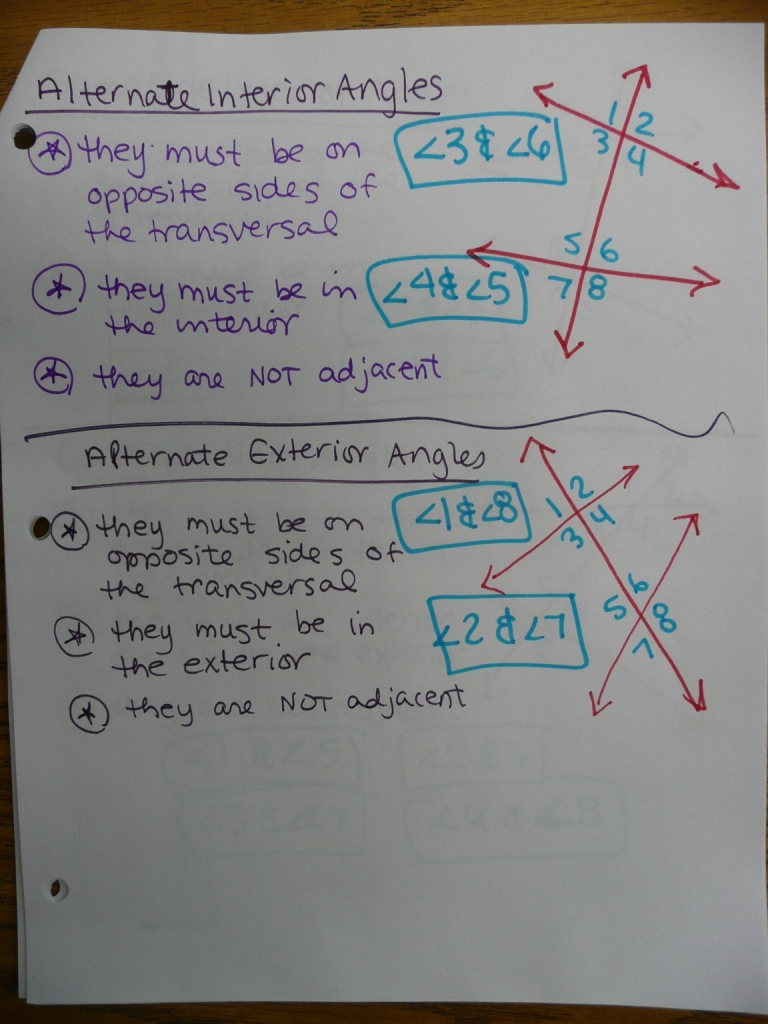
We started talking about 2 lines cut by a transversal this week in geometry. I had fun with the "magic hand" statement, and it seemed to work with my students. I held up my hand at the appropriate moment and asked them what it was ..... "a magic hand!", and then I placed it over the "4th line" that I had drawn.
I also mentioned that the two lines could be like sandwich slices and the transversal is the toothpick that goes through the sandwich. So when I had them identify types of angle pairs, I could keep saying, "who's the bread? who's the toothpick?". That seemed to help them be successful once the "magic hand" removed an extra line.


I also mentioned that the two lines could be like sandwich slices and the transversal is the toothpick that goes through the sandwich. So when I had them identify types of angle pairs, I could keep saying, "who's the bread? who's the toothpick?". That seemed to help them be successful once the "magic hand" removed an extra line.



Subscribe to:
Posts (Atom)