We are just finishing up trigonometry and special triangles in geometry and moving on to areas, but as with all skills, they need to revisit the topic a few times. Here's a sheet I made up that I'll be giving my students next week.
EDITED LATER TO ADD: Well, after I made the sheet, I thought about how much I like the puzzle sheets with answer banks, so I improved it to make the following puzzle geometry sheet.
Saturday, March 06, 2010

Thursday, February 25, 2010
Quadrilateral Project
Holy Cow, my kids are awesome. Out of about 23 students in geometry class, 8 turned in amazing projects, and the rest (barring 2 late assignments) did great stuff (but not with the "wow!" factor of the first 8). Here are 6.
Here's "super man". You can put it in front of your chest and strut your stuff.

Here's a purse. All the math equations and essentials are on strips of paper inside.

Here's a camera, taking a picture of the world.

Turtle Soup. The "recipe" is awesome.

Surfer Dude (had an incident with a shark).

Monster in the closet.

Here's "super man". You can put it in front of your chest and strut your stuff.

Here's a purse. All the math equations and essentials are on strips of paper inside.

Here's a camera, taking a picture of the world.

Turtle Soup. The "recipe" is awesome.

Surfer Dude (had an incident with a shark).

Monster in the closet.

Sunday, February 21, 2010
Differentiation Chapter 1
Maybe this will motivate me to actually get through the differentiation book. There are 18 chapters, and I like her writing style and attitude. Invariably, though, for me, with all good ideas I read about, I'm all "Great Idea!" and then it's a crap shoot as to whether I implement it. So maybe if I talk/blog it out, it'll have a better chance of going into action.
The first chapter can be summarized as "there were no good old days of teaching". Way back in the late 1800's only a teeny percentage of boys went to and completed high school. And it seems the debate was always on about the purpose of high school and what should be taught and such. Here's a site with one synopsis.
So what does this have to do with differentiation? I guess in the early days only a select type of kid went to high school and only a few graduated. Now we're trying to get everyone to be successful, so that means we have all levels of kids in our classroom, not just the select few. And not everyone learns the same way.
She has one statistic that by 1990 only 38% of the nation had graduated from high school. Wow. Page 11 of this document breaks down graduation rates by state in 1990 and 2000. Too many percentages in the 60's and 70's. So I guess if kids weren't cutting it in school or the school wasn't serving them, then off they went. These days, I'm guessing most schools would not make "adequate yearly progress" if these were the numbers, and the school would be a potential candidate for closing.
So, this sort of makes the case for differentiating for students who need more/different ways of learning instead of just listening and notes. It's not making a case for the "fast learners" and how to differentiate for them. We have to keep both in mind.
The first chapter can be summarized as "there were no good old days of teaching". Way back in the late 1800's only a teeny percentage of boys went to and completed high school. And it seems the debate was always on about the purpose of high school and what should be taught and such. Here's a site with one synopsis.
So what does this have to do with differentiation? I guess in the early days only a select type of kid went to high school and only a few graduated. Now we're trying to get everyone to be successful, so that means we have all levels of kids in our classroom, not just the select few. And not everyone learns the same way.
She has one statistic that by 1990 only 38% of the nation had graduated from high school. Wow. Page 11 of this document breaks down graduation rates by state in 1990 and 2000. Too many percentages in the 60's and 70's. So I guess if kids weren't cutting it in school or the school wasn't serving them, then off they went. These days, I'm guessing most schools would not make "adequate yearly progress" if these were the numbers, and the school would be a potential candidate for closing.
So, this sort of makes the case for differentiating for students who need more/different ways of learning instead of just listening and notes. It's not making a case for the "fast learners" and how to differentiate for them. We have to keep both in mind.
Saturday, February 20, 2010
Algebra Epiphany
I'm apparently a slow learner. I just realized the other day that I'm treating my algebra 1 preAP students like "gifted" kids, or "true preAP" students. I show them 1-3 examples (they work at least 2 of them by themselves in class) of a particular topic, and then invariably the bell rings MUCH too soon, and I send them off with homework. I also provide them with my school website in which I've linked various videos and sites that help for that topic.
I give about 10 problems of a type, and then the next class starts and we move on to a new topic after we've gone over homework. About 25% of the class (very rough estimate) is fine with this and can self assess and readjust their thinking and learn from their mistakes. BLACH! That means I'm not serving 75% of my students. They need MANY more examples, they need more hand-holding, they need more time in class to process new information.
Then there's always the war raging on in my head: Ackh! I'm going too slow, we won't learn everything we need to know for algebra. Eek! I'm molly-coddling them too much, when will they learn to stand on their own. Oof! what about the kids that get it, what will they do when we're practicing more in class when they already GET it. Yeesh! This is a preAP class, step up to the plate, kiddies.
Yes ... the "D" word ... differentiation. I had started to read a good book about it a while ago, and then as always seems to happen, other things got in the way, and I only finished 3 of 18 chapters. Then just the other day, I started reading it again. I'm on chapter 3. MUST. READ. BOOK. Must reflect on another way to do things.
I give about 10 problems of a type, and then the next class starts and we move on to a new topic after we've gone over homework. About 25% of the class (very rough estimate) is fine with this and can self assess and readjust their thinking and learn from their mistakes. BLACH! That means I'm not serving 75% of my students. They need MANY more examples, they need more hand-holding, they need more time in class to process new information.
Then there's always the war raging on in my head: Ackh! I'm going too slow, we won't learn everything we need to know for algebra. Eek! I'm molly-coddling them too much, when will they learn to stand on their own. Oof! what about the kids that get it, what will they do when we're practicing more in class when they already GET it. Yeesh! This is a preAP class, step up to the plate, kiddies.
Yes ... the "D" word ... differentiation. I had started to read a good book about it a while ago, and then as always seems to happen, other things got in the way, and I only finished 3 of 18 chapters. Then just the other day, I started reading it again. I'm on chapter 3. MUST. READ. BOOK. Must reflect on another way to do things.
Wednesday, February 17, 2010
Textbook Skills
I had a major scare yesterday after school during tutoring. My kids had a test the following day, and the homework I assigned was 1/2 odd problems (answers in the back) and 1/2 even on all the skills they needed for their test. One of the students was working an odd numbered problem, and then asked me if it was right. I told her to check the answer in the back. This was a total revelation to her. She didn't know the odd numbered answers existed, and after I told her, she couldn't track them down.
Then another student asked me how to do another problem. I asked her what the directions were and had her read them to me. Then I asked her to flip to the start of this particular section of problems. She didn't know what to do. We figured that out. Then I asked her to find an example they work through that is similar to that problem. We struggled to do that, too.
So, their homework tonight is a Textbook Scavenger Hunt (we use the Holt book).
Then another student asked me how to do another problem. I asked her what the directions were and had her read them to me. Then I asked her to flip to the start of this particular section of problems. She didn't know what to do. We figured that out. Then I asked her to find an example they work through that is similar to that problem. We struggled to do that, too.
So, their homework tonight is a Textbook Scavenger Hunt (we use the Holt book).
Sunday, February 14, 2010
New Math Game Addiction
Friday, February 12, 2010
Geometry Polygon Project
Inspired my Mrs. H and by the cool graph separation of a grid from Mr. K, I designed this geometry project for my kids after we've covered all things polygon. I'm going to pass it out next week and see what I get back.
Thursday, February 11, 2010
A Valentine for "sticky notes"
I love the versatility and color choice and usefulness of sticky notes. Especially for returned homeworks.


Thursday, February 04, 2010
Line Project Finale
Well, all, okay most of the projects have been turned in, and now comes my grading fiesta (ay yi yi yi) which I solemnly do swear NOT to put off until forever and a day (p.s. I dread grading projects). I love the creativity of the students, and was impressed with some of the facts they found that they thought interesting. Here are a few of them (with no mention yet of whether they are accurate or not).


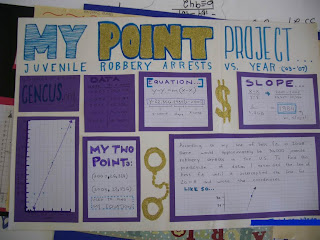


Things I've learned and would change for next time:
Be more specific about what you want on the poster (data, what work, the sentence of the prediction, the fact that the prediction has to be from using the line equation and not just the slope).
Be SUPER HAND-HOLDY on the step by step procedure of finding the equation of the line of best fit.
Grin and take Deep Breaths because even though some projects are not exactly what you were expecting, everyone still learned something about how lines are used in "life".


Things I've learned and would change for next time:
Be more specific about what you want on the poster (data, what work, the sentence of the prediction, the fact that the prediction has to be from using the line equation and not just the slope).
Be SUPER HAND-HOLDY on the step by step procedure of finding the equation of the line of best fit.
Grin and take Deep Breaths because even though some projects are not exactly what you were expecting, everyone still learned something about how lines are used in "life".
Saturday, January 30, 2010
Lines Project Continued
My students are still working on their Line Project, and I'm glad I assigned it because various things have come up that I think are good learning experiences for them and for me. I had separated their completion of the project into 3 successive class periods, and for the 1st one they had to turn in a set of data points and a computer-generated scatter plot to show the linear correlation. Well!
Most kids were fine, but others had a variety of issues:
* "The spreadsheet won't make a scatter plot of my data!" (the student was entering data of height vs. weight, and the heights were typed in as 4ft 5in, 4ft 6in, ...)
* "Here's my data ... SEE! Linear" (the set of points was EXACTLY linear since the student found a site that said that every 1 second ___ kids drop out of school, and the student had used that to create 5 coordinate points)
The 2nd class period, they had to turn in their own hand-created scatter plot and best fit line and equation and idea for a prediction using their line equation. Issues:
* Some kids used rise/run to calculate their slope, but the scale of their graph wasn't in "1's".
* Some prediction ideas were: I predict the cost of a loaf of bread will rise 31 cents every 7 years (they used their slope instead of their equation)
* Some just connected the data points, forgetting the example we worked on in class for best-fit line.
And so on. This seems to have taken them out of their comfort zone of how our math class has been going, so I'm glad they're being "mathematicians in action" and learning extra skills. I'm also glad I broke it up into 3 days of checkpoints since I'm guessing I saved myself (and them) the agony of incorrect or NO final products. While I was walking around critiquing their graphs this past class, I gave them THIS to work on.
On a side note, after my hectic week of various extra tasks added on to the already busy schedule, I went out for drinks with my friend, and we had an interesting discussion about the difference between "unethical" and "immoral". What types of things would fall into each separate category? Would some things be both? What's the distinguishing characteristics of something that is one or the other?
Most kids were fine, but others had a variety of issues:
* "The spreadsheet won't make a scatter plot of my data!" (the student was entering data of height vs. weight, and the heights were typed in as 4ft 5in, 4ft 6in, ...)
* "Here's my data ... SEE! Linear" (the set of points was EXACTLY linear since the student found a site that said that every 1 second ___ kids drop out of school, and the student had used that to create 5 coordinate points)
The 2nd class period, they had to turn in their own hand-created scatter plot and best fit line and equation and idea for a prediction using their line equation. Issues:
* Some kids used rise/run to calculate their slope, but the scale of their graph wasn't in "1's".
* Some prediction ideas were: I predict the cost of a loaf of bread will rise 31 cents every 7 years (they used their slope instead of their equation)
* Some just connected the data points, forgetting the example we worked on in class for best-fit line.
And so on. This seems to have taken them out of their comfort zone of how our math class has been going, so I'm glad they're being "mathematicians in action" and learning extra skills. I'm also glad I broke it up into 3 days of checkpoints since I'm guessing I saved myself (and them) the agony of incorrect or NO final products. While I was walking around critiquing their graphs this past class, I gave them THIS to work on.
On a side note, after my hectic week of various extra tasks added on to the already busy schedule, I went out for drinks with my friend, and we had an interesting discussion about the difference between "unethical" and "immoral". What types of things would fall into each separate category? Would some things be both? What's the distinguishing characteristics of something that is one or the other?
Sunday, January 24, 2010
Lines Project
In algebra 1 we've covered most line topics I think are important:
* calculating slope from a graph and from 2 points without a graph
* looking at a graph and finding the line equation in all 3 ways (standard, pt-slope,slope-int)
* being given either 2 points or a point and a slope and calculating any of the 3 equations.
* looking at any of the 3 line equations and graphing
* looking at any of the 3 line equations and finding 5 points on the line (and the intercepts)
* seeing that if you have a graph and it's line equation in any form, that you can plug in any point on the line and it will "work" and plug in any equation not on the line, and it won't work in the equation.
(I've probably missed some, but this is what I remember)
We still have to talk about parallel and perpendicular lines, but soon we'll move on to systems of equations. Before we do that, I thought that this would be the perfect time to assign a line project to my students. In all their later topics and math courses, lines will just be an aside where it's already assumed they have learned about them.
We had a discussion about positive and negative linear correlation and no correlation and correlation that is not linear. We went through the process of creating best fit lines and using that line to make a prediction for another point that is not represented by your data. Then I discussed that in real life, people collect data, and if they all fell on a straight line, the mathematicians/scientists would faint from the rareness of this occurrence, and that usually, if the data seems to be linear, it'll look like our scatter plots that have a linear correlation, and THAT'S how this is used in real life. People make a model and then use that model to make predictions.
Then I assigned this project that I will collect in a succession of 3 class periods. I already have had one student send me her data that was interesting. She found information about teacher pay from the 40's to the 2000's, and you can see that it looks linear until about 1980, and then there's a BIG leap of the points and then it looks linear again. After a back and forth e-mail discussion, she found that some site stated that there was a 400% increase in pay in 1980 .... hmmm, haven't verified that, but I remember some of my older teacher friends mentioning their super low pay in the 70's.
* calculating slope from a graph and from 2 points without a graph
* looking at a graph and finding the line equation in all 3 ways (standard, pt-slope,slope-int)
* being given either 2 points or a point and a slope and calculating any of the 3 equations.
* looking at any of the 3 line equations and graphing
* looking at any of the 3 line equations and finding 5 points on the line (and the intercepts)
* seeing that if you have a graph and it's line equation in any form, that you can plug in any point on the line and it will "work" and plug in any equation not on the line, and it won't work in the equation.
(I've probably missed some, but this is what I remember)
We still have to talk about parallel and perpendicular lines, but soon we'll move on to systems of equations. Before we do that, I thought that this would be the perfect time to assign a line project to my students. In all their later topics and math courses, lines will just be an aside where it's already assumed they have learned about them.
We had a discussion about positive and negative linear correlation and no correlation and correlation that is not linear. We went through the process of creating best fit lines and using that line to make a prediction for another point that is not represented by your data. Then I discussed that in real life, people collect data, and if they all fell on a straight line, the mathematicians/scientists would faint from the rareness of this occurrence, and that usually, if the data seems to be linear, it'll look like our scatter plots that have a linear correlation, and THAT'S how this is used in real life. People make a model and then use that model to make predictions.
Then I assigned this project that I will collect in a succession of 3 class periods. I already have had one student send me her data that was interesting. She found information about teacher pay from the 40's to the 2000's, and you can see that it looks linear until about 1980, and then there's a BIG leap of the points and then it looks linear again. After a back and forth e-mail discussion, she found that some site stated that there was a 400% increase in pay in 1980 .... hmmm, haven't verified that, but I remember some of my older teacher friends mentioning their super low pay in the 70's.
Wednesday, January 20, 2010

Tuesday, January 19, 2010
Three Day Weekend
I went to Chicago for the nice 3-day weekend, and had a fun time walking around and people watching and freezing and sight-seeing. Here's the cool Water Tower Building:

This is "The Bean" in Millennium Park.


This is a river cutting through town and gives a nice idea of how cold it was:

I loved the ease of the subway (CTA) system and my old-styled hotel (thank you, Expedia.com and yelp.com reviewers). I loved trying out their many vegetarian restaurants and knit shops and independent bookstores (thanks again yelp.com reviewers). This will tide me over until my next adventure.

This is "The Bean" in Millennium Park.


This is a river cutting through town and gives a nice idea of how cold it was:

I loved the ease of the subway (CTA) system and my old-styled hotel (thank you, Expedia.com and yelp.com reviewers). I loved trying out their many vegetarian restaurants and knit shops and independent bookstores (thanks again yelp.com reviewers). This will tide me over until my next adventure.
Thursday, January 14, 2010
Near Miss
Yesterday at the start of geometry class I had the homework answers projected from the document camera, and was silently reviewing in my mind what we would be doing that day while my students checked their answers. I was ready to perfunctorily ask if they had any questions before we moved on to "the real learning". Okay, I'm not that robotic, but on hindsight, that's what it feels like because I almost missed a great learning moment.
On one particular question a bunch of students raised their hands. The question was something to the effect of: In a pentagon, the angles are consecutive multiples of 4. Find the measure of each angle. Instead of simply putting up the answer, I put my work down also since I thought there would be several confused students that would want it broken down: 4x + 4(x+1) + 4(x+2) + 4(x+3)+ 4(x+4) = 540 and then went from there.
The students with their raised hands weren't confused, they were chomping at the bit to show how they did the problem. Oh my goodness were there some clever kiddies there. They love to come up to the overhead and present (note to self: stop being a projector hog), and one by one they showed us what they did.
1st student: well, I divided 540 by 5 and got 108. That's a multiple of 4. The angles couldn't all be 108, but I thought they'd hover around it, so 108 was an angle, then for 2 other angles, I added and subtracted 4 and had 3 angles: 104, 108, 112. Then I added 4 to 112 and subtracted 4 from 104 to get my angles: 100,104,108,112,116.
2nd student: well, I started with 100 degrees for each angle (a multiple of 4), and with 5 angles that adds up to 500, so I had 40 degrees left to play with. Then I tried to break down 40 into 5 consecutive multiples of 4. 4, 8, 12, 16, 20. I added these up, and they were more than 40, so I just used 4,8,12,16 and it worked.
3rd student: well, I divided 540 by 5 and got 108. I divided 108 by 4 and saw that 108=27 * 4. So I then I found the consecutive numbers around 27: 25,26,27,28,29, and those were the consecutive multiples of 4, so I multiplied by those and got the answer.
4th student: well, I knew they were consecutive multiples of 4, so I set up an equation:
x + (x+4) + (x+8) + (x+12) + (x+16) = 540 and solved that.
I was very impressed and humbly reminded that there are teaching moments quite available to me even when I'm not "teaching".
On one particular question a bunch of students raised their hands. The question was something to the effect of: In a pentagon, the angles are consecutive multiples of 4. Find the measure of each angle. Instead of simply putting up the answer, I put my work down also since I thought there would be several confused students that would want it broken down: 4x + 4(x+1) + 4(x+2) + 4(x+3)+ 4(x+4) = 540 and then went from there.
The students with their raised hands weren't confused, they were chomping at the bit to show how they did the problem. Oh my goodness were there some clever kiddies there. They love to come up to the overhead and present (note to self: stop being a projector hog), and one by one they showed us what they did.
1st student: well, I divided 540 by 5 and got 108. That's a multiple of 4. The angles couldn't all be 108, but I thought they'd hover around it, so 108 was an angle, then for 2 other angles, I added and subtracted 4 and had 3 angles: 104, 108, 112. Then I added 4 to 112 and subtracted 4 from 104 to get my angles: 100,104,108,112,116.
2nd student: well, I started with 100 degrees for each angle (a multiple of 4), and with 5 angles that adds up to 500, so I had 40 degrees left to play with. Then I tried to break down 40 into 5 consecutive multiples of 4. 4, 8, 12, 16, 20. I added these up, and they were more than 40, so I just used 4,8,12,16 and it worked.
3rd student: well, I divided 540 by 5 and got 108. I divided 108 by 4 and saw that 108=27 * 4. So I then I found the consecutive numbers around 27: 25,26,27,28,29, and those were the consecutive multiples of 4, so I multiplied by those and got the answer.
4th student: well, I knew they were consecutive multiples of 4, so I set up an equation:
x + (x+4) + (x+8) + (x+12) + (x+16) = 540 and solved that.
I was very impressed and humbly reminded that there are teaching moments quite available to me even when I'm not "teaching".
Saturday, January 09, 2010
Rates of Change & Slope
As school started back up again, in algebra 1 we started our unit on equations of lines by talking about rates of change. Last year I just jumped right into slope first, and verbally mentioned some applications (if I remember correctly), but this year I thought I'd give them a context first. I started with a worksheet on rates of change and had them work through the first 2 problems with not much prompting. Then we discussed their answers. I made sure they used units. I made sure we saw ALL ways of writing the numbers. My classes (everyone's?) seem unsure that 9/4 and 2.25 and 2 1/4 can all be correct answers. They still look at me like they don't QUITE believe I'm not pulling a fast one on them.
Then they did the next two, and we discussed, and so on. I made sure to mix up the units, I have some with negative rates of change on the back. After a few, if it didn't come up, I discussed and made them write their calculations on the side as (y2-y1)/(x2-x1) using the appropriate numbers. If it didn't come up, I made sure to investigate what would happen if you used different points or a different order.
In my block class, we had just enough time to do this and then to have a discussion about rates of change and slope and how they're the same (barring units).
I'm thinking this went well because on the second day, when we discussed rise/run and started graphs to y=mx+b equations, they were pretty good and quick on calculating slope. Also, when I stepped back and asked them to identify positive and negative slopes, they had a picture of water levels increasing or decreasing and were pretty accurate.
Oh, one funny thing. I like to give them memory tools to keep things straight, and on "rise over run", I said, well what goes on top? the y's, and y's rhymes with rise. Then I told them I couldn't think of a memory tool that links run with x's, so I put it to them. Maybe these have already been done before, but I forgot, so I really liked some of the ones my kids came up with:
you run from your ex
you run from T-rex
you run cross country (x)
you run on a flat surface, and x is on the horizontal axis.
Then they did the next two, and we discussed, and so on. I made sure to mix up the units, I have some with negative rates of change on the back. After a few, if it didn't come up, I discussed and made them write their calculations on the side as (y2-y1)/(x2-x1) using the appropriate numbers. If it didn't come up, I made sure to investigate what would happen if you used different points or a different order.
In my block class, we had just enough time to do this and then to have a discussion about rates of change and slope and how they're the same (barring units).
I'm thinking this went well because on the second day, when we discussed rise/run and started graphs to y=mx+b equations, they were pretty good and quick on calculating slope. Also, when I stepped back and asked them to identify positive and negative slopes, they had a picture of water levels increasing or decreasing and were pretty accurate.
Oh, one funny thing. I like to give them memory tools to keep things straight, and on "rise over run", I said, well what goes on top? the y's, and y's rhymes with rise. Then I told them I couldn't think of a memory tool that links run with x's, so I put it to them. Maybe these have already been done before, but I forgot, so I really liked some of the ones my kids came up with:
you run from your ex
you run from T-rex
you run cross country (x)
you run on a flat surface, and x is on the horizontal axis.
Thursday, January 07, 2010
Silliness
I got a much-needed laugh today from a student. In my quest to drink more water and to stay caffeinated, I bring two 1-liter bottles of water to school every day. One (the BLUE one) I use with my electric water boiler to make tea (for normal days where you got enough sleep) or with my single-serving coffee maker to make hazelnut coffee (for the oh my god wake me up days). This water allows me 2 large (20 oz) cups of hot beverage (and I might add that it's very hard to find good, 20 oz reusable hot beverage cups. Thank you Starbucks). Add a little non-sugared soy milk and I'm in heaven. The other bottle (the YELLOW one) is to just drink straight. Of course there's the bathroom vs. class time issue, so usually I drink 1/2 of it during lunch time, and then the other half at the end of the work day.
Today, I had a mixture of chalk or dust in the throat and/or an on-coming cold and/or allergies, and I desperately needed a sip of water while I was teaching, so that I could continue without turning into a sputtering mess. I did something I'd apparently never done in class before. I got the yellow water bottle and took a few sips.
A girl looks at me for a bit and then says, "why would anyone drink water out of a yellow water bottle?"
After I finished laughing, I came back with, "I'm recycling". Ew.
Today, I had a mixture of chalk or dust in the throat and/or an on-coming cold and/or allergies, and I desperately needed a sip of water while I was teaching, so that I could continue without turning into a sputtering mess. I did something I'd apparently never done in class before. I got the yellow water bottle and took a few sips.
A girl looks at me for a bit and then says, "why would anyone drink water out of a yellow water bottle?"
After I finished laughing, I came back with, "I'm recycling". Ew.
Thursday, December 31, 2009
New Year's Teaching Resolutions
Okay, so New Year for teachers is really August/September, but it's never bad to reflect on how the year has gone so far and what things I could work on for the 2nd half of the school year. Also, by now I have some sort of groove going with the kids (good or bad), and that gives me more to work with.
1. I'm still not happy with my homework I assign. Ideally I would like it to be 80% or so new material, and 20% mixed review. That's always in the back of my mind, and it seems to have taken up permanent residence there. My issue is that I'm scrambling to create or assign homework at my favorite minute - the last one, so ... Now I'm old enough to know that this is the way I work, so I need to think of something I can do within my limitations.
Idea: While I'm creating the current homework or while I'm entering it in GradeSpeed, jot down 2 similar problems to that night's homework along with topic covered while it's fresh in my mind. If I do this for a while, then I'll build up a store of problems ready-made, and then in my future last minute, I can hunt and peck around this list and just add them to the homework. Better yet, type in or scan in the problems onto my school website, and then just point the students in that direction and tell them which additional problems to do each night.
2. At the end of each class, I really only have a good sense of how a portion of my students understand the current material. There are still too many ways in class to pretend like you're listening and comprehending, but really tuning out in the myriad of teenage ways. I'd like to have a quick easy take on everyone, and have them understand if they get it or not. Problem: I'm usually bell-to-bell, and feel 5 minutes of something else won't happen without squeezing out important content.
Idea:
Hmmm, no immediate ideas. My original idea was to have them do a problem by themselves similar to what they just learned (with? without notes?), but then I'm sitting here thinking about how I learn best, and maybe like everyone else, part of the process is to go back over what you just learned and try to rephrase it or think about it a piece at a time: what were the important points, what did this or that mean, what would happen in such a situation, etc. Maybe a starting idea to see how it works would be to force myself to stop class 5 minutes early, and have a standard set of prompts related to my thoughts above, and the kids have to silently go over their notes and work and brains and answer the questions/prompts about the topic, not solving a problem, but thinking about what was learned. No talking to others, because then I wouldn't know what they know (even though you learn by discussing, but I see this short 5 minutes as not amenable to this).
3. There are still some students who I basically never talk to. You know how it is. A handful of students in each class seem to dominate the time or attention or are the boisterous ones that always engage you in conversation. Then there are the quiet ones who sit there and behave and, well, are quiet. Sure I'll call on them, and they'll answer the question, but that's the extent of our interaction.
Idea: List such kids, and make it a point to engage in conversation with them before class starts at least____ times a 6 weeks. I don't know, I'd have to make a list of all such kids and cross them off or "check" them when I converse with them, then I could probably engage, say 2 per class, so 4-6 per week (block schedule), and then see how many such cycles I could go through. Hmmm, seems calculated. Well I guess it is, but that's what I've got.
Okay, those are not my only concerns, but let's not get carried away and have too much on our plates and end up doing nothing. Happy last day of the year to all of us. Hope 2010 holds all sorts of joy and hope and an enjoyment of at least parts of every day.
1. I'm still not happy with my homework I assign. Ideally I would like it to be 80% or so new material, and 20% mixed review. That's always in the back of my mind, and it seems to have taken up permanent residence there. My issue is that I'm scrambling to create or assign homework at my favorite minute - the last one, so ... Now I'm old enough to know that this is the way I work, so I need to think of something I can do within my limitations.
Idea: While I'm creating the current homework or while I'm entering it in GradeSpeed, jot down 2 similar problems to that night's homework along with topic covered while it's fresh in my mind. If I do this for a while, then I'll build up a store of problems ready-made, and then in my future last minute, I can hunt and peck around this list and just add them to the homework. Better yet, type in or scan in the problems onto my school website, and then just point the students in that direction and tell them which additional problems to do each night.
2. At the end of each class, I really only have a good sense of how a portion of my students understand the current material. There are still too many ways in class to pretend like you're listening and comprehending, but really tuning out in the myriad of teenage ways. I'd like to have a quick easy take on everyone, and have them understand if they get it or not. Problem: I'm usually bell-to-bell, and feel 5 minutes of something else won't happen without squeezing out important content.
Idea:
Hmmm, no immediate ideas. My original idea was to have them do a problem by themselves similar to what they just learned (with? without notes?), but then I'm sitting here thinking about how I learn best, and maybe like everyone else, part of the process is to go back over what you just learned and try to rephrase it or think about it a piece at a time: what were the important points, what did this or that mean, what would happen in such a situation, etc. Maybe a starting idea to see how it works would be to force myself to stop class 5 minutes early, and have a standard set of prompts related to my thoughts above, and the kids have to silently go over their notes and work and brains and answer the questions/prompts about the topic, not solving a problem, but thinking about what was learned. No talking to others, because then I wouldn't know what they know (even though you learn by discussing, but I see this short 5 minutes as not amenable to this).
3. There are still some students who I basically never talk to. You know how it is. A handful of students in each class seem to dominate the time or attention or are the boisterous ones that always engage you in conversation. Then there are the quiet ones who sit there and behave and, well, are quiet. Sure I'll call on them, and they'll answer the question, but that's the extent of our interaction.
Idea: List such kids, and make it a point to engage in conversation with them before class starts at least____ times a 6 weeks. I don't know, I'd have to make a list of all such kids and cross them off or "check" them when I converse with them, then I could probably engage, say 2 per class, so 4-6 per week (block schedule), and then see how many such cycles I could go through. Hmmm, seems calculated. Well I guess it is, but that's what I've got.
Okay, those are not my only concerns, but let's not get carried away and have too much on our plates and end up doing nothing. Happy last day of the year to all of us. Hope 2010 holds all sorts of joy and hope and an enjoyment of at least parts of every day.
Tuesday, December 29, 2009
Winter Trip
Just this past weekend we went to Santa Fe and stayed at a nice B&B just south of town. We also went snowshoeing for the 1st time, and now I'm a convert. It was easy to rent equipment from REI and fun to trudge through the snow for a couple of days. We lasted about 2-3 hours each day, with much resting on the way up, and a quick scurrying downhill with the promise of lunch to spur us on. I liked the partial packed snow better than the much-trampled on road/paths that were available. I also liked hanging out at the Santa Fe Baking Co. & Cafe and people watching and checking my e-mail and blogs. Here are some pictures of our outing and of our B&B place and of a funny bird that was snuffling around in the snow on one of our breaks.






Thursday, December 24, 2009
Discussions About High School
Ahhhh vacation. Time of 9-10 hours of sleep a night, of eating too much, of drinking more than needed, of talking with various people about high school.
Today I had lunch with another math teacher that I used to work with. We were discussing kids who didn't persevere and didn't have a good work ethic .... you know, "kids these days". Then we started talking about when we were in high school, and she mentioned that she wasn't such a hot student back then. Then I mentioned that as a student I wasn't that "student-y". I did what I needed to do to get good grades, but I don't remember really being engaged about topics or thinking hard or being any of the things I want for my students these days. Then I look at how we turned out as adults. My friend is a conscientious teacher who really thinks about what and how she teaches, and I want to believe I'm the same way, and I didn't really learn how to be a good student until I was in grad school and saw how other students worked. So, really, in the end, even though our high school performance wouldn't have predicted it, we turned out okay.
Then that leads me to think that even though some of the kids we teach these days don't do what we want them to do, they still are absorbing the lessons we teach them either formally (math math math) or informally (be a good person, do the right thing, think about what you're learning). And that ultimately, in the end, most likely they'll turn out to be productive adults that end up having a good work ethic or end up having a strong moral compass. Just because they're one way now, when they're 14, that doesn't mean that's how they're destined to be forever. And even though they don't seem to be absorbing what we're telling them, maybe they are at some level, and if not now, then maybe later.
Then this evening we were at an open house for Christmas Eve at our neighbors' home. They have 3 children that have graduated from high school and are now out in the world. I talked with one of the girls (20's) about high school, and she mentioned how she HATED it. "The kids were so mean." We also talked about whether or not we remembered teachers' names. Now even though she's been out for only a few years, she doesn't remember many. I've been out for more than 20, and I don't either. But I do remember 2 teacher's names. What made them different? One was a "public speaking" teacher. That was the most useful class I took. I guess I remember his name because the class had such an impact on me. Another was my freshman English teacher's name. He was all "cool" and wore jeans (in the late 70's), and had a shag rug (ooh aah), and our desks were in a circle, and I still remember his lessons on: effect/affect ... it's/its ... their/they're and so on.
I guess all this is to give myself a little pep talk to remind myself that how my students are today may not be the perfect indication of how they'll ultimately turn out.
Today I had lunch with another math teacher that I used to work with. We were discussing kids who didn't persevere and didn't have a good work ethic .... you know, "kids these days". Then we started talking about when we were in high school, and she mentioned that she wasn't such a hot student back then. Then I mentioned that as a student I wasn't that "student-y". I did what I needed to do to get good grades, but I don't remember really being engaged about topics or thinking hard or being any of the things I want for my students these days. Then I look at how we turned out as adults. My friend is a conscientious teacher who really thinks about what and how she teaches, and I want to believe I'm the same way, and I didn't really learn how to be a good student until I was in grad school and saw how other students worked. So, really, in the end, even though our high school performance wouldn't have predicted it, we turned out okay.
Then that leads me to think that even though some of the kids we teach these days don't do what we want them to do, they still are absorbing the lessons we teach them either formally (math math math) or informally (be a good person, do the right thing, think about what you're learning). And that ultimately, in the end, most likely they'll turn out to be productive adults that end up having a good work ethic or end up having a strong moral compass. Just because they're one way now, when they're 14, that doesn't mean that's how they're destined to be forever. And even though they don't seem to be absorbing what we're telling them, maybe they are at some level, and if not now, then maybe later.
Then this evening we were at an open house for Christmas Eve at our neighbors' home. They have 3 children that have graduated from high school and are now out in the world. I talked with one of the girls (20's) about high school, and she mentioned how she HATED it. "The kids were so mean." We also talked about whether or not we remembered teachers' names. Now even though she's been out for only a few years, she doesn't remember many. I've been out for more than 20, and I don't either. But I do remember 2 teacher's names. What made them different? One was a "public speaking" teacher. That was the most useful class I took. I guess I remember his name because the class had such an impact on me. Another was my freshman English teacher's name. He was all "cool" and wore jeans (in the late 70's), and had a shag rug (ooh aah), and our desks were in a circle, and I still remember his lessons on: effect/affect ... it's/its ... their/they're and so on.
I guess all this is to give myself a little pep talk to remind myself that how my students are today may not be the perfect indication of how they'll ultimately turn out.
Friday, December 18, 2009
Hellooooo Holidays
After the longest week ever and the most emotional, it's finally break time. And by break I mean that now I have time to catch up on my engineering curriculum, so that I have something to teach when I return in 2 weeks. But by break I also mean sleeping past 5am and not being stressed out and in a hurry all day long to make sure I do everything and do it well.
I made 3 finals up from (mostly) scratch, and I like some of the questions I came up with or adjusted from other sources. They also spawned ideas for future lessons.
algebra:
Let s=the amount of suger you ingest (in mg)
Let c=the number of cavities you have
the independent variable is ___________
the dependent variable is ____________
_____ is a function of _______
The correct function notation is s(c) or c(s) (circle one).
This got me to thinking that the next time I am at the first day of teaching functions, after we go through some like this, I'm going to have the students each come up with a scenario and work it through and then we'll share out. That way they'll spend more time processing the concept and figure out what it takes to be dependent and independent and how things relate to each other and what functions are.
In engineering, part of the test was on statistics, so one question I adjusted from something I found on line was:
In a certain neighborhood, the following are household incomes:
$40000, $46000,$54000, ... (and 4 more like this), then $250000000
Find the mean______
Find the median_____
Your engineering firm wants a good sense of the income level for marketing purposes. Which number better represents the neighborhood income and why?
The median came out as something like $51000, and the mean came out roughly $230000000. It was interesting to me that not everyone got it right. More discussion in class next time.
I made 3 finals up from (mostly) scratch, and I like some of the questions I came up with or adjusted from other sources. They also spawned ideas for future lessons.
algebra:
Let s=the amount of suger you ingest (in mg)
Let c=the number of cavities you have
the independent variable is ___________
the dependent variable is ____________
_____ is a function of _______
The correct function notation is s(c) or c(s) (circle one).
This got me to thinking that the next time I am at the first day of teaching functions, after we go through some like this, I'm going to have the students each come up with a scenario and work it through and then we'll share out. That way they'll spend more time processing the concept and figure out what it takes to be dependent and independent and how things relate to each other and what functions are.
In engineering, part of the test was on statistics, so one question I adjusted from something I found on line was:
In a certain neighborhood, the following are household incomes:
$40000, $46000,$54000, ... (and 4 more like this), then $250000000
Find the mean______
Find the median_____
Your engineering firm wants a good sense of the income level for marketing purposes. Which number better represents the neighborhood income and why?
The median came out as something like $51000, and the mean came out roughly $230000000. It was interesting to me that not everyone got it right. More discussion in class next time.
Friday, December 11, 2009
Stressed Out 9th Graders
Phew what a week. It was the last week before finals. Highlights included getting cussed out by a student in a "joking" manner who then subsequently skipped another of the classes she had with me. Being treated to tales of my extremely stressed out students who said they went to their rooms the previous night and started laughing and crying simultaneously without being able to stop. Watching a hugfest take place in my room comprised of various students who were trying to pacify each other. Oh my.
I guess part of it is that my freshman are the oldest kids in this school. We're "growing" a full high school and will have 12th graders at the start of the 2012 school year. At the start of one class, after I'd heard the laughing/crying story, I had a spontaneous idea. I had colored paper in my room, so I had them each take a sheet; I took one, too. I then told them that we all were going to get our stress out on the paper for 5 minutes, and I wouldn't collect their papers. It was for their eyes only, and they could write whatever they wanted to. I told them that at the end they could crumple it up or tear it to bits or take it home and burn it or whatever. I set the timer, and we all wrote away. At the end, we "put our stress away" and moved on with our review. It seemed to calm them down (temporarily?), and we were able to get some work done.
On a positive note, my cussing student was suspended for the remainder of the week, and the class she was in (my most challenging class personality-wise) went better on Friday. On another positive note, all this work stress and other related stress has brought a few of us together, and I've actually talked more with other teachers than I have in the previous two 6 weeks. Here's to finally feeling like I belong to this new school.
I guess part of it is that my freshman are the oldest kids in this school. We're "growing" a full high school and will have 12th graders at the start of the 2012 school year. At the start of one class, after I'd heard the laughing/crying story, I had a spontaneous idea. I had colored paper in my room, so I had them each take a sheet; I took one, too. I then told them that we all were going to get our stress out on the paper for 5 minutes, and I wouldn't collect their papers. It was for their eyes only, and they could write whatever they wanted to. I told them that at the end they could crumple it up or tear it to bits or take it home and burn it or whatever. I set the timer, and we all wrote away. At the end, we "put our stress away" and moved on with our review. It seemed to calm them down (temporarily?), and we were able to get some work done.
On a positive note, my cussing student was suspended for the remainder of the week, and the class she was in (my most challenging class personality-wise) went better on Friday. On another positive note, all this work stress and other related stress has brought a few of us together, and I've actually talked more with other teachers than I have in the previous two 6 weeks. Here's to finally feeling like I belong to this new school.
Wednesday, December 09, 2009
Checking Your Work
It recently came to my attention that there are students who don't FULLY understand how to check their work. During this past semester in algebra 1, we solved equations and inequalities and such. To force them to check their work, periodically I would assign it point value on their homework, so they could get at most 80% if they didn't check their work.
Here are various things I noticed. Sometimes students would start checking their work at the 2nd step or the simplified step of the original problem. We discussed why that was a bad idea (potential mistake at the 1st step, and even though your answer looks correct, it's not for the original problem).
Sometimes students would "check" their work, plugging in their answer, and at the end get some number that had nothing to do with the original equation, and then place a check mark at the end. CHECK. I've checked my work. Done. Not correct, but I don't get it, I think just going through the process and the ever-important check mark at the end is good.
And finally, sometimes students would check their work. It wouldn't pan out. But then they wouldn't take it from there. Oh well, it didn't work. I'm stopping. I don't think to go back and follow my work process to see where my mistake was.
Ideas for next time (or later this year?): write out various problems all worked out, and then have students analyze the situation: is the problem correct? how do you know. If the checking didn't work out, where is the mistake? Find it (and have some mistakes in the problem and some in the checking). Have some problems where everything seems to work out, and the problem has the checking occur from the 2nd step on of the problem and "look" correct but in reality not solve the original problem.
Here are various things I noticed. Sometimes students would start checking their work at the 2nd step or the simplified step of the original problem. We discussed why that was a bad idea (potential mistake at the 1st step, and even though your answer looks correct, it's not for the original problem).
Sometimes students would "check" their work, plugging in their answer, and at the end get some number that had nothing to do with the original equation, and then place a check mark at the end. CHECK. I've checked my work. Done. Not correct, but I don't get it, I think just going through the process and the ever-important check mark at the end is good.
And finally, sometimes students would check their work. It wouldn't pan out. But then they wouldn't take it from there. Oh well, it didn't work. I'm stopping. I don't think to go back and follow my work process to see where my mistake was.
Ideas for next time (or later this year?): write out various problems all worked out, and then have students analyze the situation: is the problem correct? how do you know. If the checking didn't work out, where is the mistake? Find it (and have some mistakes in the problem and some in the checking). Have some problems where everything seems to work out, and the problem has the checking occur from the 2nd step on of the problem and "look" correct but in reality not solve the original problem.
Saturday, December 05, 2009
Interpreting Functions
I think the kids get functions this year. After we looked at graphs and tables and mappings and saw what functions looked like for these situations (one day) and got a formal definition of functions, the next block day, I started by giving them pairs of objects like: rainfall and tulips. I asked which one depends on the other one? Which one is the input? Which one would be "x" and which one would be "y"? And, the new one for them: which one is a function of the other one? (we discussed what that means). We did that for 3 pairs of things.
Then I noted that THAT was a ton of writing, and we assigned variables to things like r and t, and I showed them t(r) and noted that the input, r, was INSIDE the parentheses, and the output, t, was OUTSIDE the parentheses, and if you were talking to your math boyfriend over the phone, you'd say, "t of r" or "t is a function of r".
Then we got to things like B(h) where B is your tutoring bill and h is the hours of tutoring. I asked them to interpret: B(3) = 120. We did this for 4 problems or so. I liked those types of questions, and we took them to graphs and tables the next day where I made them interpret v(5) or m(10) where there was context around the problems.
Next up, studying for finals and finals and a LONG BREAK to get more than 6.something hours of sleep each weeknight.
Then I noted that THAT was a ton of writing, and we assigned variables to things like r and t, and I showed them t(r) and noted that the input, r, was INSIDE the parentheses, and the output, t, was OUTSIDE the parentheses, and if you were talking to your math boyfriend over the phone, you'd say, "t of r" or "t is a function of r".
Then we got to things like B(h) where B is your tutoring bill and h is the hours of tutoring. I asked them to interpret: B(3) = 120. We did this for 4 problems or so. I liked those types of questions, and we took them to graphs and tables the next day where I made them interpret v(5) or m(10) where there was context around the problems.
Next up, studying for finals and finals and a LONG BREAK to get more than 6.something hours of sleep each weeknight.
Friday, November 27, 2009
Music & Computer Work
Frequently my IED (engineering) class is on the computer all period working on the CAD program (Inventor). Several of the students daily ask me if they can listen to music while they work. I always say no. BUT it's "Pandora", they say, there's no talking, they say, it helps me concentrate, they say. Ms./Mr. So-And-So let's me in THEIR class, they say. No, I say.
I had a bunch of reasons all jumbled up in my brain, and I didn't sort it out as to the real reason I was such a grinch until the other day. Here's my main reason. More and more I see people in society all plugged in and earbudded into isolation and in their own little worlds not interacting with the people in the present and around them. I guess I want my students to see and be with the students around them at the current time and learn to interact with them - whether it's talking with them about what they're doing, chatting about various things, or learning to focus with the outside noise potentially disturbing them. You know, being part of our community.
And also because I'm a grinch.
I had a bunch of reasons all jumbled up in my brain, and I didn't sort it out as to the real reason I was such a grinch until the other day. Here's my main reason. More and more I see people in society all plugged in and earbudded into isolation and in their own little worlds not interacting with the people in the present and around them. I guess I want my students to see and be with the students around them at the current time and learn to interact with them - whether it's talking with them about what they're doing, chatting about various things, or learning to focus with the outside noise potentially disturbing them. You know, being part of our community.
And also because I'm a grinch.
Tuesday, November 24, 2009
Reviews
It's almost time for finals, and I scurried around last minute as is my nature to make a review for algebra and geometry. While I was doing so, I remembered various conversations I'd had with my algebra students this semester whenever test time rolled around.
I want them to be active learners and to take the initiative to think of what's going to be tested, go over problems of a type, come in for help if needed, etc, etc. Yea, I know, maybe it's all pipe dreams and wishful thinking, but how do you get them there. I tried with a study guide (not a review sheet), and after some tweaking, used it the few remaining times I had tests. I never went back and surveyed the students on paper to see if it changed their study habits. Maybe they just found it one more chore to do, but maybe it put a seed in their heads about how to study.
Or maybe not. Right after another test, we were discussing it in class, and some students raised their hands:
"other teachers give us a review sheet with questions to practice"
"other teachers give us points when we turn in the review sheet"
Yeesh. They think there's something magic about the extra review problems I could come up with. And THEN they want someone else to give them motivation to actually review. I said as much (in nice teacher talk words) to them in response to these questions. I don't know who I sold, or who still thinks, "meanie. give us the review!"
I want them to be active learners and to take the initiative to think of what's going to be tested, go over problems of a type, come in for help if needed, etc, etc. Yea, I know, maybe it's all pipe dreams and wishful thinking, but how do you get them there. I tried with a study guide (not a review sheet), and after some tweaking, used it the few remaining times I had tests. I never went back and surveyed the students on paper to see if it changed their study habits. Maybe they just found it one more chore to do, but maybe it put a seed in their heads about how to study.
Or maybe not. Right after another test, we were discussing it in class, and some students raised their hands:
"other teachers give us a review sheet with questions to practice"
"other teachers give us points when we turn in the review sheet"
Yeesh. They think there's something magic about the extra review problems I could come up with. And THEN they want someone else to give them motivation to actually review. I said as much (in nice teacher talk words) to them in response to these questions. I don't know who I sold, or who still thinks, "meanie. give us the review!"
Monday, November 16, 2009
Treadmill Year
I teach 4 different preps this year, and always feel rushed to get done what I need to get done. I want to do a good job (obviously), and always go over and over in my mind what I'm teaching, how I'm teaching it, how it could be better, etc. Three of my preps are single classes, and one prep I teach 3 times per lesson. That's the lucky prep (algebra 1) because I can refine it by the 3rd time. Or maybe I should say that my 3rd class of algebra 1 is my lucky class, and the other 2 are my guinea pigs (squea squea).
Why am I mentioning this? Because like maybe all teachers I'm a world-class self-beater-upper in that I'm always thinking I could have taught it better or given better problems or better something. I finally have started saying to myself, "you're doing the best you can. do it and move on." Who knows how long I'll listen to myself.
What I am loving is my GoogleDocs account. I'm doing my lesson plans on there this year, and I like that the documents are available no matter what computer I use and where I am (home or school).
What's going on so far:
geometry - we just learned CPCTC. I'm following the curriculum I taught in New Jersey, and we're doing flow proofs. I think those are more logical than 2 column proofs, and it shows me and the students what statements are needed and how for what conclusions.
algebra 1 - we have just covered patterns and linking them to tables, graphs, rules, and descriptions using tiles. I moved away from tiles the 2nd day, and wanted them to find rules and use the rules without drawing pictures, and I like the problems I gave them. Sample:
Suppose 13 15 17 19 21 ... is a sequence of "tiles.
a. Let "13" be the 1st figure in the sequence, write the rule.
b. Let "13" be the 5th figure in the sequence, write the rule.
c. Let "13" be the 20th figure in the sequence, without counting backwards, write the rule.
d. Let "13" be the 100th figure in the sequence, write the rule.
e. For "a.", suppose you have used 51 tiles, what figure number are you at?
f. For "a.", suppose you have 200 tiles to use, what's the maximum figure number you can create?
And for each of these (a-d), I made them write what each variable and each # represented.
Then we moved on to other "tile" like problems:
A cell phone company charges $29.95 per month with a 3cent per minute fee, (after a bunch of leading questions to link to tiles): write the rule. This one was interesting because of the units issue. Many kids started with
b = 29.95 + 3m .... we had a discussion about units and got it to
b = 29.95 + 0.03m
etc.
engineering - we've talked about dial calipers and statistics and geometry. Lots of good discussion about how statistics is used in engineering.
TAKS math class - we've taken a LOT of deep breaths because of behavior issues and just plowed on. Today we learned how to count. After some snarky comments, they kind of got into it. I gave them 4 different colored snap cubes and we learned how to count "choosing 2 for a team" then "choosing a president and a vp" then choosing 3 for a team, etc.
Monday, November 09, 2009
Hall Conversations
Last week was not a good week. I was crabby and in a funk to begin with (perimenopause anyone? ... or maybe I just want to place a reason to this cloud that goes by periodically lately). Then in my TAKS help class, on Thursday, I had to deal with outrageous rudeness. The kids are usually pretty good, save for the "I'd rather talk to my friends than do math" behavior. Two particular students were in the chatty mood. One had already come into class with an attitude. About 20 minutes into class, I said, "when we start our next activity, one of you needs to move tables", and I walked away to let them process that. The next activity started, and neither had moved, I asked again, and here came the craziness. One girl gets a big attitude on her face, crosses her arms and says, "I'm not moving".
Excuse me? Step out into the hall, I need to talk to you. I got the other students started on their work, and so began the conversation in the hall. She would not let up. Finally, she's all in a snit and states she's ready to come back in and work. I don't think so. I brought out a chair, and she remained in the hall doing her work for the next hour. Oh my.
Then on Friday in my last class of the day on student mentioned she left her work in another teacher's class, and could she go get it. No, not right now. She was not happy, but she continued to work. Then about 20 minutes later, she asked to go to the bathroom. I was thinking she wanted to go roam the halls and find her homework in the meantime, but she was jiggling in her seat, and she's generally a good kid, so I said, "go quickly and come back".
Twenty minutes later she shows up. Oh my was I angry. Again I started the kids on an activity, and talked to her in the hall. I mentioned why I was upset, and asked where she'd gone (to a counselor), and why she hadn't asked (you asked me in front of the class, and I didn't want to say it out loud), and how she could possibly handle it in the future (come up and whisper your request in my ear or call me over).
Anyway, she was near tears, and I was angry and yuk, not a good way to end the day/week (wooHOO for margaritas with friends after work to decompress). Today I asked the counselor if she'd been in to see her, and she said yes, she'd been having family issues and all sorts of sad things and we should be on the lookout to support her. Great! Big Ogre Teacher with the angry face berating a poor child.
Deep Breaths and Fresh Starts this week.
Excuse me? Step out into the hall, I need to talk to you. I got the other students started on their work, and so began the conversation in the hall. She would not let up. Finally, she's all in a snit and states she's ready to come back in and work. I don't think so. I brought out a chair, and she remained in the hall doing her work for the next hour. Oh my.
Then on Friday in my last class of the day on student mentioned she left her work in another teacher's class, and could she go get it. No, not right now. She was not happy, but she continued to work. Then about 20 minutes later, she asked to go to the bathroom. I was thinking she wanted to go roam the halls and find her homework in the meantime, but she was jiggling in her seat, and she's generally a good kid, so I said, "go quickly and come back".
Twenty minutes later she shows up. Oh my was I angry. Again I started the kids on an activity, and talked to her in the hall. I mentioned why I was upset, and asked where she'd gone (to a counselor), and why she hadn't asked (you asked me in front of the class, and I didn't want to say it out loud), and how she could possibly handle it in the future (come up and whisper your request in my ear or call me over).
Anyway, she was near tears, and I was angry and yuk, not a good way to end the day/week (wooHOO for margaritas with friends after work to decompress). Today I asked the counselor if she'd been in to see her, and she said yes, she'd been having family issues and all sorts of sad things and we should be on the lookout to support her. Great! Big Ogre Teacher with the angry face berating a poor child.
Deep Breaths and Fresh Starts this week.
Thursday, November 05, 2009
Algebra Algebra Algebra
Phew! That's what seems to be consuming my thoughts these days. I like teaching it for the 2nd year, and also I like that I know what's coming up on the horizon in the higher level math classes for the kids, so I can know what skills to focus on. For example, we just covered solving proportions, and I had some problems with the variable in the denominator. Well. The kids learned from 8th grade that you can just change the equation by taking the reciprocal of both sides and then solve.
So 12/5 = 7/x becomes 5/12 = x/7.
This is all well and good, and sometimes that's the simplest way to solve, but what if in algebra 2 or above you come across:
3x/(x+1) = (3x-2)/x.
Then "flipping" does not get you any closer to the answer.
Oh. Then someone mentioned "cross multiplying". Well, I didn't even want to go there because of all the misuse of that I've seen later on: OH! magically any time I see 2 fractions together involving variables whether or not there's an equal sign, I'm going to cross multiply without knowing why it works or even IF it works. Voila!
Anyway .... tons of algebra fun. I did have a discussion with my coworker, and she had this brilliant idea that I tried with solving absolute value equations ... but it can work with solving any equation. Write down the equation. On top of it, write numbers in circles in the order of operation of what would be done to x if you were to plug in a number. Then on the side I listed PEMDAS and the circled numbers in order and wrote in words what that was:
1. multiply by 3
2. subtract 4
3. take absolute value
4. add 10
Then under that sidebar, I wrote "to solve: undo in backwards order SADMEP"
4. subtract 10
3. 2 cases
2. add 4
1. divide by 3
Then the kids had a road map of what to do, and they didn't do weird things like get rid of stuff inside the absolute value symbols before taking care of them.
So 12/5 = 7/x becomes 5/12 = x/7.
This is all well and good, and sometimes that's the simplest way to solve, but what if in algebra 2 or above you come across:
3x/(x+1) = (3x-2)/x.
Then "flipping" does not get you any closer to the answer.
Oh. Then someone mentioned "cross multiplying". Well, I didn't even want to go there because of all the misuse of that I've seen later on: OH! magically any time I see 2 fractions together involving variables whether or not there's an equal sign, I'm going to cross multiply without knowing why it works or even IF it works. Voila!
Anyway .... tons of algebra fun. I did have a discussion with my coworker, and she had this brilliant idea that I tried with solving absolute value equations ... but it can work with solving any equation. Write down the equation. On top of it, write numbers in circles in the order of operation of what would be done to x if you were to plug in a number. Then on the side I listed PEMDAS and the circled numbers in order and wrote in words what that was:
1. multiply by 3
2. subtract 4
3. take absolute value
4. add 10
Then under that sidebar, I wrote "to solve: undo in backwards order SADMEP"
4. subtract 10
3. 2 cases
2. add 4
1. divide by 3
Then the kids had a road map of what to do, and they didn't do weird things like get rid of stuff inside the absolute value symbols before taking care of them.
Wednesday, October 28, 2009
Literal Equations
We've moved on to solving literal equations for a variable. I like this transition because it reinforces the same skills they've been working on forEVER. One thing came up in my first of 3 classes to teach it this year that made me change tactics for the next 2 classes.
We were all about "isolating the variable" and "undoing what's done to the variable you're solving for" and such. Then as I'm walking around, lo and behold, a student was actually moving the variable. She wanted to get it to the other side. What was she doing?! Don't touch that variable!
That led to the following in my next 2 classes. Suppose the problem is
Solve 3A = 2w + 4p for w.
I first made them get out another colored pen/pencil, and then identify the variable they were solving for. Then they had to write that variable in a DIFFERENT color:
3A = 2w + 4p
Then I made them draw an arrow to the w and write in their notes, "DON'T TOUCH THIS" while humming the M.C. Hammer song of the same name. We continued on, and most everyone successfully colored the "solve for" variables and left them alone in the remaining problems.
We were all about "isolating the variable" and "undoing what's done to the variable you're solving for" and such. Then as I'm walking around, lo and behold, a student was actually moving the variable. She wanted to get it to the other side. What was she doing?! Don't touch that variable!
That led to the following in my next 2 classes. Suppose the problem is
Solve 3A = 2w + 4p for w.
I first made them get out another colored pen/pencil, and then identify the variable they were solving for. Then they had to write that variable in a DIFFERENT color:
3A = 2w + 4p
Then I made them draw an arrow to the w and write in their notes, "DON'T TOUCH THIS" while humming the M.C. Hammer song of the same name. We continued on, and most everyone successfully colored the "solve for" variables and left them alone in the remaining problems.
Saturday, October 24, 2009
"Subtracting or Negative"
In the course of getting my algebra 1 kids up to speed on solving equations and inequalities, they have to combine like terms, and I'm getting the above question too often for comfort. Sometimes after they combine the terms, they'll squish them all together and instead of something like 6x - 5, it will be 6x-5, where that's a teeny tiny negative sign and not a subtraction sign. I hadn't clued into this until a kid wrote "7x4" instead of "7x + 4" because in her mind, it was a positive 4 that remained after combining the like terms, and not an adding of the 4.
So I'm trying to be careful to say things like: you're keeping track of all the steps you're doing, for example subtracting 5 and then adding 18, so at the end of the day, you haven't seen all the intermediate steps, and if you had just done it in one step, you might as well have just added 13 (and not "positive 13").
Also, in my continual attempt to bring in problems in context, I had interesting conversations with the kids about this problem I gave them:
1. Two cell phone plans Verizon offers are as follows. You can have a monthly fee of $40 and pay $0.20 per text message, or you can have a select plan costing $60 and unlimited texting. Consider the inequality
40 + 0.20t > 60
a. What does the t represent (give units)?
b. What is the person trying to find out by solving this inequality?
c. Solve for t and explain what this means in the context of the problem.
d. Cell Phone Sally has tons of friends and wants to see if her texting habits would be too expensive under the 1st plan. If she texts about 10 messages per day, what would her bill be per month under the 1st plan mentioned?
e. How many texts do you send per day? What would that be per month?
f. What would your monthly bill be under the 1st plan?
I had gone online to the Verizon website, and got that accurate information. I was very careful to have them do only a couple of problems and stop them. Invariably they answered "text messages" for a. Then we had to have a discussion about "what about the text messages? their length? their time? what?".
Then for problem b, practically everyone got it wrong. They said: they're trying to find out which plan is cheaper. So I asked them, okay what is your answer going to look like when you solve the inequality, and THAT'S going to tell you which one is cheaper? We held off on answering b until they did c.
Now note, my coworker and I decided to clump topics: solving equations and solving single variable inequalities one after another, because it would give the kids a chance to practice the same skills. Also note that we have not discussed linear equations and graphs and rates of change yet in the sense that they would not know how to set up the 40 + 0.20t if just the words were given to them.
So, my students solved c. And the answer is t > 100. So we had to have a discussion about what this means. Some kids had $100, some kids said "this means the left plan is more expensive", etc. We finally got to: if someone sends more than 100 text messages, then the first plan is more expensive. I asked what the t values were the solution to this problem, and they said "all t greater than 100", so I asked, would t = 101.3 work? and they said, no, it has to be an integer in this case. good.
d was also a problem that started discussion. There were kids that just started working it without asking me how many days in a month, so that was a good check of their careful reading.
And the last two were GREAT big eye-openers for me. I don't have a cell phone, so silly me, I knew "10 messages a day" was low, but I didn't know HOW low. Some of my students reported out that they sent anywhere from 100 - 500 - in one case 1000 text messages a day? Hmmmmm, I had to ask how many hours a day they were doing this, and we had to do the math to see if this was even physically possible. Holy Moly.
So I'm trying to be careful to say things like: you're keeping track of all the steps you're doing, for example subtracting 5 and then adding 18, so at the end of the day, you haven't seen all the intermediate steps, and if you had just done it in one step, you might as well have just added 13 (and not "positive 13").
Also, in my continual attempt to bring in problems in context, I had interesting conversations with the kids about this problem I gave them:
1. Two cell phone plans Verizon offers are as follows. You can have a monthly fee of $40 and pay $0.20 per text message, or you can have a select plan costing $60 and unlimited texting. Consider the inequality
40 + 0.20t > 60
a. What does the t represent (give units)?
b. What is the person trying to find out by solving this inequality?
c. Solve for t and explain what this means in the context of the problem.
d. Cell Phone Sally has tons of friends and wants to see if her texting habits would be too expensive under the 1st plan. If she texts about 10 messages per day, what would her bill be per month under the 1st plan mentioned?
e. How many texts do you send per day? What would that be per month?
f. What would your monthly bill be under the 1st plan?
I had gone online to the Verizon website, and got that accurate information. I was very careful to have them do only a couple of problems and stop them. Invariably they answered "text messages" for a. Then we had to have a discussion about "what about the text messages? their length? their time? what?".
Then for problem b, practically everyone got it wrong. They said: they're trying to find out which plan is cheaper. So I asked them, okay what is your answer going to look like when you solve the inequality, and THAT'S going to tell you which one is cheaper? We held off on answering b until they did c.
Now note, my coworker and I decided to clump topics: solving equations and solving single variable inequalities one after another, because it would give the kids a chance to practice the same skills. Also note that we have not discussed linear equations and graphs and rates of change yet in the sense that they would not know how to set up the 40 + 0.20t if just the words were given to them.
So, my students solved c. And the answer is t > 100. So we had to have a discussion about what this means. Some kids had $100, some kids said "this means the left plan is more expensive", etc. We finally got to: if someone sends more than 100 text messages, then the first plan is more expensive. I asked what the t values were the solution to this problem, and they said "all t greater than 100", so I asked, would t = 101.3 work? and they said, no, it has to be an integer in this case. good.
d was also a problem that started discussion. There were kids that just started working it without asking me how many days in a month, so that was a good check of their careful reading.
And the last two were GREAT big eye-openers for me. I don't have a cell phone, so silly me, I knew "10 messages a day" was low, but I didn't know HOW low. Some of my students reported out that they sent anywhere from 100 - 500 - in one case 1000 text messages a day? Hmmmmm, I had to ask how many hours a day they were doing this, and we had to do the math to see if this was even physically possible. Holy Moly.
Sunday, October 18, 2009
Duties and Conversations
Most likely, just like other schools, I have extra duties and guilt that sometimes makes me volunteer for EXTRA one time duties. And, just like other teachers, there's probably a fair bit of grumbling under my breath about how I don't have TIME for this and I need my time to prepare and on and on.
On the other hand, there are some nice perks that go along with my morning duty. The 2 other teachers I share it with teach different subjects and different grade levels, and I never see them other places. So my 15 minute morning duty allows me to chat with and get to know them and feel more connected to our school's "family".
Along the same lines, I volunteered to give up my lunch time to help sell t-shirts the other day. Not so bad, since I could eat my lunch at the same time, and I have the next period off, so I didn't feel too stressed. At this duty I got a chance to talk with yet a 3rd teacher I never see (new also this year) that teaches a foreign language. This conversation was super helpful to both of us. I shared with her some of the snippy behavior and struggles I'm having with a few of my students, and she mentioned that the same was happening with her. We talked about another student that's not doing so well in either of our classes, and I think we both left with the feeling of, "Whew! it's not just me.".
It's so easy to feel isolated and stressed and feel like the ONLY one that may be having certain troubles, that it's nice to commiserate with others that are going through the same thing ... not that I'd wish it on them, but you know...
On the other hand, there are some nice perks that go along with my morning duty. The 2 other teachers I share it with teach different subjects and different grade levels, and I never see them other places. So my 15 minute morning duty allows me to chat with and get to know them and feel more connected to our school's "family".
Along the same lines, I volunteered to give up my lunch time to help sell t-shirts the other day. Not so bad, since I could eat my lunch at the same time, and I have the next period off, so I didn't feel too stressed. At this duty I got a chance to talk with yet a 3rd teacher I never see (new also this year) that teaches a foreign language. This conversation was super helpful to both of us. I shared with her some of the snippy behavior and struggles I'm having with a few of my students, and she mentioned that the same was happening with her. We talked about another student that's not doing so well in either of our classes, and I think we both left with the feeling of, "Whew! it's not just me.".
It's so easy to feel isolated and stressed and feel like the ONLY one that may be having certain troubles, that it's nice to commiserate with others that are going through the same thing ... not that I'd wish it on them, but you know...
Wednesday, October 14, 2009
Regrading Issues
Yeesh! I thought I was careful, brought on by bad experiences and lots of practice, but today ....
Way back when in the early days of teaching, when I'd grade a test/quiz/homework, and something was missing (a problem not done, a justification, some work), I learned pretty quickly to make sure to look carefully at ALL the blank space around it, and if there was, say a blank side of the page, I'd draw a diagonal mark through it to indicate I'd noted it, and also to prevent the kiddies from later on, after they'd got the paper back, ADDING something to that blank space and then claim that it'd been there all along, and then demand/request/beg more points because it was MY mistake. Ditto for blank parts of pages and such.
I know I make mistakes ... still happens ... daily ... so this marking and covering up of blank space cut down these instances dramatically. It also cut down my 2nd guessing myself that I'd missed something.
Well, we had a ton of swine flu absences a few weeks ago, and many students missed many days, and some are still making up old tests and homework. One student had come in last week to make up a geometry test. I had a meeting after school, so I put her in a windowed smaller room that I glanced in on periodically and had her work. She took forever, and it looked as if she had not studied. I think she was assuming I'd give her the same version as everyone else and not a make-up version, and she had used a friend's returned test to study the answers instead of studying concepts. She finally handed it in, and I graded it. 68/100. Ewww. On one unchanged problem, she MAGICALLY produced the answer and none of her work supported it. On another, she showed some work, but then guessed and checked an answer .... but didn't check the geometry constraints.
On a third problem, the one I had "regrading issues" with, I had made a table where students were supposed to fill in 7 cells. She left a whole column blank - 4 cells (logic symbols). I circled the whole column and put a question mark through it and graded on. Today she came to talk to me. Amongst other things, she showed me that she had written those missing answers in small letters in another column (this was a logic section, and the answers were like " p->q " and such). Hmmmmm, I didn't outright accuse her of lying, but I questioned her as to why she didn't put those answers in the right column. She had some story about how she had written them there to help her with another problem, and she didn't know what I was expecting in this problem's column titled "symbols".
I know I'm overly cynical about such things at times, and about 50% of the time I'm wrong, and I'd HATE to accuse someone of outright lying if it weren't true (it happened to me in high school with a teacher and I still remember it to this day). So, I didn't say more and gave her 1/2 the points back, but now I'll have to remember this and be more careful in the future.
Way back when in the early days of teaching, when I'd grade a test/quiz/homework, and something was missing (a problem not done, a justification, some work), I learned pretty quickly to make sure to look carefully at ALL the blank space around it, and if there was, say a blank side of the page, I'd draw a diagonal mark through it to indicate I'd noted it, and also to prevent the kiddies from later on, after they'd got the paper back, ADDING something to that blank space and then claim that it'd been there all along, and then demand/request/beg more points because it was MY mistake. Ditto for blank parts of pages and such.
I know I make mistakes ... still happens ... daily ... so this marking and covering up of blank space cut down these instances dramatically. It also cut down my 2nd guessing myself that I'd missed something.
Well, we had a ton of swine flu absences a few weeks ago, and many students missed many days, and some are still making up old tests and homework. One student had come in last week to make up a geometry test. I had a meeting after school, so I put her in a windowed smaller room that I glanced in on periodically and had her work. She took forever, and it looked as if she had not studied. I think she was assuming I'd give her the same version as everyone else and not a make-up version, and she had used a friend's returned test to study the answers instead of studying concepts. She finally handed it in, and I graded it. 68/100. Ewww. On one unchanged problem, she MAGICALLY produced the answer and none of her work supported it. On another, she showed some work, but then guessed and checked an answer .... but didn't check the geometry constraints.
On a third problem, the one I had "regrading issues" with, I had made a table where students were supposed to fill in 7 cells. She left a whole column blank - 4 cells (logic symbols). I circled the whole column and put a question mark through it and graded on. Today she came to talk to me. Amongst other things, she showed me that she had written those missing answers in small letters in another column (this was a logic section, and the answers were like " p->q " and such). Hmmmmm, I didn't outright accuse her of lying, but I questioned her as to why she didn't put those answers in the right column. She had some story about how she had written them there to help her with another problem, and she didn't know what I was expecting in this problem's column titled "symbols".
I know I'm overly cynical about such things at times, and about 50% of the time I'm wrong, and I'd HATE to accuse someone of outright lying if it weren't true (it happened to me in high school with a teacher and I still remember it to this day). So, I didn't say more and gave her 1/2 the points back, but now I'll have to remember this and be more careful in the future.
Friday, October 09, 2009
Linear Word Problems
Whew! In algebra 1 I've finished the initial introducing of solving a variety of linear equations: one-step, two-step, multi-step, weird distributive action, variables on both sides. Now it's just a matter of having them practice their hearts out until most/all of them are successful. Yesterday, I wanted to have them see how these problems could be used in real life, and after scanning through books and such, I saw that a lot of people were fascinated with how many coins someone has, or how much of a certain type of mixture to use, or which 2 consecutive numbers add to another number.
Then, whew! I scanned throught he Hughes-Hallett book of "Functions Model Change" and adapted some of their ideas that were written in table form to use as linear equation problems. There's one problems about carbon-14 dating which I know is not linear, but, boom, call it a "model", and it can become a linear situation. Then there was one about weight of a person vs. calories burned doing various exercises. Finally there was one about the years since 1970 vs population of a town.
I liked my adaptations because I've altered the scales on the variables, so that the kids have to think about what the numbers mean in terms of units. Also, these are in-context types of problems, not "math world" type. Also, the kids didn't need a calculator, since I made the numbers "doable". We had a discussion about estimating. For example, for the fossils, t represented time the tree had been dead in 1000's of years. An answer came up as t=3 & 2/11, and I asked them what that meant. We discussed approximating 2/11 by 2/10 and having t=3.2 and they finally got to the point to see that was 3,200 years. I also liked that in 2c below, they had to think to put in w=1.4 instead of 140, for example.
Here's an example of one problem I adapted:
2. Exercise physiologists tested many people, and have come up with an equation that shows the number of calories used per minute as a function of body weight for various activities. For walking they calculated the equation
b – 4.6 = 3(w – 1.7)
where b represents the calories burned in one minute, and w is the weight in 100’s of pounds of the person.
a. If w is found to be 1.6, what does that person weigh? (don’t solve; interpret w=1.6)
b. If b is found to be 5.4, what does that mean? (don’t solve; interpret b=5.4)
c. Suppose a person weighs 140 pounds, how many calories did they burn walking in one minute? In 30 minutes?
d. Suppose someone burns 5.2 calories a minute, how much do they weigh?
Then, whew! I scanned throught he Hughes-Hallett book of "Functions Model Change" and adapted some of their ideas that were written in table form to use as linear equation problems. There's one problems about carbon-14 dating which I know is not linear, but, boom, call it a "model", and it can become a linear situation. Then there was one about weight of a person vs. calories burned doing various exercises. Finally there was one about the years since 1970 vs population of a town.
I liked my adaptations because I've altered the scales on the variables, so that the kids have to think about what the numbers mean in terms of units. Also, these are in-context types of problems, not "math world" type. Also, the kids didn't need a calculator, since I made the numbers "doable". We had a discussion about estimating. For example, for the fossils, t represented time the tree had been dead in 1000's of years. An answer came up as t=3 & 2/11, and I asked them what that meant. We discussed approximating 2/11 by 2/10 and having t=3.2 and they finally got to the point to see that was 3,200 years. I also liked that in 2c below, they had to think to put in w=1.4 instead of 140, for example.
Here's an example of one problem I adapted:
2. Exercise physiologists tested many people, and have come up with an equation that shows the number of calories used per minute as a function of body weight for various activities. For walking they calculated the equation
b – 4.6 = 3(w – 1.7)
where b represents the calories burned in one minute, and w is the weight in 100’s of pounds of the person.
a. If w is found to be 1.6, what does that person weigh? (don’t solve; interpret w=1.6)
b. If b is found to be 5.4, what does that mean? (don’t solve; interpret b=5.4)
c. Suppose a person weighs 140 pounds, how many calories did they burn walking in one minute? In 30 minutes?
d. Suppose someone burns 5.2 calories a minute, how much do they weigh?
Sunday, October 04, 2009
Studying for Math Tests
Blach! I'm having an inner cursing and outer cursing with lots of hand gesturing and bad facial expressions weekend as I grade my Algebra 1 tests. This was their first true test on algebra (the other one was on topics they've seen since the womb: positive and negative numbers, fractions, simple graphing). During Friday I'd started grading my 1st set of exams (with inner grumbling and outer professionalism while my 2nd set of kiddies took the exam).
Then before my 3rd class started their exam, I had a quick informal vote: how many people did problems from scratch to study for this test (thumbs up or thumbs down)? How many people started studying before last night? How many people read through their notes? Hmmmm, the number of thumbs down was heart breaking.
Maybe it's an experience they have to go through: horrible test grades to see that they actually have to study. On a positive note, the way their grades are weighted with homework and tests, it doesn't HORRIBLY bring down their grades, but it does lower it (sometimes up to 6% points depending).
With a hope of helping them in the future, I've made up a document that I'm going to hand out to them a week before their next test. It walks through the steps of how to study for a math test. Hopefully, this will work.
Then before my 3rd class started their exam, I had a quick informal vote: how many people did problems from scratch to study for this test (thumbs up or thumbs down)? How many people started studying before last night? How many people read through their notes? Hmmmm, the number of thumbs down was heart breaking.
Maybe it's an experience they have to go through: horrible test grades to see that they actually have to study. On a positive note, the way their grades are weighted with homework and tests, it doesn't HORRIBLY bring down their grades, but it does lower it (sometimes up to 6% points depending).
With a hope of helping them in the future, I've made up a document that I'm going to hand out to them a week before their next test. It walks through the steps of how to study for a math test. Hopefully, this will work.
Monday, September 28, 2009
Memorable Classes
I started thinking about this when a *way* former student (2001-2002 school year) "friended" me on Facebook yesterday. I immediately knew who he was and what class he was in and what year and most all of the other students in that class.
Then I started thinking that this wouldn't be true with many other students and classes. Sure, some stand out and I can remember their names and faces, but ... let's see, roughly 12 years times an average of 6 classes times roughly 25 kids per class (and by "roughly" I mean I'm blotting out the recent years of 38, 40, 36, .... and 25 is easy to multiply by ... and I'm ignoring the fact that I had some students for more than one class) ... so ... 1800 students????? Is that right? Holy Moly.
So, I'm guessing it's a good bet that I wouldn't remember the bulk of them. And, I've been "attempt friended" recently by recent grads, and it feels weird, and I ignore it and move on. But back to the student in question. He's graduated from college now I guess and is working in a tech field. ...
Here are the reasons this class was memorable. It was a gifted & talented class of juniors, and they were smart as a whip. They started out kind of wary of me and the class, and were resistant, but we grew on each other. I would just throw the most obscure problems at them and put on my "game face" of "what? of COURSE I expect you to solve this .... what? you don't think you can?" and then I'd wait, and sure enough, they would come back with answers. It was also one of my smaller classes ... 14 or so. We also had a ton of laughs together over the silliest things. And ... well, after that year was over, right before their senior year started, one of the nicest, sweetest, kindest, most honorable girls from that class (and from the school) died in a car wreck on a rainy night. I'm choking up just thinking about it, and it happened, what, 7 years ago. Boy did I cry during her memorial. Their senior year was a bit more somber because of that, and the valedictorian was a girl in my former class, and her graduation speech wove that event in through her talk and about how it altered her thoughts and actions of that year.
I'm guessing that the most traumatic things are the most memorable. Like when you try to remember your earliest memory from childhood, and invariable it seems to be of some injury or something scary that happened. ...
Anyway, it's nice to see/hear about the kids that are now "adults" and having their next part of their lives. ... Maybe if I stay in one school long enough, I'll have the kids of my current kids?! Yeesh. Or at my advanced years ... maybe I'd be in dentures and Depends by then and too old to terrorize the little kiddies any more.
Then I started thinking that this wouldn't be true with many other students and classes. Sure, some stand out and I can remember their names and faces, but ... let's see, roughly 12 years times an average of 6 classes times roughly 25 kids per class (and by "roughly" I mean I'm blotting out the recent years of 38, 40, 36, .... and 25 is easy to multiply by ... and I'm ignoring the fact that I had some students for more than one class) ... so ... 1800 students????? Is that right? Holy Moly.
So, I'm guessing it's a good bet that I wouldn't remember the bulk of them. And, I've been "attempt friended" recently by recent grads, and it feels weird, and I ignore it and move on. But back to the student in question. He's graduated from college now I guess and is working in a tech field. ...
Here are the reasons this class was memorable. It was a gifted & talented class of juniors, and they were smart as a whip. They started out kind of wary of me and the class, and were resistant, but we grew on each other. I would just throw the most obscure problems at them and put on my "game face" of "what? of COURSE I expect you to solve this .... what? you don't think you can?" and then I'd wait, and sure enough, they would come back with answers. It was also one of my smaller classes ... 14 or so. We also had a ton of laughs together over the silliest things. And ... well, after that year was over, right before their senior year started, one of the nicest, sweetest, kindest, most honorable girls from that class (and from the school) died in a car wreck on a rainy night. I'm choking up just thinking about it, and it happened, what, 7 years ago. Boy did I cry during her memorial. Their senior year was a bit more somber because of that, and the valedictorian was a girl in my former class, and her graduation speech wove that event in through her talk and about how it altered her thoughts and actions of that year.
I'm guessing that the most traumatic things are the most memorable. Like when you try to remember your earliest memory from childhood, and invariable it seems to be of some injury or something scary that happened. ...
Anyway, it's nice to see/hear about the kids that are now "adults" and having their next part of their lives. ... Maybe if I stay in one school long enough, I'll have the kids of my current kids?! Yeesh. Or at my advanced years ... maybe I'd be in dentures and Depends by then and too old to terrorize the little kiddies any more.
Friday, September 25, 2009
"69"
Argh! The dreaded number for a high school teacher. And what is it, that if you just make a problem up on the fly ... out of the infinite possible results that could come out, THIS one does.
Anyway, at my "new" school (when will I stop starting a sentence with that?), the kids are pretty well-behaved, and I don't really have many situations where I either inwardly or outwardly roll my eyes at their adolescent-ness. In one class, I have some 2 girls that are classified for special ed because of learning disabilities. Once or twice in the past when I'm making up problems on the fly, to "engage" them more in the process, I ask generally, "what is your favorite number?", and the first one to call one out, gets that number in the current part of the problem. This one particular girl shouted out as her favorite number, "69" amongst the other one digit numbers I was hearing. I didn't make a big deal of it then and just moved on, but I thought at home about an effective way I could address it.
In the past it was boys that did it, and I would just roll my eyes in front of the class and say, "high school boys!" and move on. Here .... girl yelling out .... weird. I couldn't get a grasp on whether she was doing it for effect or if she actually knew what it meant or was just cognizent of the fact that it got a reaction. Anyhow ... it happened again today, and I was ready. I turned to her and said, "you need to stop calling out this number. You probably don't realize it, but you are making yourself out to be a person you REALLY don't want to be mistaken for." or something to that effect and moved on. ... Let's see if this works in the future.
Anyway, at my "new" school (when will I stop starting a sentence with that?), the kids are pretty well-behaved, and I don't really have many situations where I either inwardly or outwardly roll my eyes at their adolescent-ness. In one class, I have some 2 girls that are classified for special ed because of learning disabilities. Once or twice in the past when I'm making up problems on the fly, to "engage" them more in the process, I ask generally, "what is your favorite number?", and the first one to call one out, gets that number in the current part of the problem. This one particular girl shouted out as her favorite number, "69" amongst the other one digit numbers I was hearing. I didn't make a big deal of it then and just moved on, but I thought at home about an effective way I could address it.
In the past it was boys that did it, and I would just roll my eyes in front of the class and say, "high school boys!" and move on. Here .... girl yelling out .... weird. I couldn't get a grasp on whether she was doing it for effect or if she actually knew what it meant or was just cognizent of the fact that it got a reaction. Anyhow ... it happened again today, and I was ready. I turned to her and said, "you need to stop calling out this number. You probably don't realize it, but you are making yourself out to be a person you REALLY don't want to be mistaken for." or something to that effect and moved on. ... Let's see if this works in the future.
Sunday, September 20, 2009
New Kid on the Block
Blach! I think last Thursday and Friday were the 1st 2 days in a row that I had a completely good day. All the other days have been filled with either snippy looks from certain students because I dared move their seats, or second guessing myself because all the other teachers seem to be clicking and I'm not chatting with them, or rush rush rushing to get all my things ready to teach my 3 different preps and not feeling as prepared as I'd like to be and semi-winging it. And just general "blahness".
On Thursday I decided to kill my students with kindness. Instead of just scanning their homework for completeness, I wrote little notes on them ... something positive: "great work", "you really get it", "your handwriting is so neat and easy to read", that sort of thing. That was in my snippy student class with the seat changes. Well, miracle of miracles, we had a good day together. They actually worked and laughed at my lame jokes, and nary a snippy look passed.
Then another teacher sat down with me and we mapped out the algebra course we're teaching and that was good and I felt like I belonged. Then I actually had time to think things through about how I'd teach a concept (the dreaded "5-2(x-3)" type of situation where they DON'T want to distribute the negative (or subtraction) in front of the 2.
Then there was teenage girl drama on Friday, and I happened to walk in on it, and I think I was part of their solution. This was with a group of friends that were clashing, and some of the girls were my snippy students, so maybe we've made progress towards forming a better relationship.
So, WooHoo, I'm on the up part of the inevitable rollercoaster.
On Thursday I decided to kill my students with kindness. Instead of just scanning their homework for completeness, I wrote little notes on them ... something positive: "great work", "you really get it", "your handwriting is so neat and easy to read", that sort of thing. That was in my snippy student class with the seat changes. Well, miracle of miracles, we had a good day together. They actually worked and laughed at my lame jokes, and nary a snippy look passed.
Then another teacher sat down with me and we mapped out the algebra course we're teaching and that was good and I felt like I belonged. Then I actually had time to think things through about how I'd teach a concept (the dreaded "5-2(x-3)" type of situation where they DON'T want to distribute the negative (or subtraction) in front of the 2.
Then there was teenage girl drama on Friday, and I happened to walk in on it, and I think I was part of their solution. This was with a group of friends that were clashing, and some of the girls were my snippy students, so maybe we've made progress towards forming a better relationship.
So, WooHoo, I'm on the up part of the inevitable rollercoaster.
Tuesday, September 15, 2009
Absent Students on Test Day
I got my first taste on how things work at my new school in the cases where kids are absent on a test day. In my old school after I'd been there a while, I found what the culture of the school was and what it would take for the kids to finally make up a test (so that a week or so hasn't passed and they then finally meander in after school to make it up). I announced firmly at the start of school and frequently after that (right before test day) that if they were absent during a test, then I would put them in the hall the next class and they would finish/take the test. This stopped people from being spontaneously sick during test day. It also stopped people from taking forever and 2 days to make it up.
Well, at my new school, I just gave my first test. To be fair, a ton of kids have been out with the flu and such. So basically I had about 2 kids per class that missed a test over the span of 2 block days. Hmmm, I was told the kids were pretty good about coming in and being proactive about taking care of business. Supposedly, they were to come to me of their own initiative and make up the tests. Did not happen. Then the next class day I asked them separately when they could come in after school. Hmmm, mumble mumble. Still did not come in. Finally, I entered a 0 in the electronic gradebook for the absentees' test columns, and it brought their averages WAY down.
Our students and their parents have access to the gradebook. The advisory classes were also to check grades today. And magically, 3 students showed up after school today to make up their tests without any extra prompting from me. Coincidence? Well, either that, or I don't have to keep nagging. If they choose to keep the zero, okay. .... Well, what if later on after TOO much time passes, THEN they want to make it up. I guess I'll wait and see what happens to see if I'll change my strategy.
On another note. One of my classes was getting TOO chatty, and I was crabby in class because of it. New seating today. Poof! Quiet class (for now!) and poof poof: happy teacher that could actually crack some jokes because she wasn't monitoring their rude behavior. I even threw in some off-topic math that they actually found cool (who knew). I was making up problems and asking for numbers, at one point someone called "6". Then I had to say, "you know, 6 is a perfect number". Then went on to tell them what the definition of a perfect number is. Then shockingly (I guess it shouldn't be, but remember, this was my trouble class), they started to wonder out loud about other numbers and their perfectness. Ahhhh, I'll take this one bright spot with this class as it was our best time together since the start of school. Hopefully, it will happen more often.
Well, at my new school, I just gave my first test. To be fair, a ton of kids have been out with the flu and such. So basically I had about 2 kids per class that missed a test over the span of 2 block days. Hmmm, I was told the kids were pretty good about coming in and being proactive about taking care of business. Supposedly, they were to come to me of their own initiative and make up the tests. Did not happen. Then the next class day I asked them separately when they could come in after school. Hmmm, mumble mumble. Still did not come in. Finally, I entered a 0 in the electronic gradebook for the absentees' test columns, and it brought their averages WAY down.
Our students and their parents have access to the gradebook. The advisory classes were also to check grades today. And magically, 3 students showed up after school today to make up their tests without any extra prompting from me. Coincidence? Well, either that, or I don't have to keep nagging. If they choose to keep the zero, okay. .... Well, what if later on after TOO much time passes, THEN they want to make it up. I guess I'll wait and see what happens to see if I'll change my strategy.
On another note. One of my classes was getting TOO chatty, and I was crabby in class because of it. New seating today. Poof! Quiet class (for now!) and poof poof: happy teacher that could actually crack some jokes because she wasn't monitoring their rude behavior. I even threw in some off-topic math that they actually found cool (who knew). I was making up problems and asking for numbers, at one point someone called "6". Then I had to say, "you know, 6 is a perfect number". Then went on to tell them what the definition of a perfect number is. Then shockingly (I guess it shouldn't be, but remember, this was my trouble class), they started to wonder out loud about other numbers and their perfectness. Ahhhh, I'll take this one bright spot with this class as it was our best time together since the start of school. Hopefully, it will happen more often.
Friday, September 11, 2009
Algebra 1 Surprises
This is only the 2nd year I've taught algebra 1 as a one-year course (in New Jersey we had a slower paced 2 year course of which 1 taught the 1st year). Recently, some interesting things have come to my attention that I'll be aware of the next time I teach it.
We've just started "baby graphing" ... I give them an equation, and x values, and then they find the y values and plot the points. They're still at the stage where they don't know if they should connect the points or not. When I prompted them on a linear graph as to whether they should connect them or not, I got "yes because they go up at a constant rate" or "yes, they follow a pattern". We'll fix that later. But here are some more immediate things that I need to address.
On the 2nd day we were doing this, I then did NOT give them x values. Oh HOLD THE PHONE! What should we do???? Oh no!!! We got that straightened out with the "rule of thumb" (then I had to tell them the origin of that phrase). Then here's the problem, sometimes I had given them a preset grid, and OH NO, the points they chose did not fit. They didn't figure out that they could change the scale, or NOT plot that particular point. So ... new buggaboos that I'm learning to address in the course of this unit.
Then, here's the more interesting one. I saw with alarming frequency that apparently, 10 divided by 20 is 2. I know. Who knew?! Then I realized, they did not know that if they saw "10 div 20" (where the div is the division sign) that that was the same as 10/20 or 20 into 10 (under the long division symbol). They didn't know what went where.
And finally, I'll have to come up with a clever way to make stick that if you're given: y = -x^2, and you plug in x=3, then that's NOT (-3)(-3). or similarly, if you plug in x=-5, then that's not (--5)^2 or 25. I'm thinking "x box": put a box around the x physically and follow PEMDAS. ... Another teacher today said that a student of hers suggested, "oh! y=-x^2 can just be written as y = 0 - x^2". Then they would follow PEMDAS more easily. Maybe I should try that.
We've just started "baby graphing" ... I give them an equation, and x values, and then they find the y values and plot the points. They're still at the stage where they don't know if they should connect the points or not. When I prompted them on a linear graph as to whether they should connect them or not, I got "yes because they go up at a constant rate" or "yes, they follow a pattern". We'll fix that later. But here are some more immediate things that I need to address.
On the 2nd day we were doing this, I then did NOT give them x values. Oh HOLD THE PHONE! What should we do???? Oh no!!! We got that straightened out with the "rule of thumb" (then I had to tell them the origin of that phrase). Then here's the problem, sometimes I had given them a preset grid, and OH NO, the points they chose did not fit. They didn't figure out that they could change the scale, or NOT plot that particular point. So ... new buggaboos that I'm learning to address in the course of this unit.
Then, here's the more interesting one. I saw with alarming frequency that apparently, 10 divided by 20 is 2. I know. Who knew?! Then I realized, they did not know that if they saw "10 div 20" (where the div is the division sign) that that was the same as 10/20 or 20 into 10 (under the long division symbol). They didn't know what went where.
And finally, I'll have to come up with a clever way to make stick that if you're given: y = -x^2, and you plug in x=3, then that's NOT (-3)(-3). or similarly, if you plug in x=-5, then that's not (--5)^2 or 25. I'm thinking "x box": put a box around the x physically and follow PEMDAS. ... Another teacher today said that a student of hers suggested, "oh! y=-x^2 can just be written as y = 0 - x^2". Then they would follow PEMDAS more easily. Maybe I should try that.
Saturday, September 05, 2009
Sitting at Tables
This is the 1st time in my teaching career that the students sit 4 at a table. I've always had desks that have been arranged in groups of 4 (facing forward). Now the kids are 2 on each side facing each other, and the tables are angled towards the front, so that everyone can see the board.
Well, this past week I gave my 1st quizzes, and I was pondering what to do about wandering eyes. I didn't have enough time to make a big table divider, and doing nothing didn't sit well with me since I can't monitor all students at all times. So I remembered what I'd heard about manila folders propped up in front of each student.
I was passing out the folders to my 9th graders, and some of them started to act offended. I don't know if it was a show or real offense, but the comments were, "we haven't done this since the 6th grade", "this is so childish", etc. Hmph. I've SEEN 9th grade eyes wandering. I presented it as, "humor me. This is so I don't wrongly accuse you of cheating, and it makes me feel better." But seriously, the seats/papers are too close together to not have issues. I wonder what other people do? I guess I'll ask at my school.
Well, this past week I gave my 1st quizzes, and I was pondering what to do about wandering eyes. I didn't have enough time to make a big table divider, and doing nothing didn't sit well with me since I can't monitor all students at all times. So I remembered what I'd heard about manila folders propped up in front of each student.
I was passing out the folders to my 9th graders, and some of them started to act offended. I don't know if it was a show or real offense, but the comments were, "we haven't done this since the 6th grade", "this is so childish", etc. Hmph. I've SEEN 9th grade eyes wandering. I presented it as, "humor me. This is so I don't wrongly accuse you of cheating, and it makes me feel better." But seriously, the seats/papers are too close together to not have issues. I wonder what other people do? I guess I'll ask at my school.
Tuesday, September 01, 2009
Answer Banks
Still loving the new school, but not loving the last minute scrambling to get everything together. Guess I'll figure it out soon (or it will be June and a moot point). The school philosophy sort of discourages the use of textbooks for homework problems, and we're to create our own thing. I'm fine with that because mostly that's what I do, but this year with basically 3 classes to get materials ready for, it's a challenge.
Anyway, wa wa wa. What I am pleased about is how my algebra 1 homeworks are going. I know when I'm learning something new, I like to have immediate feedback on my correctness. At the same time, if I'm a high school student that may quickly look at the answer without struggling with the problem first, that wouldn't benefit me. Therefore, I've been giving about 10 problems per homework and then putting an extra box on the bottom of the sheet with all the answers in mixed order. So they have to do all problems and cross them all off and will know soon if something is amiss.
I had feedback today as I was handing out the next assignment. One girl looked at the sheet and whooped, "YES! Thank you for the answer bank!".
I guess for algebra (not the line graphing) it'll be pretty easy to keep this up, but the geometry ... hmmmm, will have to think about it.
Anyway, wa wa wa. What I am pleased about is how my algebra 1 homeworks are going. I know when I'm learning something new, I like to have immediate feedback on my correctness. At the same time, if I'm a high school student that may quickly look at the answer without struggling with the problem first, that wouldn't benefit me. Therefore, I've been giving about 10 problems per homework and then putting an extra box on the bottom of the sheet with all the answers in mixed order. So they have to do all problems and cross them all off and will know soon if something is amiss.
I had feedback today as I was handing out the next assignment. One girl looked at the sheet and whooped, "YES! Thank you for the answer bank!".
I guess for algebra (not the line graphing) it'll be pretty easy to keep this up, but the geometry ... hmmmm, will have to think about it.
Saturday, August 29, 2009
Psychology of Pricing
I had an epiphany the other day about how much each homework was worth. In our grading program we can assign different weights for different types of things: homework, tests, projects, etc. I have a totally independent category for homework and it was worth 25% of their total grade. Now since this is the only type of object in this category, it doesn't matter what each homework is worth if they're all worth the same: each 2 points, each 100 points, etc. It all comes out in the wash. My homeworks were worth 2 points each, and I deducted points (or partial points) as needed, so you could still earn 100% or 80% or so on on an assignment.
I don't know why the 2 points always worked for me. Maybe I fell prey to the psychology of pricing, too, and subconsciously I thought that tests were where you really showed your stuff, so those were worth 40 or 50 points or what have you, so the homeworks should be worth 2 points.
Anyway, at my new school, all the 9th grade classes have to have the same percentages: 45% homework/classwork and 55% tests/projects. There was some extra wording about deducting 5 points for various homework infractions, and so being new on the block and wanting to at least try things the way everyone else is doing them, I'm deciding this year to have each homework be worth 100 points. Again it shouldn't matter because it's in its own category.
So here was my epiphany. In my old school maybe part of the reason why kids were lacksadaisical about turning in their homework was because, "hey, it's only worth 2 points. no biggie if I don't turn it in." When in reality, it was a big deal because those 0's started to add up. I'm wondering if they would have had a different attitude if I'd assigned each homework 2000 points, just to mess with their minds or to get them to think about how the math all works out.
In other news, how's my new school going? Well, I think all the staff I've encountered have come from a different planet: the planet of graciousness and kindness and hard work. Oh my goodness, I can't tell you how many nice e-mails or cards or words I've gotten from other staff just to welcome me (and other new teachers, I'm sure) and check to see if I'm okay and to see if I have any questions or need anything. I'm so blessed this year. WootWoot.
I don't know why the 2 points always worked for me. Maybe I fell prey to the psychology of pricing, too, and subconsciously I thought that tests were where you really showed your stuff, so those were worth 40 or 50 points or what have you, so the homeworks should be worth 2 points.
Anyway, at my new school, all the 9th grade classes have to have the same percentages: 45% homework/classwork and 55% tests/projects. There was some extra wording about deducting 5 points for various homework infractions, and so being new on the block and wanting to at least try things the way everyone else is doing them, I'm deciding this year to have each homework be worth 100 points. Again it shouldn't matter because it's in its own category.
So here was my epiphany. In my old school maybe part of the reason why kids were lacksadaisical about turning in their homework was because, "hey, it's only worth 2 points. no biggie if I don't turn it in." When in reality, it was a big deal because those 0's started to add up. I'm wondering if they would have had a different attitude if I'd assigned each homework 2000 points, just to mess with their minds or to get them to think about how the math all works out.
In other news, how's my new school going? Well, I think all the staff I've encountered have come from a different planet: the planet of graciousness and kindness and hard work. Oh my goodness, I can't tell you how many nice e-mails or cards or words I've gotten from other staff just to welcome me (and other new teachers, I'm sure) and check to see if I'm okay and to see if I have any questions or need anything. I'm so blessed this year. WootWoot.
Saturday, August 22, 2009
Creating Your Own Thing
In this crazy week of prepping for the start of school, I've been in a few situations where I keep thinking about the book "Why We Teach", well really about one essay in particular. The teacher described her growing up years and the need for her to find her own voice and opinions. She got to the point where she didn't want to have a discussion with others or listen to other people's opinions on something before she had a chance to digest things and form her own opinion or method of doing something. Otherwise, she felt that she was just going along with the crowd or that her thoughts would either be stifled or not formed or swayed by what others thought.
So I periodically thought about this as I was coming up with a syllabus or a first day activity or how to decorate my room or procedures I want to put into place. Maybe it's not a "la la la la I don't hear you" type of situation where I think "it's my way or the highway, baby", but more of a reminder to think my own thoughts, then gather other opinions, then go back and reflect about how I think things should be done that carry my personality stamp.
Here's one new idea I'm trying, and who knows if it'll work. For the past many years I have taken a picture of each group of students on the 1st day of school and during that 1st class I had them fill out a seating chart AND print their names on a small sticky note. Then that 1st night I go print the pictures, and with double-sided tape I put their sticky notes on their picture. This helps me learn their names, and I also put all the pictures up in the room. They love to look at them at odd times during the semester.
Because I've seen that they SO love to go up and glance at all the pictures and discuss things and point certain things out (ooh, I just realized one reason why ... this helps them also to see who everyone is). Anyway, because of this, I'm going to ask them to bring in a favorite picture of themselves that 1st week (that I'll return to them later), and I'll use the awesome stikki clips to put them up as a border around either the blackboard or a bulletin board.
So I periodically thought about this as I was coming up with a syllabus or a first day activity or how to decorate my room or procedures I want to put into place. Maybe it's not a "la la la la I don't hear you" type of situation where I think "it's my way or the highway, baby", but more of a reminder to think my own thoughts, then gather other opinions, then go back and reflect about how I think things should be done that carry my personality stamp.
Here's one new idea I'm trying, and who knows if it'll work. For the past many years I have taken a picture of each group of students on the 1st day of school and during that 1st class I had them fill out a seating chart AND print their names on a small sticky note. Then that 1st night I go print the pictures, and with double-sided tape I put their sticky notes on their picture. This helps me learn their names, and I also put all the pictures up in the room. They love to look at them at odd times during the semester.
Because I've seen that they SO love to go up and glance at all the pictures and discuss things and point certain things out (ooh, I just realized one reason why ... this helps them also to see who everyone is). Anyway, because of this, I'm going to ask them to bring in a favorite picture of themselves that 1st week (that I'll return to them later), and I'll use the awesome stikki clips to put them up as a border around either the blackboard or a bulletin board.

Tuesday, August 18, 2009
New Toy
I was recently at training and learned about fun ways to present information such as:
A Movie I Made (I see a side job forming)
I could see it getting old, but it's a nice thing to throw in the mix.
I've also met amazing people at my new school. It's only been open for 2 years, so they're still inventing who they are and what they are capable of doing. They seem genuine and smart and committed. BUT.
Information Overload. I'm totally at the stage of, "I'll never remember to do all this", and "Argh, what if I screw up, and they secretly shake their heads at the mistake they made hiring me", and "Oh My GOD, I'll never be ready come Monday". You know, the usual jitters (and don't forget: they have only HOW MANY copiers? What, no work/eating/microwave room?, etc.)
I'm teaching 4 different preps this year ... well, 3.5 (one is a type of study hall). And I've agreed to be some sort of team leader and occasional yoga instructor. I must be woozy from lack of sleep. Must. Learn. To. Say. No. I practiced a bit today when an afternoon robotics team leader position presented itself: no. Whew! Go me. Baby steps.
A Movie I Made (I see a side job forming)
I could see it getting old, but it's a nice thing to throw in the mix.
I've also met amazing people at my new school. It's only been open for 2 years, so they're still inventing who they are and what they are capable of doing. They seem genuine and smart and committed. BUT.
Information Overload. I'm totally at the stage of, "I'll never remember to do all this", and "Argh, what if I screw up, and they secretly shake their heads at the mistake they made hiring me", and "Oh My GOD, I'll never be ready come Monday". You know, the usual jitters (and don't forget: they have only HOW MANY copiers? What, no work/eating/microwave room?, etc.)
I'm teaching 4 different preps this year ... well, 3.5 (one is a type of study hall). And I've agreed to be some sort of team leader and occasional yoga instructor. I must be woozy from lack of sleep. Must. Learn. To. Say. No. I practiced a bit today when an afternoon robotics team leader position presented itself: no. Whew! Go me. Baby steps.
Tuesday, August 04, 2009
Words to Ponder and Chew Over
I recently came across a chart that contained these comparisons, while I was searching various high school websites. (hmmm, the formatting is wonky, but ...)
Comparing Solution Building with Problem Solving
Solution Building vs. Problem Solving
Ooh, 7 makes me wince because in some of my classes, that's what I did sometimes. Off the top of my head: if students were having continual problems understanding, I would tell myself that I was ALWAYS available after school and they had every opportunity to come to tutoring. Yet every year, there are kids who for a variety of reasons don't come to tutoring and STILL fail to understand various topics. Maybe I need to enhance my toolbox of skills so that more kids understand more topics in class or have different avenues of seeking help other than coming to my tutoring.
Anyway, more stuff to reflect on.
Comparing Solution Building with Problem Solving
Solution Building vs. Problem Solving
1. "How did you do that?" vs. "Why did you do that?"
2. Focus on the future without the problem vs. Emphasis on past with the problem
3. Solution talk vs. Problem talk
4. Attention on what is working vs. Attention on what is wrong
5. Student is capable. vs. Student is flawed.
6. Teacher skilled at "not knowing." vs. Teacher is "all knowing."
7. If it works, do more of it. vs. Just keep using what you think should work until it, hopefully, does.
8. Change is inevitable. vs. People cannot change.
This resonated with me and it's been popping in and out of my mind for the last few days. If I scan down the list, this past year I could count 5 of the 8 where I was more focused on what was wrong at my school than just rotating my thinking and concentrating on what I could change or fix or be a part of making better.Ooh, 7 makes me wince because in some of my classes, that's what I did sometimes. Off the top of my head: if students were having continual problems understanding, I would tell myself that I was ALWAYS available after school and they had every opportunity to come to tutoring. Yet every year, there are kids who for a variety of reasons don't come to tutoring and STILL fail to understand various topics. Maybe I need to enhance my toolbox of skills so that more kids understand more topics in class or have different avenues of seeking help other than coming to my tutoring.
Anyway, more stuff to reflect on.
Wednesday, July 29, 2009
Learned & Reaffirmed Things
After a slew of math workshops all crammed together in one summer, I can generate a list of things I've either learned or relearned from my experiences:
1. Your math text is NOT your curriculum. Not for what you should teach, not for how you should teach, not for why you should teach something.
2. Every workshop seems to have the same set of characters (other than perfect people like me ... cough cough):
- the know-it-all that has to shout out all the answers quickly just to show they know things.
- the on-the-sly-constant texter
- the nary-a-peeper
- the challenged learner that asks TONS of questions
- the I-know-this-&-am-too-cool-to-REALLY-process-what-you're-saying person who will probably be unpleasantly surprised when they have to actually apply this current knowledge next year.
3. I'm set in my ways. Before my 1st out of town workshop, I was stressing, "oh no, I won't have my favorite tea, my vegetarian food, my own bed, ..." waa waa waa. I *mostly* had a change of attitude and used it as an opportunity to try new things ...... mostly.
4. I love my new school-provided laptop. When I was getting homesick, I could stream our local NPR station, and I could Skype my husband, and I could send e-mail and impatiently wait for replies to feel connected to friends.
5. "yelp.com" is a great new asset in my traveling life. I could just type in a city and "thai restaurant" or "breakfast" and get tons of opinions to scroll through to find places to go.
6. "mathforum.org" has a section called "math tools" and you can enter the subject you teach and the topic you're interested in, and it returns a list of resources for you to browse through to use: applets, calculator tasks, worksheets.
1. Your math text is NOT your curriculum. Not for what you should teach, not for how you should teach, not for why you should teach something.
2. Every workshop seems to have the same set of characters (other than perfect people like me ... cough cough):
- the know-it-all that has to shout out all the answers quickly just to show they know things.
- the on-the-sly-constant texter
- the nary-a-peeper
- the challenged learner that asks TONS of questions
- the I-know-this-&-am-too-cool-to-REALLY-process-what-you're-saying person who will probably be unpleasantly surprised when they have to actually apply this current knowledge next year.
3. I'm set in my ways. Before my 1st out of town workshop, I was stressing, "oh no, I won't have my favorite tea, my vegetarian food, my own bed, ..." waa waa waa. I *mostly* had a change of attitude and used it as an opportunity to try new things ...... mostly.
4. I love my new school-provided laptop. When I was getting homesick, I could stream our local NPR station, and I could Skype my husband, and I could send e-mail and impatiently wait for replies to feel connected to friends.
5. "yelp.com" is a great new asset in my traveling life. I could just type in a city and "thai restaurant" or "breakfast" and get tons of opinions to scroll through to find places to go.
6. "mathforum.org" has a section called "math tools" and you can enter the subject you teach and the topic you're interested in, and it returns a list of resources for you to browse through to use: applets, calculator tasks, worksheets.
Saturday, July 25, 2009
Even Better Calculator Trick

We explored a "different ways of payment" problem and learned a new calculator trick to boot. Suppose plan A gives you $20 the 1st day and increases your salary by $1 per day. Suppose plan B gives you $0.01 the 1st day and doubles your salary every day.
Calculator:
{1, 20, 0.01} (to represent 1st day, plan A, plan B)
ENTER
{ANS(1)+1,ANS(2)+1,ANS(3)*2}
ENTER, ENTER, ENTER, ..... to keep seeing current day, plan A, plan B updates.
Nice. And sandwiched between 2 nice pictures of a recent trip.

Subscribe to:
Posts (Atom)