Saturday, March 07, 2015

Precalculus Sequences & Series

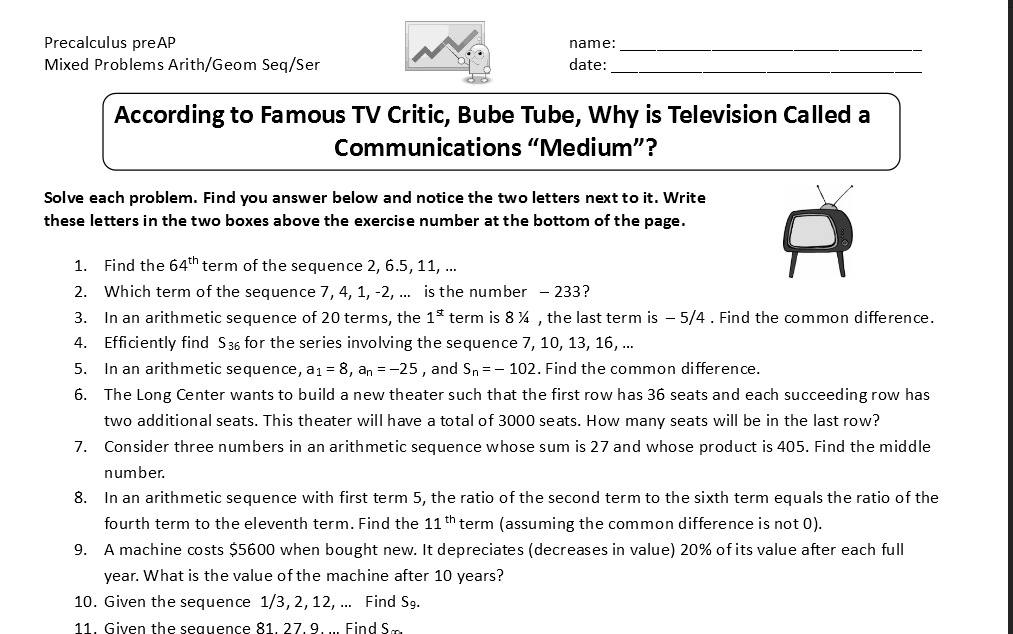
We had time for a mixed review day in Precalculus. ... As I type that, I wonder why it always seems rushed to teach this class. Last year, my colleague and I seemed to speed through things and didn't give things a fair treatment. But the flip side is, what do you leave out? There are too many cool things the students have never seen before and this class always seems like the last high school chance to showcase things. Anyway, I revived this sheet I'd made a long time ago. It has some nice challenging problems (#6 will floor you .... Hah! #clickbait) gathered from a ton of places.


I tried to make sure that the way the questions were asked forced the kids to look for efficient ways to find first terms and sums and such.

 On a "make you feel old" note, they had never heard the term "boob tube" for television. Some students thought the term referred to those tops that were elastic for girls that had no straps. Hah! So I told them to look it up.

Tuesday, March 03, 2015

Calculus Motion and Accumulation Combined

I made up a new worksheet for the students to practice straight line motion problems combined with their accumulation function knowledge for AP Calculus AB.

 I really like problems 7, 8, and 11. It's very interesting that they forget they can find the equation of a line to substitute in for the v(t) function on 7 & 8.

Sunday, March 01, 2015

Half Century

I turned 50 years old a month ago today. Probably like most people who get here, I'm still a little dazed that this number is associated with me.
I'm the young whippersnapper. I'm not the old geezer. My friend jokingly got me this shirt: 


I think it was jokingly. But I'll go with it.

I've also been teaching a long time; this is my 18th year. So in celebration (or reflection) of all this, I am challenging myself to list "50 things I've learned about teaching" ... notes from an old geezer / village elder wannabe.

(in no particular order other than what popped into my brain and when)
 

And also, obviously, these are just things that are "true" because of MY experiences and the schools I have taught in. Mileage may vary for you.

1. Enjoy the students. They're pretty amusing.
 

2. Try to separate the behavior from the kid/adult. I'm still working on this all the time (after I grumble and curse and have a pity party about what's been "done to me").
 

3. It really IS true that they will remember how you made them feel other than what you taught them.
 

4. If a kid is sleeping in my class. It's more effective to say, "___, wake up. I'm sorry you are tired, but I need you to be here." versus
    "$(&*($  ____ you will NOT sleep in my class!!!!" (though sometimes the second one feels better in the short term ... so I act it out in my head)
 

5. Just because they are staring at you while you are talking, it doesn't mean they are processing what you are saying. (I wonder what the % breakdown is ... or maybe I don't want to know.)
 

6. Every day is a fresh start and a fresh chance to do it right. (and to screw up in other ways)
 

7. Keep reflecting on what and how you are doing things. Never settle.
 

8. It's fun to learn new things along with the students. (and I am always "joyful" in my multitude of mistakes I make ....)
 

9. When I show my excitement about a topic, it adds to the lesson.
 

10. Even if I "learn something" about teaching one year ... that doesn't mean I remember it or put it into action consistently.
 

11. Just because other teachers seem to be successful doing things one way, it doesn't mean that EXACT thing will work with my students.
 

12. Even if I think something is obvious as a teaching practice, it doesn't mean it's obvious or even useful to others.
 

13. Share share share and borrow borrow borrow and adapt adapt adapt.
 

14. I teach students not subjects. 

15. I need to keep teaching learning skills along with topics.
 

16. I need to keep acknowledging to the students that learning is hard, and they should be proud of their effort.
 

17. Keep a large binder for each subject. Put copies in sheet protectors. Put the keys in there. Do it chronologically. Make sticky notes about changes for the following year.
 

18. For anything out of the ordinary in my daily schedule, make a google email reminder to help you not forget.
 

19. Humor humor humor is a nice wheel greaser.
 

20. Just because you taught it to them last year AWESOMELY, it doesn't mean they remember it instantly this year. Review, scaffold, and acknowledge that it's human. (and secretly be shocked that they don't know how to do fractions. Still.)
 

21. Teachers of non-math topics are also a source of great material to adapt to math teaching.
 

22. For big projects, I have found more success with having many stepping stone grades to ensure completion.
 

23. For big projects, I make a "contract" that has stepping stone due dates and a place for peer checking first and then my grading.
 

24. Gallery walks are great because the students get to see others' work and they also get to show off their work to more than just me.
 

25. I have been extremely fortunate in the schools I've taught in and the people I have taught with and the kids I interact with.
 

26. Even if something "bad" has happened to me in teaching/life in the past, it's great fodder for "stories" to share with the kids.
 

27. I try to do the big projects along with my students. That keeps me honest in what's involved, and I think I get more buy in from the kids.
 

28. I don't let students talk poorly about other teachers/students in my class. I try to gauge the situation to see if they can constructively resolve things.
 

29. People have to eat and go to the bathroom. I have rules that work for me and don't seem too jail-like, and then mostly everyone is happy.
 

30. Just because students are silent, it doesn't mean they are not participating.
 

31. There needs to be quiet thinking time, and students need to be reminded of it, as in, "okay, to yourself, figure this out, to yourself" .... "silently" ... "alone".
 

32. This has worked for me: "okay, now turn to someone and either give them the deer in the headlights look, or nod your understanding of what I just said". "discuss".
 

33. It's okay not to have lunch with other teachers and to just be in my room doing my thing in the middle of the day without being "on".
 

34. It's really helpful to have things to look forward to during the week. (hello Spanish lessons and breakfasts out each week)
 

35. I need to try out new ideas immediately, or else they usually don't get tried out after a conference.
 

36. For all my answer keys, I highlight the edges on both sides of the paper, so it's easy to find and identify as the key.
 

37. Answer banks are awesome. I mix up their placement, but it gives kids immediate feedback on their work.
 

38. Practice doesn't make perfect. Perfect practice makes perfect. (thank you, basketball coach, math teacher from another school)
 

39. Hurt people hurt people. Kindness rules. 

40. Make eye contact with ALL students as much as possible. It's too easy to only engage with the students that are always the contributors. I don't want anyone to feel invisible. I still need to remind myself of this when I am staring at the back of the room when I'm talking and trying to keep straight what I'm saying.
 

41. I like to exercise in the morning because I know then it will get done. It doesn't hurt that I'm a morning person. Mwa ha ha.
 

42. My clothing choices are fascinating. Apparently. New clothes? New comments!
 

43. I need to have good reasons for what I am teaching and why I am teaching something the way I am.
 

44. "When am I ever going to use this?" responses: you may not use this, but this is how it is important ..... or, you never know what you will do when you grow up, so it's nice to have options.
 

45. You are apparently never too old for stickers.
 

46. Every class has their own personality, and what works great with one may not work with another. (what's WRONG with them?????)
 

47. It takes me about 3 passes through to "perfect" a lesson so that it's actually effective in the way I want.
 

48. People Before Paper. I need to not multitask when a student is talking to me and give them my full attention.
 

49. My attitude affects the class. If I'm cranky and tired (which happens), I let the kids know, hopefully in a joking way, and I try to get over it.
 

50. Sheesh, what a wind bag .... bla bla bla .... okay, LAST ONE ... digging deep .... wise words ... stalling .... Every school has its own challenges, and parts of the grass may actually be greener elsewhere, but other parts are covered in fire ants.

Okay, look for the sequel to this in 10 years .... "60 things I've learned and maybe remember about teaching mixed in with a list of my aches and pains".

Monday, February 16, 2015

Inverse Trig Graphs Take 2

Even with what I thought were great manipulative tools (patty paper to be used to help teach inverse trig graphs), there were students that still did not grasp the overall concept when they had to put it to use. During the times that they came in for corrections on their test, this strategy SEEMED to work. I first had them sketch (say) the sine graph:

 Then I ask them to color in the restriction that will allow the function to have an inverse function (this part they remembered).


 Then we get to the part they couldn't apply successfully, so we broke it down. First I asked them to find (say) 200 degrees on their graph. This seemed a nice challenge for them and it was nice to hear their thought process.

Then I asked them to find sin(200deg) on their graph. Also, enlightening.

 Then I asked them to reason through finding arcsin(sin(200deg)), and I had them talk out their reasoning as to why it was placed where it was.


And finally, we took it to the unit circle, so they could summarize and wrap it up.

I think I may start with this technique the next time through because it shows everything on one page and they can work through the visuals of WHY even through you MAY have an angle in the first quadrant, it still is not valid for an arcsin function because the angle is more than 360 degrees (for example).

Saturday, January 31, 2015

Dear Teenager...

Dear Teenager Cashiering at the Grocery Store,

First of all, congratulations on being responsible and earning some money while you are going to school. Yay you! Second of all, you are doing a pretty good job, mostly. 

But, you are making me sad for the state of things on two counts, okay, three ... probably more, but I will stop at three. First sadness, when you are talking to the other teen that is bagging the groceries while you are "helping" me, I feel like a non-person. I am in the way of your fun chatting event with my pesky food that is sliding along and being summed up and packed. There is enough anonymity and struggles in the world without having to feel invisible during everyday chores.

Second sadness, you are giving the group that is "teens in America" a bad name or a "kids these days!" moniker. I know you're probably pretty awesome since I teach others in your group, and I enjoy them immensely. You on the other hand are not attending to your job properly, and are helping add another item to the secret adult list of "why teens are poos". 

Final sadness, for now, most of you don't know how to make change. Math! Money! Please, please, PLEASE don't look at the register screen to make change on a $16.80 bill when I give you a $20 and a nickel. Maybe my sadness is more for the managers that have (not) trained you than you. You can do it! I know you can! 

Signed, 

Former Teen Grocery Cashier,  Former Movie Theater Cashier, and Current Adult/Teacher 

p.s. Thank you Ms. Dora at AMC all those years ago for teaching me how to make change.
Tuesday, January 20, 2015

Giving Ourselves a Break

Have you ever watched a performance, music / dance / theater / gymnastics , as a non-expert in that area and just been impressed with what was appealing to you whether or not it was "hard"? Then you think about someone with lots of knowledge in that arena watching the same performance, and they are probably having a different experience. They may be thinking, "Wow! Look at that difficult move they just executed! Amazing!". You may have missed the impressiveness of it, but you knew what resonated with you. And the performer has a third version of the events thinking, "ooooh, I hope I pull off that triple-quadruple-back-slide doohicky perfectly!" and you may not even have known to be impressed with the challenge of the doohicky.

I'm thinking it's the same with our kids. We may be all impressed with our various ways of presenting/teaching a topic, but it may be hit or miss whether it works or not with the students. I'm thinking that they mostly only care about knowing that you care and that you have their backs and that if they are struggling with the learning, you will be there for them. They are not sitting back and thinking, "hmmmm, look at that student-centered stunt she just pulled off!" ... or, "wow, that's master teaching skills right there!".

So I'm thinking that, yes, we should strive to do our best with all our teaching skills, but maybe the most important thing that trumps the whizbang lessons is the fact that the kids see you caring about their learning and pausing enough and waiting for them to process and keeping your questioning and explaining processes churning to make sure they know you have a safety net for them in their learning journey.

I guess this is all to say that it's okay if I don't kill myself all the time worrying about presenting a lesson "just right" because as long as I honestly care during the lesson and am tuned in to what and how the students are learning, then I am doing fine.

Sunday, January 11, 2015

Inverse Trig Graphing

Teaching Inverse Trig Functions, Take 10 (??). Okay, patty paper to the rescue*. I'm hoping THIS year, since we are taking time to construct and ask questions and have a physical thing in our hands that we can flip over and analyze that the students will more readily be able to reconstruct their knowledge of inverse trig graphs.

We started by making an envelope for their notebooks.


 Then we SLOWLY with lots of back and forth questioning created this sheet for sine:


We had to refresh our memory on Inverse Functions in general from previous knowledge. Then we flipped the paper over (after we discussed the "x and y switch roles") by keeping our thumb (positive x) and index finger (positive y) attached to the paper:


And we had a discussion on what part we should restrict the domain of the sine graph to to make this inverse function a function. THEN we shaded the right graph part with a sharpie. 

We did the same with the cosine graph the next day. Then because of a discussion with some students AND the fact that even though we stress that ONLY ONE output is possible, they still are confused with a problem such as:

Without a calculator, find  arccos ( cos ( 200 °) ). 

So after the patty paper, I had them explore with this sheet:


 Let's see if THIS is the year the information better sticks to their brain cells.

* Funny note: when we were making the graphs and free-style drawing, a student said, "hey, they should make patty paper lined with a graph/grid". I flipped the patty paper box over and showed her that it really was paper meant to be put between meat patties or some such food.

Monday, January 05, 2015

Clip Art and Thoughts as a Whitey

I periodically like to put clip art on the worksheets I create for my students. I've never thought much about it, I just Google Search for "free clip art _____" where the blank is replaced by my topic of choice. Then I pick the cutest or most appropriate picture. Most times it's an animal or inanimate object, but sometimes the clip art is a person. 

With all the dialog going around about "white privilege" and "what kinds of images do you see" and "what types of people are chosen to be actors in various shows" and "how are people being represented" and "do you ever see a ______ computer scientist", etc., I started to notice my clip art. 

When I scan the images, I look for "girl student" for example, and then pick from some of the choices. I guess either all/most of the images are of "white" cartoons, ..... I just stopped typing and did that search. Out of the first 22 pictures, 1 was a black student. Then I kept counting to 56 - maybe 1 or 2 more non-white kids. Also, no Asian, Hispanic .....

Sheesh. Being a harried, time-strapped teacher, I guess then most frequently I would just go with "white". Lately, (okay, last couple of worksheets), I deliberately kept searching until I found a non-white clip. I then mentioned this to a co-worker, and she asked about "Indian" clip art kids .... Nope, haven't seen them.

Then I started to think, well, if I have ___% of various ethnicities in my class, do I keep a tally of what type of images I project? Am I overthinking? Is this situation just part of the invisible problem that I was not aware of as a whitey? Do my students even notice? Some kids? All kids? Are they desensitized, too, because that's how it's been?

Sunday, January 04, 2015

Two Truths and a Lie

I remember when I taught in NJ years and years ago, we had 41 minute classes and saw every one of our 8 classes every day*. Now that I have block schedule and see only 4 classes a day for 90 minutes each, I marvel at how much we used to get accomplished.

I am thinking back on this because tomorrow when we go back to school, we will have a "C" day, and see all our 8 classes for 45 minutes each. Scandalous! And, as a connoisseur (thank you spell check) of last minute creating, but intermittent (again, thanks) thinking, here is what I will do with my calculus class (link):


Side Note: The year I left NJ, they were planning on having a rotating schedule the following year: 8 classes, but only 6 met each day, something to the tune of:

M - 1,2,3 ... 5,6,7
T - 2,3,4 ...  6,7,8
W - 3,4,1 ... 7,8,5
Th- 4,1,2 ... 8,5,6

Or something to that effect. Yeesh, how do you wrap your mind around that schedule. On the plus side, you would see kids in different situations, so they wouldn't all be sleepy or whatever all the time.

Monday, December 22, 2014

Whew!

Hello vacation. I have a love/hate thing going with time off. 
* Love the 9 hours of sleep each night. 
* Hate not having so many people to interact with. 
* Love being able to read good books. 
* Hate that at the end of a day I sat too much ("worse than smoking" is now a thing). 
* Love that I have time to cook non-frozen things. 
* Hate that the refrigerator is right there. All the time. Waiting. Calling.

Last week of school. There is a student that hangs out in my room before school starts each day (to talk with her other friends who I actually have in class). I was chatting with the kid, and she was groaning, "I shouldn't have come today. It's going to be so boring. We're watching movies all day." It reminds me of a great piece of advice I got from my math supervisor in NJ long ago, "you need to give students a reason to be here. Otherwise, who could blame them for staying home." She mentioned this around vacation times, and it always stuck with me. Even when the kids groan, "what?! you're making us work?" I think they're just yapping and are secretly glad to have something productive to do. That's what I tell myself anyway. 

Goals for break:
* Map out how I'm going to use my SparkFun Redboards in CS and DE. 
* Try acupuncture. Have always been curious, and I saw a discount for teachers.
* Do yoga daily.
* Not sit all day.
* Be a movie matinee glutton.
* Continue drinking my 16 glasses of water a day. (link to what got me)

Sunday, December 14, 2014

Crack Kids....

I was not in my classroom some time two weeks ago, and for whatever reason, I had various kids come up to me that I had to record their names. It was a mix of kids I teach and don't teach. I don't know about you, but in those situations, I panic and for the QUIET kids in my class, those who NEVER speak or never engage me in side conversations or never disrupt class or never cause a ripple and fall through the cracks of my attention, I feel time pressured and blank and either can't remember if they look familiar because I've seen them in the halls or if I actually teach them.

I mean, sure, if they are in my class, and quietly in their seats, and in a context my mind links with their names, GREAT! I remember their names. Otherwise, it's a 50-50 shot.

So I was recording names after looking at their faces, and for the ones I didn't know who were just standing there, I said, "who are you?". Well, of course, this one student got all wide-eyed, and her friend who I also taught looked at me, and there was red egg on my face as I slowly realized who she was. I made a joke about it, "well, you are SO quiet! Your homework is now to talk to me in class."

But then I festered on this situation later. Here is what I did in my classes this past week (when I remembered). If time and lessons allowed, I walked up to the ripple-free student in my class and said, "tell me 3 Laura facts" .... or "tell me a Judy fact". That opened up a short conversation and I actually heard their voices that I would not recognize ... yet.


Thursday, December 11, 2014

Calculus f and f Prime graph information

Surprise! This is a hard topic for my students. I have adjusted some things and through various conversations I've had and pondering I've done, I came up with this activity that I tried today. This is after a couple of days of activity and discussions and problems related to:

If you see THIS on ____ graph, what does it mean about ______ function?

Here's what we did today for a while. I took it problem by problem and then we discussed it and for each problem I had them draw the "eggnog height vs time" graph after they had ruminated for a while. I also then introduced up and down arrows under the curve to represent "magnitude of rate of change".

In one class, we had a heated discussion about whether when you start or stop pouring, if it's an immediate leap to some rate of change or gradual.


Saturday, December 06, 2014

End of the Semester

I'm loving the switch over I've made from doing a paper copy to a GoogleDocs Form of student surveys for my classes. Now all the survey responses are online and easily searchable/readable without having to find the papers and remember them from years past. 

I also have them do this in class after I discuss "constructive criticism" and "helpful comments" and the fact that I have found previous comments very useful and have even changed how I run class because of some comments. I think that if I didn't have them do this in class, many would forget to do the survey, and I wouldn't have enough information.

Here are the questions I ask:


Useful feedback so far. For example, I recently started uploading my flipped class videos a different way, and I wouldn't have known it was not as helpful if it were not for some comments kids made. I also try to keep my videos short, but some comments asked for my creating extra "showing examples" videos that would be optional. I think that is a useful comment.

And because I just copied this form from the year past and changed the name, I have last year's comments to refer back to to refresh my memory. Win. Win.

Monday, November 17, 2014

Sine Graphs and desmos.com

We have finished all of the transformations for sine and cosine graphs, and soon I want to have an application day where they can write models for various data: blood pressure, tides, weather, oscilloscope readings.... but first I assigned them the following homework:

Think of a city in the world, maybe you want to visit, or it's exotic, or it's far away, or it's a place you have never heard of but searched for online. Then find weather data for a 12 month period for your city. We quickly logged onto desmos.com and they got accounts and we practiced making/plotting table data and changing window settings and such. They were to come back with their city weather data entered and saved.

The next class, we practiced on paper with "weird data":

I made them just draw a generic sine graph with no axes or numbers around it. I then prompted them for numbers, and then got (say) the "28" for the top x value and the max (71) and min (-31) y values. I made sure to wait until I heard things I wanted before I committed them to the paper.

Then they had to find the amplitude/vertical shift/horizontal shift/period. We talked it through and then got an equation. We did it again for a cosine graph. 

Then we went on the laptops and they brought up their weather data. I asked them to do what we just did to find an equation that would model their weather data. Most importantly, YES they could guess and check, but it would be WAY better to think things through and come up with an equation first and some justification for the 4 key values as we practiced and then play around.

It made for some interesting conversations about "not normal" data points (I picked Timbuktu, Mali, and the year's data had a cold snap for 4 months that should have been hot) .... and about north of the equator and south of the equator cities (one student's data was warm in January and cold in August) ... and cities that were near the equator (all the temperatures stayed basically the same all year). 

My Prague data worked out better than my Timbuktu data:


Tuesday, November 11, 2014

Hello (mid) November

I have nothing to blog about, so here I go blogging. Isn't that how it works? Is there a point in every year/blog/person where you start to think of something to expand on and then go, eh, been done, not interesting, navel gazing, ....

Some things I've learned so far this year:

* My "if you want help, you need to ask for it" policy was NOT working for all kids. Shocker! In my mind, I was all, "You're 11th and 12th graders! Ask for help!" But in reality, for whatever reason (apparently, I'm scary??), there were kids that were just fine with sitting there in class or after school and being stuck but not asking for assistance. When I finally picked the brains of some kids, I got various responses: well, I don't know how to phrase the question specifically .... well, you were busy .... well, I feel you judge me .... etc. This has caused me to reevaluate how I run class. Now I purposely stop at each table and kid and ask how it's going. It seems that if I'm the initiator, then I get more responses.

* For precalculus, I have a 100% or 0% quiz I give to the students so they learn the values of sine/cosine/tangent of special angles in the 1st 2 quadrants. They initially have 2 minutes and 10 questions, and if they get any wrong it's 0%. They can take the quiz as many times as they want in a grading period. Usually, this is enough of a motivator for my groups of kids to study. This year, not so much. I had the idea of having MANDATORY 15 minute conferences with me about 2 weeks into the grading period. I made a sign up sheet that basically said: morning, lunch, after school with 3 name slots for each and told the kids they HAD to come in at some point in their time frame. I loved it. This allowed me to talk to kids that would NEVER come in for help. I could see how they were tackling the problems and give tips on speed and patterns and strategies. Of course some kids were already fine, so I could just validate their awesomeness in this arena and move on. I'm thinking of having such a mandatory conference for all my classes (on what?) and all my kids at some point in the year. Am I the only one that hasn't ever done this? Some things I like about it are that I talk to kids I may never talk to in class. I also get to see their thinking and pick their brains one on one on how they are doing. I also get reminded that they are humans and not math-receiving vessels.

* In AP Calculus AB, the learning opportunities NEVER stop. I hear my kids learning AFTER an exam when I make them come in to do corrections one on one. I see them learning when they go through my detailed answer key where I give them extra tips on how to do things and what to watch out for. I sense them learning when they are helping each other through hard problems. Yay math.

* Humans are prone to be happy AFTER something is over and they realize it was not so bad after all. I saw some kids that were in calculus last year, and they are unsettled with the math they are learning this year. They said they "missed calculus" and they were surprised. Hah. I take this more as, now that calculus is over and they saw they were successful, they want that comfort level again because they know how it turns out. Now they are in a new situation with a new teacher and it's an unknown, which everyone knows equals SCARY. I'm guessing next year, they'll be all, "oh, I miss last year's math class!".

* I'm turning 50 this school year. Oy! So that's occupying a large space in my mind. I've decided to make this a year of "trying new things". So far that has entailed going out to eat at DIFFERENT restaurants, ordering a DIFFERENT smoothie than usual, cutting all my hair off into a short cut not seen since 1985, .... that's it so far: food and hair. Go me. 

Okay, maybe I did have some things to blather on and on about.

Thursday, October 23, 2014

Fraction Remix...

I had about 20 minutes after a test today, and RIGHT before the test, a high school student in precalculus was confused about how to divide 2 fractions, and she couldn't remember the method: "do you multiply the top and bottom?" were words that came out of her mouth.

So. I thought I'd give the following short lesson on why the "flip and multiply" that they seem to spout works.

First I asked them the following questions:

Simplify:   (7/3) / (4/5)

Then after they did that and checked, I asked them to discuss WHY it worked, and "my teacher said so" or some such thing wasn't an option.

Then we walked through the following 4 scenarios:

 So to recap, it basically boils down to seeing how many groups of the denominator fit into 1 unit (that's where the "flip" comes from), and then how many 1's fit into the numerator, and then you combine the 2 numbers and MATH.
 

Saturday, October 18, 2014

Boring Ceiling. Fixed That For You.


Something needed to change. I could no longer stand the travesty that was my ceiling. How could we spend day in and day out under such a boring mess? How was learning taking place? How did we all not just fall asleep under the endless white scandal that was looming over our heads?

After searching the internet for ideas and finding an art teacher that had her kids paint black and white designs ON the tiles and realizing I didn't want to go THAT far, I came up with:

 I am happy with the results. I still need more, as not all kids chose the opportunity. And as a side note ... for all the questions I get about bonus points, you'd think I'd be drowning under a pile of drawings, but, nope. Nada. I am not one for bonus points, and this was a rare instance, but, hah, go figure.


Thursday, October 16, 2014

Intermediate Value Theorem

I have never liked my unit as a whole for the Intermediate Value Theorem in Calculus. My explanations, I like, my homework and the time the kids spend thinking about it and then quickly forgetting it, I don't like.

Attempt this year:

 I like this first page because the kids have to stop and process the whole IVTh and think about the parts and then analyze the parts and see what goes wrong. I heard some good discussion.

I like this second page because for 5 and 6 they then have to start the thinking process graphically on how to apply the IVTh. Then problems 7-9 are what I just used to do by themselves. Hopefully, this year after they've processed things, then 7-9 should go better. We will see.

In other news, apparently I make kids feel dumb - based on a conversation I had with a parent. Oy! They interpret how I talk to them as just expecting them to know things already. Of course it's an obvious logical conclusion on my part that "one kid" implies THE WHOLE CLASS. Go me! Because of this, I made the following handout, and we had a discussion, and I asked them to tape this in their notebooks (or staple it to their hearts) to remember:


Monday, October 06, 2014

Trig Identity Match Up Activity

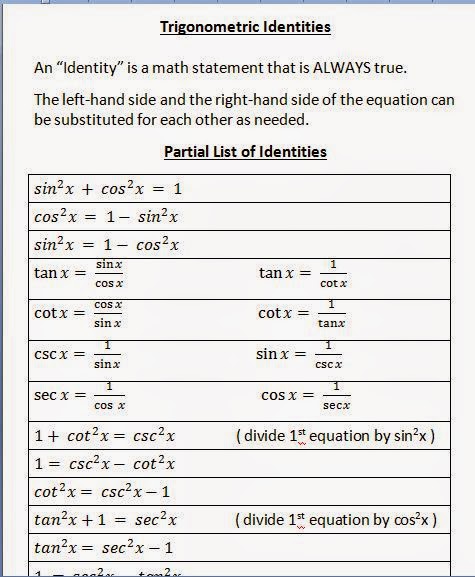
I'm on my quest to try different things for the Trigonometric Identities unit. They explored last class, and today I wanted to get them started on simplifying various trig expressions using identities. Here's what I did. I made this set of 2 sheets for every student, put it on colored paper, and then made them cut them up (my first class) when they started.

They're mixed up on the sheets, and there are FOUR total problems that start with the "squiggly" boxes, but I didn't tell them that first. I said they should look for 2 cards that pair up in such a way that they are ONE step away from each other either by an algebra law or by an identity. I did one example with them and took questions. Then they were on their way.
Since they sit at tables, and I didn't want to do different colors of sheets of paper (though I guess I could have), I had them draw dots in different colored pens (one per set) at the bottom right corner of their cards to avoid mix up.

Once they got as many pairs as they could, and I mentioned that depending on a variety of things they may not get pairs. Then I said they could try to find a "triple" pair for their remaining lone cards. After some time for this, then I asked if they can "pair up" the pairs to get a set of four .... Ultimately, I then said, or they noticed the "squiggle" cards, and we got to the point that there are FOUR separate problems, that each start with a squiggle card, so see if you can set up 4 different strings of "one steppers".

During all this they had their "notes" on pink paper that they were going to eventually tape in their notebooks.


This all took about an hour or so to give them think time, and not everyone was successful with all of them, but we came together as a class and talked it out and got the 4 sets of problems, and celebrated any successes they had. Some problems had 7 steps, some 6, some 4. Then students taped the notes in their books, and we copied down 2 of the problems into their notes with "reasons". Hopefully, this will aid in their homework tonight where they have to do a string of one steps for each problem.

Friday, October 03, 2014

Trig Identities

We have started our unit on Trigonometric Identities in precalculus. Every year is going to be THE YEAR where it all comes together nicely, and the sun comes out and the birdies chirp and the kids embrace their Identities. Yes. It will happen. Chirp. Chirp.

I took some extra time at the start of the unit this year for them to explore instead of me walking them through things and them nodding their heads pretending to understand.


This took most of a block period (2 pages), and it was a nice refresher of a few things: 
* proof rules from geometry
* fraction rules for adding/dividing
* exponent rules

Hopefully, the extra time we spent will be worth it in the end as we skip and hop through solving/simplifying various equations/expressions involving trig.