Oy! I'll be semi-happier after the April 25 week when our math TAKS tests are over. For the last forever amount of weeks, I've been tutoring 3 sets of kids, once a week, during advisory, strictly for this test. And last Friday some words came out of my mouth to my group of tutees that now have me thinking.
I didn't want them to think they were just in there because we thought they'd have a high chance of failing. That's definitely not the case. And, I guess I'm a product of the "feel good about yourself" school of growing up .... though from what-all I'm reading, I have to think about how I offer THOSE words of praise. So after we went over some material, I said something to the effect of, "okay! we're going for commended!" and I went on with going over problems.
Well, a 10th grader in that group came up to me afterward. She's a diligent, hard-working, come-in-for-tutoring if she thinks she needs it kind of math student. It does not come easily to her at ALL, and I had her last year for algebra and this year for geometry, and I've seen a great improvement in her algebra skills this year after her having time to absorb it.
Anyway, she came up to me and said, I'm really discouraged about this math TAKS. I haven't been commended on the math portion since the 5th grade. She's passed every year, but here we are, a higher performing school, and the message we're encouraged to give is, "don't just PASS, go for commended!". So not getting commended is apparently the new failing for these students. Crap! It didn't occur to me until that moment how students may feel every year when, yes, they may pass, but, oh no, I've let down my teachers by not being commended.
I don't know how successfully, but I told her that one of the main reasons we've been saying that (in my opinion) is to get the kids to try and do their best, and I already see she puts out her effort on every question she goes through, and that's the type of diligence that's going to get her far in the world, not the "oh yay! I passed and got commended on a state test." ... It's even telling that she's stressing about the 10th grade TAKS, and it's not really as high stakes for the kids as the exit level in 11th grade.
Regardless, here's another bad side effect of these tests and what we may seem like we expect from the kids all in the name of some outside random measure of "are we doing our jobs as teachers" test.
Sunday, March 27, 2011

Tuesday, March 22, 2011
Trig and Teaching and Knocking
TEACHING:
Lately I've been noticing in various forms of teaching or discussions about teaching, sometimes the "speaker/blogger/writer", either intentionally or not, conveys the message that, "if you don't do things THIS way, you're doing it wrong!" ... or ... "why in the WORLD would you even CONSIDER teaching so-and-so THAT way, you hack!". Or maybe it's just how I'm reading into things.
I think for the most part we're all trying to do the best job we can, and obviously there's no magic bullet that's going to work for all topics and all days and all teachers all of the time. We (and by "we" I obviously mean "me" because that's obviously who it's all about) should just stop beating ourselves up when someone speaks/writes/communicates how they do something, and it sounds so perfect and rosy, and my (our?) first thought is, "sheesh, THAT person has it all figured out. What's wrong with me?". Okay, my self-pep talk is over.
KNOCKING:
Anti-Joke of the moment I love:
Knock, Knock.
Who's there?
To.
To Who?
To "Whom".
TRIGONOMETRY:
As with all things we do the 1st time through (or maybe it's just me), there are kinks to be worked out with the activity I wrote about last time. The last 2 days I took my students to the computer lab, and they self-taught basic trigonometry ratios with my GeoGebra file and the 4 page packet. I realize I'm fortunate to (this year) have frequent access to a computer lab.
I know that that was one of the BIG reasons before that I didn't like Geometer's Sketchpad or even bother to learn GeoGebra. Once the kids grasped it on the one time a semester I actually got to go to the lab, then they forgot it all the next semester when we could go back, so basically what was the point. I guess that's why I'm liking this GeoGebra, because if a student has computer access at home (and I know that's not always the case), at least this is an extra resource for absorbing things. Anyway, choir .... preaching .... bla bla bla
I would do the activity again next year, but here are some things that happened and how I'd revamp. I teach a 1.5 hour class, and after we went over homework and did another small activity, we had about an hour for this activity ... WAY too little time for them to be set on their own and finish up.
The first thing I changed was I had them cross out 2 of the cases for each of the 6 tables. So they were only checking sin/cos/tan twice for each acute angle. Next year, I think I'd change it even more: check just once total and then check what a neighbor or 2 got and notice.
I also would take out the ratio of sides on my GeoGebra activity. Invariably, once a kid had to fill in column 2, they didn't read very carefully, and just used my #s above, even though they may not be the correct ratio of sides ... but HEY, all the letters started to blend together.
Other than that, with periodic "giddyup-ing" by me in the form of "you have 30 more seconds to finish up to ______". "Okay, the main point of that was _______. Now do the next section." ..... I think it went well ... Especially, since I seem to have lost my voice YET again this year. Chronic sick-fest.
Sunday, March 20, 2011
Learning Trigonometry
Now I'm almost ready to start my trigonometry unit. Here is the 4-page self-teaching packet I'll hand my students tomorrow, along with a graphing calculator and an e-mail message that has all the links they need. My goals for them are to be able to: identify opposite and adjacent sides of an angle in a right triangle, find the sine, cosine, and tangent ratios of a triangle given the 3 side lengths, and link these skills to the special triangles they just "learned". Once I make up a homework sheet (or use the textbook), I'm good to go.


Also, on a cheery, vacationy note, here are some Marfa and Fort Davis, Texas pictures from our short Spring Break trip.


Also, on a cheery, vacationy note, here are some Marfa and Fort Davis, Texas pictures from our short Spring Break trip.


Saturday, March 19, 2011
Quiz Anyone?
I'm writing up my worksheet to go along with my geogebra "baby trigonometry" applet, and I found I needed/wanted a quiz for them to take online. I couldn't find any with the right number of questions or types of questions, so I made one up. We'll see Monday if it's a success or a stinker.
Wednesday, March 16, 2011
SO excited about Geogebra
A nice person commented from my last post and showed me some applets she'd made for Geogebra (thank you Lsquared). This must have planted a seed in my mind, because today I was tinkering around with how to start up my trigonometry unit. I went to the Geogebra site. I clicked "download". Then I clicked "Applet Start". I figured my kids don't have downloading capabilities on the school computers, so this would be fine.
I tinkered around with things and came up with this activity. I'm going to make a worksheet that goes with it to guide them through a self teaching, first day of trig, what is sine/cosine/tangent activity. I think some of the questions may even be of the effect of, "set your triangles, set up your calculator just so, press cos ____ (degree shown), compare it to ratio."
I would love feedback on this "non applet". Effective? Hard to manage? Fine?
Note: I tested out opening the file on another computer. It "failed" with Firefox, but worked fine with Explorer. I DID have to change the window size to 200% or something like that. But there is a way to show WHOLE picture.
Anyway! Off to write the worksheet. I'll share. Okay, really off to dinner then Lindy Hop, then Marfa, THEN to write the worksheet.
Tuesday, March 15, 2011
Spring Break
Phew! I can't tell you what a consistent 9 hours of sleep each night can do for a person ... or maybe I can. I feel great! Here are some pressing activities on my plate:
1. Watch cheesy bad movies on Netflix streaming (Blackbelt Jones, Cherry 2000, ....)
2. Read book(s) (Saving Fish from Drowning)
3. Catch up on grading (test corrections)
4. Sign up for the Digital Electronics STI workshop for PLTW (soooooo excited)
5. Prep myself for the Cardboard Chair Project for my engineering class (design, test, create a cheap durable cardboard chair for a dorm room ... cool "hook" video)
6. Prep myself for my PBL unit (project based learning) of trigonometry
7. Take a blanket out to local parks and laze around and soak up sun and outdoors
8. Go to Marfa, TX (Thursday)
9. Do my "train" project on Inventor for IED (I'm doing the homework with my students this year ... keeps me honest)
10. Puzzles, puzzles, puzzles (hiyawake puzzles my new favorite)
11. Get ready for the PLTW certification visit on 4/1/11 (eek! hope that's not portentous)
12. Sleep more than 7 hours a night (or did I mention that already?)
13. Get my IED students to write thank you e-mails for a recent speaker/friend that came to visit and talk about his engineering experiences. (It was useful to send my students THIS e-mail as a primer):
Hey! Let's be green (and timely since it's Spring Break). Here is your EXTRA homework to turn in to me NEXT Monday 3/14/11 .... and by that I mean 3 days from now .... OVER spring break.
Please send me an e-mail, either with an attachment of a thank you card for Mr. H., or your thank you words inside the e-mail message.
I will then gather them all up together in one e-mail and send them along to him.
Thank YOU for saying more than just "thank you for coming to speak to us". Maybe indicate what you liked or found interesting or learned or whatever.
Example, here's my "thank you" to YOU, my IED students:
Dear IED students of 2010-2011,
I love teaching you because you're so creative and make me think of new things and ways to teach you. I also love that you're excited about the various things we do and learn. I look forward to your questions because they make me think through the why's and how's of various concepts.
Signed,
Ms. ______
I look forward to your thank yous for Mr. H.
Ms. _____
(I've gotten 6 out of 12 back so far)
Anyway .... must go exercise with my other latest craze (as of 4 weeks).
Saturday, March 12, 2011
Special Quadrilaterals
We finished studying special quadrilaterals a while ago, took a test, and now the kids are trickling in for their retests. Ew. Something didn't stick or even get through to some students, and I'm trying to process how to improve it for next year.
Here is how I taught it:
parallelograms: I had 4 already printed on a paper, and they were to use their rulers and protractors to measure various things to discover the facts about the angles and diagonals.
squares/rhombi/rectangles: I had them neatly draw one each in their grid notebooks (I gave the instructions on where to put the vertices). Then I had them again use their protractors and rulers to measure various things and fill out a chart as to which had which properties (diagonals congruent, diagonals perpendicular, diagonals bisecting opposite angles).
trapezoid/kite: I had a sheet with some drawn we worked through the logic of things to get to their properties.
All this went in their notes. They had review problems. At no time did I have them (and apparently they didn't think they needed to) gather all the information into one place (foldable? 1/2 page) to have a quick summary. (I will change this for next year).
Okay, then test time. The usual suspects did well, but too many kids had no idea about things they should have. For example, when a student was coming in for a retest, and I asked her about what a rhombus was, she was silent. Oy! Now I know this particular student coasts by and can look like she's playing school, but .... Regardless, I want them to learn despite themselves.
I think something happened at another tutoring session that will make me either add a day to my lessons, or replace the previous lessons with this. I'm leaning towards add to the lesson.
Another student was studying rhombuses, so that she could take the retest, and she still wasn't understanding or processing things she should know. She couldn't even draw a vaguely accurate rhombus. I took a piece of colored construction paper, and pretty quickly used a ruler to cut it into a rhombus (it turned out to be approximately 8.5" per side). I liked that it was big enough to see things on and to write on and play with. Then I had her folding it to make the diagonals. Then we stared at it. It was clear the diagonals were perpendicular. It was clear that they were bisected. It was clear which angles were congruent (you could match them up and check). It was clear that the diagonals bisected the angles (again you could fold and check).
Then as she was trying to redo a test problem, I had her write the given information on the rhombus, and then figure out the rest. ... I don't know if this will stick. I guess we'll see when she actually does a retest, but maybe the extra visual and tactile properties of the shape will be clearer in her mind.
Tuesday, March 08, 2011
Pythagorean Theorem Video
Today we started reviewing radicals, and talking about Pythagorean Theorem. I know they've seen it before, but they still need help on the harder problems. I found this cool, short video that I showed a few times in a row until they understood it. It was a fun discussion on what he was trying to do.
Then we built up their skills with individual problems of varying difficulties:
(the terms listed are "a", "b", and "c" for a right triangle with hypotenuse "c"):
FIND x
1. x, 4, 10
2. 3, 9, x
3. 2*sqrt(3), x, 4
4. x, 3, sqrt(17)
5. x, 3x, 20
6. some sort of trapezoid with 90 degree angles on one side.
Anyway, I just wanted to post about the water video. Done. Dinner.
Friday, March 04, 2011
Room Fustiness
Phew! Stinky Room Alert! I don't know what it is .... well, maybe I do, but the last few weeks while I'm teaching in my room for hours on end, I don't notice anything. But step out of the room for a few minutes and walk back in after a gaggle of teenagers have been in there, and Stink City.
It's not that way in the morning when I first get to work. It's not that way right before 1st period. But after I teach a class or two and leave the room and come back. Ew. Not HORRIBLE horrible, but noticeably smelly/musty.
So my question is, is it just my particular group of teens? They don't really smell strongly, but I guess get enough of them together and have them in there for an hour and a half and watch out. I don't like the fake smell of room deodorizers. I can't open my windows. I have one plant in there (which sometimes causes its own problems with teeny bugs that flutter around and like to hover around the vacuum of your nose only to be accidentally sucked in and EWWWW). Do we think more plants would help? Certain plants? Has anyone successfully overcome this TRAGIC situation?
Signed,
Singed Nosed Sufferer
Wednesday, March 02, 2011
Algebra/Basics Review in Geometry
I'm basically teaching two levels of geometry this year even though we call them both "preAP". I have the 8th and 9th graders in one class, and for the most part they whiz through everything and delight in the challenging problems. I'm also teaching 10th graders that are in other sections, and they approach math in a different way. I have to keep reminding myself not to rush rush rush through topics and to keep remembering that they need more practice on everything to make it stick and to make it make sense.
I am doing one thing, though, to help them keep their algebra skills fresh: ALGEBRA :). For example, for the last few topics, I made sure to make up geometry problems that ended up having a factorable quadratic equation in it at some point. This led us to recall FOILing and ("claw"ing .... Thanks, Mrs. H) and factoring. Now I'm making sure to include quadratics that CAN'T be factored (hello quadratic formula review).
BUT. Here are some things that I didn't think would come up, but did/do, and REALLY I should make a mental (or better) note to myself of where things can go askew, so that I can make more problems throughout the year to have such examples, so that we can have a discussion about them and keep them fresh in our minds.
Example 1:
A student is solving: 2x + 4 = (1/2)x + 8, for example.
Hmmmm, I don't like that (1/2)x,
so I'll just remember that I can do the opposite to x to undo it,
and I multiply ONLY the 2x and the (1/2)x by 2 to end up with:
4x + 4 = x + 8. Eeeeek.
Example 2:
A student gets to a point in an equation where they have (13/2)x = 14. Well, heaven forbid we keep things in fractions and go the easier route of multiplying both sides by 2/13 to get x = 28/13. Boom. Done.
No.
We convert to 6.5x = 14.
We stress that 14 is not easily divided by 6.5.
We chug through and do long division and create pain and suffering for ourselves.
We curse the teacher for such a hard problem and no calculator.
Example 3:
Teacher takes the expedient route frequently and makes up problems where the answers are integers. This saves time, she thinks, so that they're not struggling with messy things and they're concentrating on new material.
Students freak out the first instance an answer is not integer.
Gasp! I must have done something wrong. Things ALWAYS work out nice and pretty in "math world". Fractions are not REAL numbers, no matter WHAT my teacher says. Oh, and by the way, "your answer key says 3/2. Is it okay if I write it as 1.5? As 1 1/2?"
Example 4:
A problem comes up where you're asked to find the height of a person. The decimal answer is 4.666666666 feet. You think this either means 4' 6" or 4' 7" (if you round). You DON'T think that 2/3 of a foot is not either of these answers.
Sunday, February 27, 2011
Inspired by the TI-nspire.....
I was SO ready not to "drink the kool-aid" of the fancy what-sa-ma-gadgets that were newer than the TI-84s. I was feverishly searching for talks at the T^3 conference that were not TI-nspire or "navigator" based. I was looking for good calculator activities that would supplement my teaching and help the kids absorb and understand more about the math they were learning. Well, you see where this is going, right? Sip, sip, gulp, wipe the red-dye #5 off my chin.
The first 2 talks I went to were baby/basic/"the on button is here" types of talks about the TI-nspire and the Navigator. Boom, that's all it took. I was hooked. For those of you like me (or maybe I'm the only one left that doesn't know much about these things), here are some basic functions and reasons I'm sold.
TI-nspire:
1. There are a ton of resources (example) for most (all?) math levels that include teacher notes, student worksheets, programs for your calculator, etc.
2. The students get to explore a topic by playing around with slopes or points or triangles or such.
3. If a student is taking the AP Calculus exam, they can "create new pages" for work for (say) each problem, and then save and refer back to the work as needed (it stays on the page).
4. One of the teacher presenters there mentioned that she has kids referring back to an exploration weeks after they had done it, and it still stuck in their head.
5. The key strokes and such are intuitive (I got the hang of it after 1-2 sessions).
6. Example lessons we worked with: someone had created a program that guided us/students through discovering how slope works. On the calculator was a line with 2 points highlighted and their coordinates showing. The "right triangle" rise over run dotted lines were showing. Above the graph the slope was showing. The kids could grab a point and move it and see what happened to the slope. ..... You know, stuff you probably do anyway, but with maybe a worksheet(s) with them walking through your problems. Now it can all be condensed on the screen and you can be green (ar ar ar). The kids are also asked various questions about the situation. I'm sure you can make up your own questions, but I like the fact that the program is readily available to download to all the kids' calculators. There was also a calculus example where the tangent to the slope was shown that you could move around and see what the instantaneous rate of change was.
7. There are options for calculator pages, graph pages (which talk in f(x) notation), spreadsheet capabilities, scatterplots, .....
8. There is math type availability .... I'm guessing somehow you could also do things on your calculator and then screen capture and cut/paste to tests (??)
9. Cabri is basically on the calculator and easier to play around with (bigger screen) AND the activities and programs prewritten make it more accessible and easier to use daily (rather than find a time when a computer lab is open to take your kids to use Geometer's Sketchpad .... which they've forgotten since it's been a month or 2 since they last saw it).
Navigator:
This is the presenter option where you can see what all is going on in your class. You can make a kid's calculator the "presenter", and they could be doing the key strokes while you're talking.
Anyway, glad I went. I actually bought a TI-nspire and have been playing around with it. I want to download some programs to see further just what's available .... and maybe write a grant to get some class sets for next year.
Saturday, February 19, 2011
A Good Week
I just found out I passed the Computer Science 8-12 teaching certificate test, so that was a great capper to the week. I'm not sure if we'll offer it next year due to a variety of reasons (budget cuts, small school, only put on the upper class-kid's choice sheets, so low enrollment,...), but maybe in the future we can offer it.
Also, we had professional development yesterday, and I went to 4 different math sessions that had good things to offer:
1. Found out the T^3 conference is in San Antonio next weekend. I've never been but am thinking of going. The PD presenter also mentioned some potentially good websites:
mathbits.com
mathplayground.com
education.ti.com/calculators/timath/
She also mentioned that there's this new feature on the calculators (don't know what operating system) where you can push 3 buttons at a time, and it disables the apps and such .... think TAKS test. It seems like an easier way than clearing ALL the memory and apps and then having to reload them. And then to get it back, you somehow link to another calculator and do something basic (forget what). It's called PRESS TO TEST, and you can probably google it and your calculator type to find out more.
2. The "Web 2.0 tools" talk showed some great websites as resources:
mathvm.pbworks.com
this is a "warehouse" of math related sites and on the far right of the table there are videos that explain their usage/power.
3. I went to a "using stations in high schools" talk that just may get me out of my "rut" of doing things the same way all the time.
4. I went to a foldables talk and got some more ideas.
Now off to grade some IED projects to enter for the 6 weeks grades.
Saturday, February 12, 2011
RollerCoaster Week
Ugh! This was the LONGEST week ever: I was cranky, the kids are overwhelmed, I was getting over a cold and coughing "wetly" all week, we started TAKS tutoring during our advisory periods, I had to pick up a cell phone from a stealth texter, we had two meetings that took up morning planning time, and on and on and on.
Then the capper was on Thursday after school when I had students staying for tutoring and retesting of math concepts. I was going along on my merry way, and one of the girls decided to "share" with me, "you know, Ms. ____, in class, we're not laughing WITH you; we're laughing AT you."
Thanks. That basically put the final sour grapes on my week. She was smiling the whole time. She's also the girl that when I'd lost my voice a few weeks ago and was rallying on teaching in a harsh whisper ALL week, said one day, "oh! Ms. ____. Your voice!". Thinking she was commiserating with me, I said/rasped, "I know. It doesn't hurt, though." Then she said, with a pained expression and her hands over her ears, "no. I mean my ears. You're hurting my ears." ....
Anyway. So I went into work on Friday in a miserable mood, grumbling and muttering to myself about the ungrateful little tykes, and I open up this e-mail from a former student:
Hello
You have been on my mind. How have you been? I'm at _____ doing my clinicals. I'm level 1 nursing. You would be so proud. thank you I owe you so much you are a wonderful person.
That turned things around 540 degrees! Here was a student that had gotten pregnant her junior year, and somehow figured out a way to graduate and move on with her life and now is a successful nursing student. Love her! And SO appreciate her taking the time to basically make my week end on a great note.
Sunday, February 06, 2011
Time For Parallelogram Review...
Well, we had a snow day on Friday, and I got sick, and I like puzzles, and I was trapped at home, and on Monday we're having a "C" day with shortened classes to make up for our lost day and so we don't go off our predestined ABABABABABAB schedule for the rest of the year, so......
This is what I'm having them work on and review so far in our special quadrilaterals unit:

I've checked it a few times, and I THINK I've worked out the bugs, but I guess I'll see how it goes tomorrow. I tried to mix in some algebra review of quadratics and such in there. Hopefully, it'll be a good mix of easy/medium/hard problems.
Wednesday, February 02, 2011
What's enough for a parallelogram to appear?
Whew! We've graduated PAST triangles to quadrilaterals in geometry, and now we're cruising. The first day I showed some Internet clips/pics about scissor lifts and pantographs and wood routers that are made like pantographs and such to show parallelograms in "the real world". Then we explored by measuring and conjecturing about the 5 (6) properties of parallelograms. The 2nd day I started with this sheet:


I had a brief discussion with them about what could you "get away with" and magically GET a parallelogram for free if you were creating an object that needed to be a parallelogram. It may be more costly or time consuming to force 2 pairs of parallel opposite sides instead of some other properties that might save you some time or money. Then they discussed with whatever tools they wanted, and then we converged as a class. I made sure to either have them draw a picture at the end as a counter example to the shape being FORCED to being a parallelogram, or we did a "flow proof" to show some were forced.
Today was a crazy day. It started out as 17 degrees F in the morning and up to the 20's during the day, and our city/state had rolling brown outs to be able to handle the load of everyone trying to stay warm I guess. Anyway, at school we were in a ratio of 45:15 off:on electricity practically all day. Sheesh! Thank goodness we have TONS of windows. But BOOOO on the lack of microwaves and coffee pots for the essentials: lunch and caffeine!

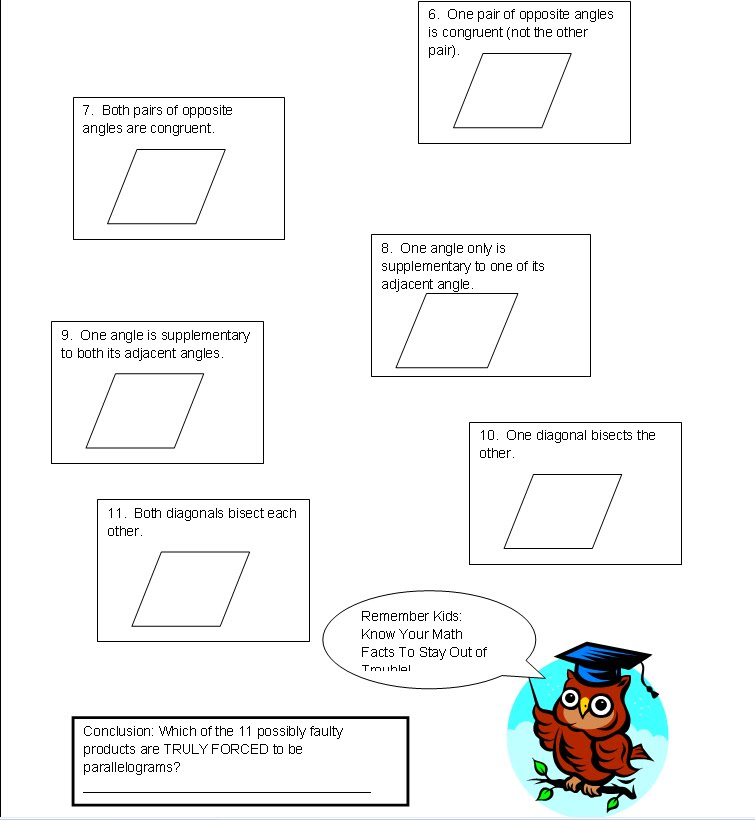
I had a brief discussion with them about what could you "get away with" and magically GET a parallelogram for free if you were creating an object that needed to be a parallelogram. It may be more costly or time consuming to force 2 pairs of parallel opposite sides instead of some other properties that might save you some time or money. Then they discussed with whatever tools they wanted, and then we converged as a class. I made sure to either have them draw a picture at the end as a counter example to the shape being FORCED to being a parallelogram, or we did a "flow proof" to show some were forced.
Today was a crazy day. It started out as 17 degrees F in the morning and up to the 20's during the day, and our city/state had rolling brown outs to be able to handle the load of everyone trying to stay warm I guess. Anyway, at school we were in a ratio of 45:15 off:on electricity practically all day. Sheesh! Thank goodness we have TONS of windows. But BOOOO on the lack of microwaves and coffee pots for the essentials: lunch and caffeine!
Tuesday, February 01, 2011
Teaching The Sine Graph
I still get requests for the file I used to teach the sine graph WAY back when in the days I taught precalculus (side note: I'll be teaching it again at my new school next year). This is an idea (I forgot where I heard/saw it from) that I wrote up. It involves string, spaghetti, and the worksheet. The kids use the string to wrap around a circle to mark off random angles/marks on the circle. They transfer this to the "linear" xy plane. Then at these angles, they measure the y value on the circle with the spaghetti and transfer that height over to the linear graph. Kids should have prior knowledge of radians, calculator/triangle practice with calculating sine (I forget what else....). Here's the file.
Sunday, January 30, 2011
Coolest Foldable Yet
This year we hired a new chemistry teacher, and she is now OFFICIALLY my "creative genius" idol. Every time I have been in her room, she has all these inventive ideas of things she's done with the kids to get them to learn. The latest is this foldable I saw her kids doing, and I just knew I had to do it soon. We're on the "special quadrilaterals" unit, and I'm going to do something with this.
Anyway, here is the general idea:
1. Fold a paper (longest side) into quarters.
2. Cut any size slits down the center two folds.
3. Cut 2 other papers so that they're just a sliver shy of 1/4 of page.
4. Weave them through the 1st paper as shown.
The beauty is that you get a SECRET extra "side" by prying open the middles. Notice the numbering on the pink strips. You eventually get "12" parts with how I cut it.


Wednesday, January 26, 2011
A Challenge for my Geometry preAP Kiddies...
In an effort to provide a challenge worthy of the students who always get EVERYTHING, I put the following problem on their last review packet with the intention that not everyone would get it, but that it would give the super smarties something to chew on.
Consider line AB that goes through an x-intercept of -8 and a y-intercept of 3. This line goes through the altitude in triangle DEF from vertex D. Find D, E, and F, and convince me that your points satisfy these conditions.
I gave my students the key to every other problem in the packet, so they could study for their test, but not this one. I was gone to a workshop while they took their test, and today when I came back, I had some students present their answers. No one got it (yet), but it provided some great conversation about what they did and how we knew it didn't work.
I was interested to see that some students just used a slope approach, and tried to find D, E, and F using slopes of things they knew. Mixed success. Some students forgot how to find points on a line, so we had a bit of review. I still didn't tell them the way (a way) to solve this, and mentioned that somehow, before the end of the 6 weeks, they have to each convince me that they can do it (for a grade). It's interesting having students come up to the document camera and present. We get to have a conversation on how to do so and how to talk to an audience. I also get to pick their brains about their understanding and also poll the class about their understanding (even though they're not the ones in front). ... We'll see what they come up with next.
Tuesday, January 25, 2011
Can You Say Busy?
Whew! Coming up for air temporarily ... won't go into all the details because I'm sure everyone else either is or has been in the same place. I just got back from a PLTW training in Dallas that was awesome, and I learned so much.
One great side note about this is how one teacher handled students working in groups. You know how there's always "group issues": someone slacks or someone bosses everyone else around or friends always want to work together or whatever. Here are some tips from one teacher:
* During the year on his various group projects, the rule he mentions to the kids at the start of the year and as a reminder throughout the year is that you can never work in a group with the same person twice.
* He hands out a team management sheet that the kids have to maintain (online?) it has columns for task that needs to be done, who's responsible, target due date, completion date, comments. If the "responsible" person doesn't do their job, his/her name is scratched out and the "doer's" name is put there. That way there's a record of what/who.
* The teacher mentions that he should be cc'ed on all e-mails, so this way he can address various issues and kids as the project gets done as opposed to hearing at the end that so and so didn't pull their weight or so and so overwhelmed everyone else.
I liked his approach, and I'll try it next time, and institute it more next year. There was also this PHENOMENAL "cardboard chair" project for IED he mentioned. The kids actually go through this 9 week project and all aspects of polling people, making mock ups, doing the statistical analysis of body measurements, etc. to build this functional chair out of cardboard that should hold up to 200 lbs and weigh no more than 16 lbs. COOL! Hopefully, I'll get my act together this year to try it out.
There was also some great information on how to make short "desk top" videos to provide instruction for your kids (don't have my notes with me). That way, for the things you say 2000 times, or for the kids that are absent or for the kids that have to hear things again, you/they have this resource.
Monday, January 17, 2011
Ocean Beach
I went on a solo vacation this MLK 3-day weekend holiday to Ocean Beach, CA, which is in/near San Diego. I'm guessing I left at a good weather time since it was drizzly and "cold" in our town. Brrrrr, 40's and 50's (spoiled TX person talking here). As I was walking around OB in jeans and thin layered tee's, I was hot and had to change to shorts. Nice. Well, except for the pasty white leg skin.
My hotel was RIGHT on the beach and had this view out the door:

People were surfing and walking the pier all weekend:

Palm trees everywhere, day and night:


Most of the electrical boxes were decorated:

A little south of town, there were dramatic cliffs:

I had to laugh at this sign on a church .... is this therapy for teachers who've HAD it with state-wide-testing?

It's a funky little town, and you can walk it all and get by without a car. I took the super shuttle in from the airport (10 minutes away). I took the public bus and trolley to old town and downtown. All in all a relaxing and fun diversion before the school craziness starts again on Tuesday.
Subscribe to:
Posts (Atom)