Friday, September 26, 2014

Learning is Hard

Students are learning to solder in Digital Electronics. I let them tinker and figure a lot out for themselves. I do give them tips, and we had a safety discussion, and we saw a soldering video and we talked some more. But basically, once they have the kits, they have to jump right in to something they are not comfortable with. 

There are casualties. 

Hopefully, this is not a symbol on how they feel inside.
 

Monday, September 15, 2014

Basic Derivative Rules

Last year our school got "schooled" on Kagan strategies, and one I liked was "Quiz Quiz Trade". I used that today for about 10 minutes for my calculus students to help each other learn some basic derivative strategies for monomials.

They always struggle if there are radicals or x's in the denominator or fractional exponents. I have tried in the past to get them to rewrite the f(x) first as axb. But after they nod their heads "yea yea", they go back to messing up.  

Quiz Quiz Trade to the rescue. They get practice, and they have to explain, and they have another student helping them, and they want to understand. I think it helped this year, since I had less questions when they started their homework.

Here is my template for cards that looked like this:


Quiz Quiz Trade Rules:
 
You have to model this and keep an eye on them and move them along.
1. You raise your hand high when you need a new partner and you search for 
    another hand and you pair off.
2. You greet each other with eye contact (social skills)
3. One person holds their card, question side facing partner.
4. The quiz-ee tries to answer it.
5. If correct, you praise the quiz-ee (social skill).
6. If wrong, you give hints on how to get to answer .... until answer correct, 
    then praise.
7. The quiz-ee is now the quiz-or and does 3-6.
8. When both done, TRADE. and go to 1.


Sunday, September 14, 2014

Back to School Night

It's that time again: Back to School Night. Our school is following the "no schedule" rule, so that after a brief overview in the "cafetorium", the parents can wander the halls and pop in on various teachers at their convenience as opposed to rushing from class to class and being talked to for about 5 minutes before they zip off to another class.

Because it's not always possible to talk with every parent for as long as they would like, I have made up a half-sheet hand out that sums up why the courses their kids take from me may be useful or interesting. I didn't list everything, obviously, but just enough for "dinner party" conversation.

I'll also have some projects laying around and our notebook of things learned so far (or maybe last year's notebooks).


Wednesday, September 10, 2014

Stolen Ideas....

I found a "study sheet" of one of my Calculus students practicing for their trig quizzes, and I totally stole her idea for today's trig lesson.


(excuse the sideways issue!) I feel it will be a great visual resource when they do these special radians in their heads.

Templates HERE.

Monday, September 08, 2014

Unit Circle and Radians

Breaking News: Kids struggle with fractions!
Alert: Kids can't describe how 3π/4 relates to π.
News at 11: Radians? What new torture is THIS?!

I tried something new today in precalculus to help cement the "special angles" around the unit circle. Based on the spontaneous comment of one of my students ("this REALLY helped."), I am hoping for greater and sooner fraction success this year.

First I made templates and printed them on various colors of papers (one color for each special "radian"):


Each student trimmed the circles and pasted the yellow "unit circle" in their notebooks along with a blue slot to store wedges:


We then had a discussion about π/6 and I had them place various radians in standard position and we discussed reference triangles and values around the sides:


I made sure to do some negative angles:


We finally discussed the π/6 angles and worked through a problem:


 Now I sit back and wait to see if THIS year they are fraction geniuses!


Function Notation Error

No matter how clearly I think I explain that f(x + Δx) ≠ f(x) + f(Δx), I still have the "believers".

Yesterday, I drew a graph to explain it to a student, and she had the big, "OH!" moment, so hopefully, THIS will work. Here's a short video of what I did:


Tuesday, September 02, 2014

Yearly Goal

Aaaaaannnd we're back into the swing of things at school: frenzied hamster on the wheel looking over her shoulder while madly scrambling faster, so that the big boulder does not plow into her because she did not complete a task.

Fun things for the 1 week of school so far:

* Love my students.  Because I haven't taught all the geometry kids now for a couple of years, I have tons of new student (to me) in precalculus.

* My advisory students are just funny and sweet.

* I've purged a bunch of things I've basically never used but felt I needed or "would use someday" from my classroom, including the teacher desk, and now it feels more roomy.

* I keep thinking of this quote, and it gets me through just about everything.

* I think my operating theme for THIS year is: take care of each other above all else.

It's more important to have kids feel heard and valued and loved than to "get through my to-do list". People before paper! Be present! Enjoy the little whipper-snappers.

Sunday, August 17, 2014

School School School

Back to school on Monday for the start of PD week. Our fun admin has decided to "flip our lessons" for the week, so that we have more time to chat and plan together. That should be new and intriguing. 

And we have 2.5 new math teachers to show all the ropes to. Yay for new blood and new ideas. Boo for sleep deprivation. Yay for getting back to more people to talk to than just my mirror's image, so I can alleviate the loneliness of summer isolation. Boo for sleep deprivation. Yay for actually moving around to justify eating calories. Yay for goofy kids and spontaneous laughter.

This year (don't have the official word yet, though, you know, since it's more than a handful of days before school starts), I will be teaching Precalculus, AP Calculus AB, Digital Electronics, and Computer Science 1. A nice mix to keep me from getting bored. 

I'm working on doing some form of SBG in DE and CS1. I had grandiose plans of mapping it all out during the summer. Yea, about that ..... apparently, it will be business as usual, and I'll think about to and from work and in between and map it out as the year goes on. I don't know why I'm so continually deluded into thinking that I'm a different person than I really am.

Other than that, hopefully it's another epic year in the making. Good luck and good math to everyone else who is starting or has already started school. Go Us!
 

Saturday, July 26, 2014

In Class 1st Day Activity

Okay, after 17 years of teaching, maybe I WON'T leave everything until the last minute, because I think I've just finished all my 1st day things. Hah! Who am I fooling. This is a fluke. Soon it will be back to business as usual. This year is different, though, because I think I'm going to fly out for the weekend before school starts to see my turning-80-years-old dad, so I won't have those 2 days to get ready.

I did just remake my 1st day in-class activity for precalculus. It really has nothing to do with precal, but that's the class I'll use it in. I like my calculus activity from last year and will do it again, and for digital electronics, I'm going to have them do a DE thing, and for CS, they will be coding independently from day 1.

I was inspired by this activity from KFouss. Woot! Internet Searches! 

Here is my version:


These will be done by the kids in class while I'm snapping pictures and calling roll and passing out a seating chart and passing out more information.
 

Thursday, July 24, 2014

Who Vacuumed Up All the Summer?

Sheesh! I just realized that I only have 2 unstructured-ish weeks left of summer. Must. Soak. Up. Fun.

I did enjoy doing a crafty thing by knitting and felting a "bowl" for a friend (just look away from the glaring error that SOMEONE was too "zen" to fix):


And I have revised my first-day homework assignment:


And I'm trying to sit less by sprinkling exercise in throughout the day via a checklist:


 Other than that ....

Tuesday, July 15, 2014

Studying Tips for Students

I recently attended a CS workshop for teachers, and if you live in TX, I highly recommend it for next summer. We learned a variety of things, and though some topics were not immediately adaptable to taking back to the classroom, they still were fascinating things you could mention to your students or adapt in some way to your population. Example, did you know that your brain doesn't have to process how to walk (for the most part), the mechanics of the motion are stored in your spinal cord.


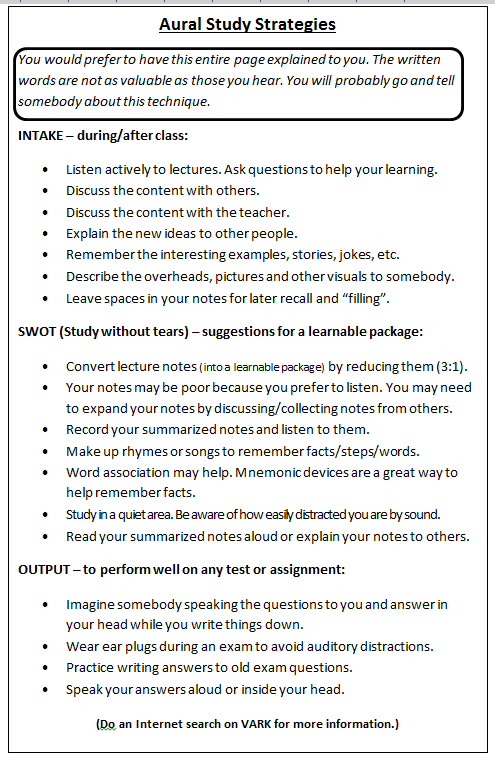
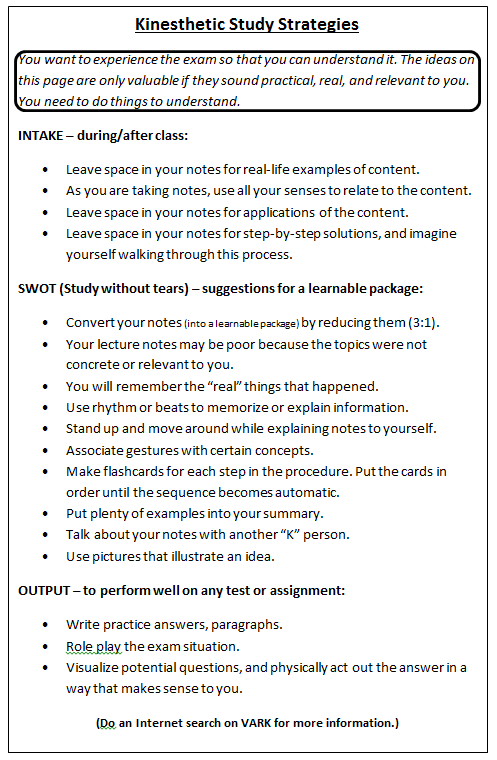
One of the talks was on effective teaching, and the presenter mentioned VARK, which I had never heard of. This stands for visual/aural/read-write/kinesthetic, and, of course, refers to learning styles. What I found useful in the talk was actual suggestions on how students could study for and take exams more effectively than they may be doing currently. The hand out was not in a form I would hand out, so I made my own version on half pages for the students to tape in their composition notebooks on the first day of class for future reference. I culled from the VARK website and others that offered tangible ideas.


Online they have a questionnaire for the kids to take to determine which type they are (yay, first night's homework!). I like that you can choose more than one answer for each question and that you could be a "multi-modal" learner. There are different versions of the questionnaire for adults and such (do a search on VARK).


I want the students to tape in ALL four styles into their notebooks because they may find helpful ideas from a mix of strategies.


Thursday, July 03, 2014

Geometry Idea

Next year will be the 2nd year in a row I haven't taught geometry, but I had an inkling of an unformed idea for a possible exploratory activity. Whoa! Doesn't that sound like you just want to jump on it and use it the FIRST day of school (far far away from now).

I was in an Airport Shuttle and staring mindlessly out the window and saw a building wall made up of tessellated hexagons. Then I remembered how learned about angle sums of polygons in class by separating various polygons into triangles from one vertex and noticing a pattern [(#vertices - 2)*180]. 

Let's use the pentagon for an example of my future I-can't-use-it idea. Kids most likely don't know that there are 3*180 or 540 total degrees in all the interior angles of a pentagon. I was thinking of (for the pentagon group) having the kids use 10 pieces of spaghetti taped on 5 different scraps of paper to form 5 different angles. Then they would measure the angles and get a total sum of the 5 angles. Then they would try to manipulate the 5 taped down "2 sides and a vertex" scraps of paper to try to form a pentagon. 

I'm thinking there would be 4 or so people in a group, and they would each have a different sum they would most likely come up with. Most likely a pentagon won't be able to be formed unless they happen upon a 540 degree sum.

Then maybe they could try again. Then maybe they could see what works and get that sum (having a human error discussion at some point for measuring mistakes). I'm also thinking there would be different groups with 4 sides and 6 sides (3, too??).  In this way, they can see the tactical things that go wrong with angles that don't "fit". Then there would be a follow up summary and pattern.

Next post: things I could teach in 6th grade math ..... KIDDING

Friday, June 20, 2014

Playing with Math

I just finished a nonfictional Romance Book called "Playing with Math", edited by Sue VanHattum. It's filled with passion (for math), joy (of games and puzzles), good-looking heroes and heroines (math makes you sexy), conflict and tension (hello math haters and standardized tests), and a warm and fuzzy resolution (math conquers all). Okay, it's not really a romance novel, but the passion about math is threaded throughout the whole book. There's basically something for everyone, whether you are a math teacher of any sort, a parent, or a math enthusiast.

I teach in a public school to goofy high school students, so I can only give my perspective as a non-mother, non-math-circle-participant, non-unschooler, non-homeschooler. But just like in math, where you see patterns in one problem and can then extrapolate to solve OTHER problems, in this book, I could read about the variety of settings, and always find something that I can either take back to my classroom or take back to my mind to work on. 

Every other chapter is a math problem of some sort. These range in levels of difficulty and variety of math concepts. Many times I found myself putting the book down and pondering the cool problems and figuring them out. There are also a ton of resources listed, from books, to online options, to people you could e-mail and start a discussion with. This wealth of goodies in itself is a reason to read "Playing with Math".

Before I read this book, I only had my biased, public-school-teacher opinion of homeschooling and had never heard of unschooling. Through the various sections and vignettes shown, my opinions were swayed with an understanding of how such situations could be in the best interest of different students, and how kids could thrive. And even if I won't rush out and un-enroll my non-existent offspring and start unschooling their imaginary selves, I did find myself taking notes on each chapter to remember great quotes and philosophies and teaching techniques that I'd like to remember and adapt to my classroom.

I also enjoyed to peek into things I didn't know existed. There is a section on taking a math circle to a prison, and the nonthreatening and successful way the teachers engaged with the men. There is a section about the nonlinearity of learning math, written in a nonlinear and creative fashion, and it's filled with words I want to mull over and process. And these are just a few examples.

Whether you want to have a new source of good math puzzles, or find out how to start a math circle, or re-engage your love of math, or find more things/thoughts/techniques to bring back to your class this coming fall, or simply to stay awhile in the company of others that love math as much as you do, I think you can't go wrong with this book.

Tuesday, June 10, 2014

Binary Addition

I would like to move towards SBG for various basic topics in my Digital Electronics class next year. To that end, I will spend this summer creating and/or finding online practice tools for my students to hone their skills. 

One of the topics they learn is Binary Addition. After searching for "just the thing" online and coming up short, I created a Scratch program for them:
 

I think I'll leave it as such, but if you have any suggestions for improvement that can easily be done by a summer teacher, thanks for sharing.

Also, I had originally created this program with Java with the intention of making an applet to put on our school website. This turned out to be a pain full of "security issues" ... "bad!" .... "don't even think you can open or share this applet". Don't know if I'm doing something wrong, or if that's the way of applets these days, and I have to pay money or some such to be able to have that message not come up. Does anyone know?

Saturday, June 07, 2014

Viva La "Inflated Sense of Self"

And by the way, Viva La End of the School Year.

This week our school got together as a team and discussed children and things that may benefit them next year and what resources they may need that we should provide. Threaded through the conversation a handful of times was that so-and-so had an "inflated sense of self" with the meaning that the kid may be in for some wake up call in terms of college applications and acceptances. I nodded my head in agreement because I knew the kid(s), but then later I started to wonder if we have it all wrong.

I think back to my childhood, and alternately absent and alcoholic and human and goofy as my parents were, they ALWAYS made us feel like we could do anything and why shouldn't we and of course it's possible. Maybe we were living in a (champagne) bubble and other adults were going around tsking and shaking their heads and wondering when our big fall would come. I know my 6th grade teacher despised me and thought I scraped the bottom of the barrel, and I know a few HS teachers and college professors that would scrunch their faces if they knew what I accomplished, but being "bubble girl" (and I now realize "inflated sense of self girl") I still plowed on. 

Maybe that's one of the important things we can provide for the kids we teach, "of course you can do it" ... "why not you" ... "don't be silly, it's totally within your reach". This, obviously, has to be sprinkled with lessons on hard work and persistence and grit and the power of failing and getting back up and such. But how sad the alternative would be, a kid looking at you and your shaking head and attitude of "bless your heart" and taking that to heart and giving up on whatever before they even put out their whole effort into the endeavor.

There are students I have who I don't know if they'll "do it", but who am I to decide. And mostly, I hope what comes out of my mouth and heart is, "DO IT" "you can do it" "obviously it's within your reach". I just do this without thinking all year long, but I'm reminded of the power of this when I get a smattering of end-of-the-year cards that state, "thank you for believing in my and not giving up on me". I am also reminded of this when a student, just by happenstance, gets put into a position to shine, and they soar way beyond what we've seen of them before. These may not necessarily be the kids that think they are all that, but whatever "that" is, hopefully I don't, as a teacher, contribute to snuffing it out before it has a chance.


Friday, May 23, 2014

Post Calculus Exam: Sonic Boom

I spent 2 of the class periods after the AP Exam exploring and expanding on a cool problem I found in Smith and Minton. The problem is about what a sonic boom is, and how you can visualize it graphically.

The first day we had to refresh our memories on parametric equations and graphing. Then the students looked up various things on the internet and wrote it in their notebooks as such:


We had some good discussion on the various speeds and if they are "exact" and what could change the values. Then I made sure they got what a Mach number is by the following "quiz" in their notebooks:


I had them look up the speeds of various vehicles and we tried to get a wide range of numbers and then they had to figure out the Mach numbers based on their speed of sound.

On the 2nd day we then read over the "yellow" paper from page one, and I had to make sure they understood what a unit on the graph was. That was fascinating. It was more of a struggle for them than I would have thought, but we eventually got to it, and again, good discussion.

Then the actual graphing began. We had to take it slowly and keep talking about what the units meant and how you made decisions and such. Here is the graph for a jet going Mach 0.8. We had to keep stressing that the "arcs" were at time 5 seconds after "start" of the 5 noises the jet made at various times:


Then we graphed the "same thing" but for the jet moving at Mach 1:

 
 The students were excitedly asking me question upon question, because really it is cool and wonder-ful ... and I kept mentioning that I'm not an expert, but that we should write their questions down to think about for later.

Then finally we did the same process for a jet moving FASTER than the speed of sound ... Mach 1.4:


We had to be cautious with scales and such and all sorts of great mathy things came up. Then class was over. 

I loved their enthusiasm and questions and wonderment at this actual topic.  
 

Saturday, May 03, 2014

GrumpyCrabbyNess

Why are all these teenagers acting like ..... teenagers?! How old ARE you anyway? Behave and fly right!

Excuse me while I detox:

Our principal some time earlier in the year did away with bells for whatever reason. You were still required to show up to class on time, but you had to rely on yourself and your handy dandy watch/clock/cell phone. I let a ton of things slide in general (lie, but ...), but one thing I do not like is kids sauntering to class late. They started being 15 seconds late, then maybe a minute, then consistently 3 or so minutes. It got to be too much. So I instituted a "be in the room or get a demerit" policy last week. I hate giving demerits. Boo on being the bad guy. I know it's ultimately good for them, and I know I have to be consistent, and I know I still have a grumpy knot in my stomach for the about a bazillion demerits I have given out in the last several days. Kids have started coming to class on time. Shocker. I still have a grumpy teen that is consistently late. Yay! Have her for 2 classes. Twice the demerit fun.

AP Calculus Exam Studying. Hmmmmm. I think a good chunk of the kids are studying the way I think they should be studying. The rest are being, well, teens. I have carved out time in class to do released exams and have them discuss things. In my mind that's going to help the most. We will see in July when the scores come out.

AP Exams start this week. So do EOCs. And thus, so do tons of kids being gone from class in a sporadic fashion. Yay for being flexible and being able to roll with it. Or at least putting on my game face.

Good things: 

My CS class and I are going on a field trip to an apparently well-known local game developing business. We have spent some time playing their games and researching them and creating questions for the field trip.

The NHS group of kids I co-sponsor have done an amazing job this year with doing service and getting fund-raising ideas and actively participating.

My precal students are just a hoot, and even the not-so-strong-mathematically students are a treat to talk with.

Ice Cream.


Monday, April 21, 2014

What?!?! Me Study?!?!?

AP Calculus Exam coming up. Let's have the kids create a study calendar! That's the ticket. Because you know, if you fail to plan, you plan to fail.

I fell into the old Geometry Logic trap. Just because ~p --> q is true, it DOES NOT say anything about what p implies. Silly me. About a week after they all made their calendars, I checked in with about 3 or 4 of them. Sheepishly, they admitted that they were not adhering to their study calendars ... their beautiful calendars they set up.

We had a class powwow. We brainstormed. We came up with ideas. Who knows what will work.

Things I need to think about changing/adding next year: a part of the homework for the calendar that mentions what incentives they'll give themselves for studying ... maybe some strategies they need to write up for the times they DON'T feel like studying ... other?

I checked around with other AP teachers. Yup, their students (we all share) basically admitted to not doing extra studying outside of class ... much.

Okay.

Well, I've instituted some other motivations. Don't know what will work, so I'll do multiple ones of them. Here's one I thought of today after seeing something similar on Pinterest.

Today, I had them start a foldable that is due next class. I prepped for the insides by listing various things they need to memorize:


Then I made one myself (sort of) and made a flipped video for them to watch to see what goes on the inside. Here are the flaps:


 Here's a wee look on the inside. I didn't just want formulas, I wanted examples:


I'm SURE this will be the ticket. Girls LOVE pretty colorful things, right? They won't be able to tear their eyes away from it. They'll study daily.  

Friday, April 18, 2014

Making a Graph Updated...

A while ago, I used to make graphs for my worksheets in a way that, at the time, seemed reasonable. Hah! and Double Hah! I have seen the light. I don't know where I heard about this technique, but I am using it now, and just today, I enhanced it to be easier for me. 

Here is a finished graph that took about 4 minutes to make from a blank space:

I like this process because I can never seem to find my old "made" graphs, and if I do, they are never the right size.

Also, I used to make a similar grid using "tables", but then I would go and insert shapes with textboxes to do the scale. Tedious. I just realized today how I could do it all with tables. Viva la tables!

Here are instructions in case you are in need of graphs.

Thursday, April 10, 2014

Quick PSA for Precalculus

We are now into our Logarithms and E Unit, but before that I wanted to review exponent rules and manipulations for a day. We did that, but I showed my students THIS Public Service Announcement. To set the stage for their project.

We went over 6 different exponent rules, and I mentioned that if everyone remembered them really well just from taking notes and practicing them, then we wouldn't need this review. I said that they each were assigned one of the 6 rules, and they had to make a PSA for that rule. 

We discussed that JUST restating the rule was not effective and sort of besides the point. We discussed that humor or shock value is effective. We discussed linking new things to things you know. We also discussed that the thinking of the actual content was the hardest part, and then you had to ink it out, so just use your "pockets of time" in the next 2 days to brainstorm through some creative ideas.

I also only gave them until the NEXT class to do it (8.5" x 11" paper, colored, correct, effective...). I also joked with them that if I had given them a week, they would have left it until the last minute anyway, so just pretend I assigned it last week.

Don't know if this will be effective or not, but I liked the project, and I liked seeing the wittiness and creativity of kids that I may not otherwise talk to that much because they're not the yappers in class. Here are some samples.