Tuesday, January 28, 2014

Ice Day!

Yeesh, at this rate, school will be out in July or something. We had sleety drippy cold 27F weather this morning, and it started out as a two hour delay. Yay! I could go to school and torture teach children. I left early anyway to treat myself to breakfast out. Also, I live about 24 miles or so from school, so I wanted to leave with PLENTY of time for the icy road conditions. I did see some slipping and sliding, and here are my car tires when I arrived.


Then, what's this? School is canceled. Yeesh. Now I am killing time by surfing and blogging.

On a positive note, LOVE my mini iPad and the local natural foods place with free wifi and friends I can chat with on Facebook. I think it is almost warm enough to make the trek "back north" without fear of accidents. Maybe there is lunch out in my future. Must keep up the energy to come up with more teaching techniques ( and by teaching techniques, I mean gentle ribbing of the kidlets ).

Thursday, January 23, 2014

Seniors, Workload, Responsibility

I'm mulling over recent events and trying to decide how to handle this next year if it comes up again. 

Background story. At our school, we do push the students to take full course loads every year. They get a little slack their senior year and maybe can have a flex period or such. But since our intention is to get them to college and to succeed in college and to look good on college applications, we push. Also, in Texas, our students basically have enough credits to graduate their junior year ... give or take some requirements. So basically they're hard workers.

The flip side of this is that depending on what courses the students take their senior year, and how they approach their scholarship applications and college applications, and what sports they play, and how far their daily commute is, the amount of time they have for homework and sleep and life fluctuates. Needless to say, there are stressed out little bundles of walking sleepless zombies.

Okay, back to me, which, of course it's TOTALLY about. I have (had) 3 seniors in Computer Science 1 along with juniors. So far this past week or so, 2 have stressed out and decided they needed the time during the school day to do their homework, so they dropped out of CS1. I didn't complain too much, just gave them the stink eye, but I go back and forth as to what's best for the student, and how I want to handle this in the future.

One part of me thinks, "you signed for a class ... or you made a commitment to something (anything in general), then you should follow through even if it gets tough. This is what defines your character."

Another part of me thinks, "there are times when you have to cut your losses and maybe decisions you made are not the best."

A third part of me thinks, "I don't want this to be a precedent. Kids will then just sign up willy nilly to look good on their college applications, and then drop the ball when things pile up too much."

A fourth part of me thinks, "if students get in the habit of quitting things when they get too hard, then they are teaching themselves the wrong lessons and are not letting themselves get the satisfaction of knowing they can do things or figure things out when things don't go so easily."

Oy! I have some ideas on how to broach this next year, but I can still stew about this year.

Wednesday, January 15, 2014

Related Rates Update

A while ago I mentioned that I wanted to get the students to create some more realistic related rates scenarios for calculus. I made up a sheet last semester and had them do just that. We talked a bit about how the "simple" and "cheesy" problems they see in the book are just SIMPLIFIED stand-ins for actual problems people really want to solve. I gave some examples. Here is the sheet with their assignment.


We talked about the "cheese" factor. And by "we" I mean "me". Apparently, that was not enough, because about 1/3 of the samples I got back were still "edible and fermented". Next year more "we" and less "me". (hah! as if!)


I made sure to share the wealth and divide the types of problems "evenly" by birthday.

I made sure to get them to talk to someone who is NOT from calculus about the problem and ask if it was something that looked like someone would care if it was solved.
 

Tuesday, January 14, 2014

AP Calculus Wall

Last year or so I saw our AP English teacher had pictures (with AP Exam score) up of previous kids who had passed the AP exam. I thought it was a great idea and could be an archive of our history and an incentive and reminder for the "current" students. My issue was that I couldn't see how she managed to get pictures of the students after July. Nothing seemed efficient or manageable. Yes, I could have asked her, but there it is.

My vision is that after each exam is finished, the following year the "Wall of Fame" is added to with new pictures and new scores. I know this is not a new idea, and I'm sure I saw this idea somewhere before.

I'm thinking that the following may work for me. Some time in the beginning of each year school year, when students are still well rested and fresh, and we're not too into curriculum, I take everyone's picture with a blank placard, something like this:


Then after I see who passed the exam, I print those pictures and write their score with a sharpie .... or HOLD THE PHONES ... I could even edit the pictures, so not everyone has a white ball face (joke). 

Anyway, I'm excited about this, and soon the little cherubs will be in my camera roll.

Monday, January 06, 2014

Calculus Graphical Organizer

Okay little Calculus Kidlets, maybe THIS will settle things in your mind.

After reading my end-of-semester surveys, too many students were mixing up what to do when and why when finding the maximums and minimums of functions. I created this graphical organizer to put in their notebooks. This is how I picture it in my head and how I remember it, so maybe it will help some students.


Sunday, January 05, 2014

End of Semester Surveys

Our administration reminds us every semester that every class must give a survey to every student and then share the responses with our department chair. I think this is a great idea, and I love to sift through the student reflections, and I'm SO HAPPY the admin reminds me WAY ahead of time. This is because without fail, I always forget to give the survey, and then I'm scrambling to hand them out on paper to the students either on a finals review day or GASP maybe even one time during the final (no! that can't be true can it?).

Anyway, my clever department chair mentioned doing the surveys online, and I tried that this semester. We did it in class, since I have laptops. I don't know if I would have had 100% responses if it was a homework assignment. SOLD! I think the students took more time to answer the questions, and I couldn't distinguish their handwriting, so it was pretty anonymous (though some revealed themselves on purpose), so maybe that helped. I do take some time, though, no matter how I give them out, to talk about the great life skill of giving constructive criticism versus negative feedback that is not helpful.

Blah blah blah. Dear Google Docs Forms, Thank you for being easy to create and send out and read anytime anywhere.

Here were my AP Calculus Questions for the Form, and some of the answers with my thoughts.

*************************************************

1. Things you liked/disliked about calculus and class in general (think about daily activities or the class as a whole).

I liked being able to discuss with peers while doing homework because it gave us the opportunity to work together on harder problems instead of giving up. The ability for me to be motivated and actually have intriguing discussions completely depended on who I was seated with. For this last section of the semester, I was next to two people who generally got the concepts so if I was stuck on a homework or didn't understand a concept I didn't feel like I would ask them about it.

This is a problem I haven't mastered yet. I totally get not feeling comfortable asking your table mates  for help because you feel stupid. Part of me wants to say, "figure out a solution" and part of me wants to jump in and spend lots of time on seating arrangements and part of me wants to do a warm fuzzy table bonding activity so there is love spread all around. 
  
************************************************* 
Some questions on flipped lessons (good/bad) and improving the Haiku experience.
************************************************* 

5. What surprised you about calculus?

It is nothing like Pre- Calculus. Although it is math Pre-Calc is like the thinnest base ever for what you do in calculus.
 
Agreed! It does seem to me that labeling the class we teach as "precalculus" is a misnomer. I mean basically everything then would be precalculus because it comes before calculus. I love precal, and maybe a better name would be "all the cool stuff that you haven't learned in the other math classes and you won't see in calculus but we want you to be exposed to math", though I guess that wouldn't fit on the schedule box size.

I was surprised at how difficult calculus was for me. Previously, I was able to succeed in math by putting in extra work effort and simply working hard. In calculus, though, it doesn't seem to be enough - I don't understand why most of it is used or when to use it until several weeks after the class, when we've moved on to other subjects. Because of this, calculus has been a class I really struggle with. 

Oy, part of me is feeling like I dropped the ball here because, HELLO! I do mention why people would need to know about rates of change and how they're useful. But I guess I do it only a smattering of times at the beginning of a unit and then we go over all the various derivative rules and maybe the students don't realize that it's still all based on the cool stuff. I guess I could keep mentioning this every other class and change some problems to be application problems (now that I think about it, I don't have many. eek!). 

************************************************* 

6. What topic(s), if any, do you think I need to change my strategy on AND HOW/WHY? (see your table of contents)

This was revealing. Many people answered about jumbling up some concepts because we went through them "so fast". Good to know.  

************************************************* 
7. General suggestions you may have for my teaching of this class in the future.

Not so many abstract hand motions, more drawings and patty paper. The hand motions just confuse me.

Hah! And here I was patting myself on the back for using CLEAR hand motions. Who knew.  

************************************************ 

8. If you could give yourself advice for the 2nd semester, what would that advice be?
 
Shockingly, they give themselves the same advice I'd give them. Imagine that :).

************************************************* 
9. What are some things you feel you’ve learned really well (and why do you think you did)?

Interesting answers and mixed. Some felt they learned some things well where those were the very things other kids felt they suffered with. Hmmmm. 

************************************************* 
10. Anything else you think I should know.   

If I had one hour left to live, I'd spend in this class because it feels like an eternity ................................... I'm just kidding I love this class and math loves me (most of the time) but also maybe more AP question exposure?  

Best answer yet!


Wednesday, January 01, 2014

Calculus: f and f ' graphs

Happy New Year! Happy New Calculus Activity. 

I'm not 100% (okay, even 60%) sure my students fully grasp the challenging topic of how y = f(x) and y = f ' (x) graphs can be looked at to give you information about the "other" graph, so I just made this activity to welcome them back to the first day of Second Semester. 

I'm all for using technology, but I think (maybe everyone does and is rolling their eyes now) that putting their chubby little hands on pencil and paper and manually creating things will take the "magic" out of things and allow the kidlets time to process what's happening and what it means.

Also: Dear Spaghetti, thank you for being an awesome math tool that I can use over and over for a cheap cost and effective tool not only for math but for bad jokes about eating the tools afterward and such.


Wednesday, December 18, 2013

Semester Wrap Up

I could be grading finals, but ... phawwwww, maybe I'll blog instead. You're supposed to take brain breaks, right? RIGHT?!?!

The Good:
 * Thank you to whoever (whomever?) I read who wrote about answering questions with, "that's a good question!" and walking away. It's my favorite technique, now, especially on tests. Of course, I gauge whether or not it's something I want/need them to figure out on their own first. 

* My Precal Teaching Buddy and I are working on a project to do with sine waves and their graphs and applications. We (I) usually don't like math "projects" that are "meaty" because they end up not seeming meaty and taking away too much time for the students to learn the basics. We structured it so that there is class time and explore time and lots of check points. It's not perfect yet, but here are some questions the students came up with as a result of the project:


1. Is there a relation between where a color is on the wavelength spectrum and how often it appears in nature?
2. Can gamma waves cause hallucinations? 
3. Can frequencies cure mental illnesses? 
4. Does manipulating your brain waves during the day affect your dreams?
5. Can other cellular components of our body be regulated by a sine function and is this information useful for doctors?

* I'm actually following through with my Marathon Training Schedule, and have been into it since school started. My long run/walks on the weekend are now up to 13 miles. Toot toot goes my horn!

* My Computer Science kids are happy, and the administration is now seeing that this is an good class to have at school, especially an all girls school, and they want to expand it somehow. 

* Our first-time-graduating-class kids have started to trickle back and visit. Even the ones I had trouble with were all smiles and happy to say hi. They are thriving at college, so that's a win.

The Bad:
 * What is UP with my right shoulder! Tendonitis? Bursitis? Pinched Nerve? Some stubborn person WON'T go to the doctor, but she may soon have to.

* There are STILL a smattering of kids choosing to fail. I don't know why I still am annoyed by this. It's a pattern and their choice and I see it every year, and it usually works out for the best because it puts a fire under their butts. But people, grow up already and figure it out, so I don't have to have these heated conversations with you inside and outside of my head, full of scrunched faces and wild gestures.

The Ugly:
* Lack of enough sleep. Crow's feet. Bad home situations for various students.

Okay. Break over. Calculus and DE finals ... here I come.

Saturday, November 30, 2013

The Bless Your Heart Award

My rookie FTC Robotics kids and I keep joking around that next weekend at our first qualifier, we do NOT want to get the "Bless Your Heart" award. We will go in and do our best and be happy with it, and if we make improvement from the scrimmage before, then we will consider it a success. We have learned a ton and will be way better next year. We actually have a working robot, but things are still in pieces and kids are busy and bla bla bla. So, we'll see. And, no, we don't need your pity, judges, thank you very much. We rock!

I don't know if they even give such awards, but I feel they do. You know, the "good job" and "you've come a long way considering ...." and "best looking design" and such. Maybe their hearts are in the right place, but in my mind, the subtext is, "oh, you poor things, here's something just for showing up with all you sad sack ways and don't feel bad for being such a loser".

Then that started me thinking about how I approach my students. I was JUST grading some IR quizzes for calculus (immediate recall quizzes ... things I want them to know like the alphabet .... thank you AP Summer Institute for the idea). One student has been struggling a ton with life things and managing her studying and such. I know she's smart, and I know she can do it, and I know she's been struggling. 

I THOUGHT I was grading her paper, and the person was doing really well, and they just missed a problem because they didn't hear it right. I started to write on the paper and finished writing: "you WOULD have gotten it right if that was the problem". Then I'm glancing at the name on the paper, and it's another kid, an uber smart kid, and I found myself thinking, "oh if I'd have known it was her, I would have just marked it wrong, and she would have figured out what happened." 

Ackh! Here I was handing out a "Bless Your Heart" Award. And I'm sure the recipients probably react just the same way I do. I'm basically patting the kid on the head and implying that she can't handle it.

Oy! Need to self monitor better and treat everyone like the rock stars I know they are and can be.

Tuesday, November 26, 2013

Computer Science MatchMaking Project

I did the Match Making Project again with my Computer Science 1 students this year, and I added a new component that just makes me giggle.

First I have them run this code to show them how a basic init/paint/action graphics program may work in Java. Then they get the task of creating a program to simulate "match making" HERE. They ask the user a series of questions about dating a boy/girl ... hair color .... and some questions of their choosing.

This lets them practice IF statements and nested IF statements, and it's fun.

Then after they are done with the program, we did a gallery walk around the various programs and ran them and left nice comments on a paper about the program for the coder.

Then here is the new component. They had to make an advertisement for their matchmaking services by copying some of the pictures of the "dates" and selling the company. Here are the specs.

And voila! Here are my creative students:


Tuesday, November 19, 2013

Quote

I happened to be in the car at the right time a while ago, and heard an interview with Aisha Tyler. I don't remember if this was the interview, but it'll do. She seems like a kick-angle-side-side kind of person.

Anyway, she had this quote that resonated with me, and I wanted to share it with my students, so I went through many iterations of how that would happen, and I came upon the following idea.

I counted up the number and type of letters in the quote. It happened to have 68 - the EXACT same number as a total of 3 of my math classes. Sorry, people who have to cram more students in their classes. Anyway, 

* I cut into 4, enough colored 8.5" x 11" pieces of paper
* The students selected a paper
* I assigned each person a letter
* I had a discussion about wanting to put a quote up
* And, no, I won't tell you the quote until it's up
* And, no, I don't want slop and last minute jobs
* And, be artsy
* And it's due next class
* And they should be capital letters
* Facing Portrait, NOT Landscape

And then I hung it in the hallway ..... voila:


Sunday, November 17, 2013

Jumping in the Pool Dogpaddling!


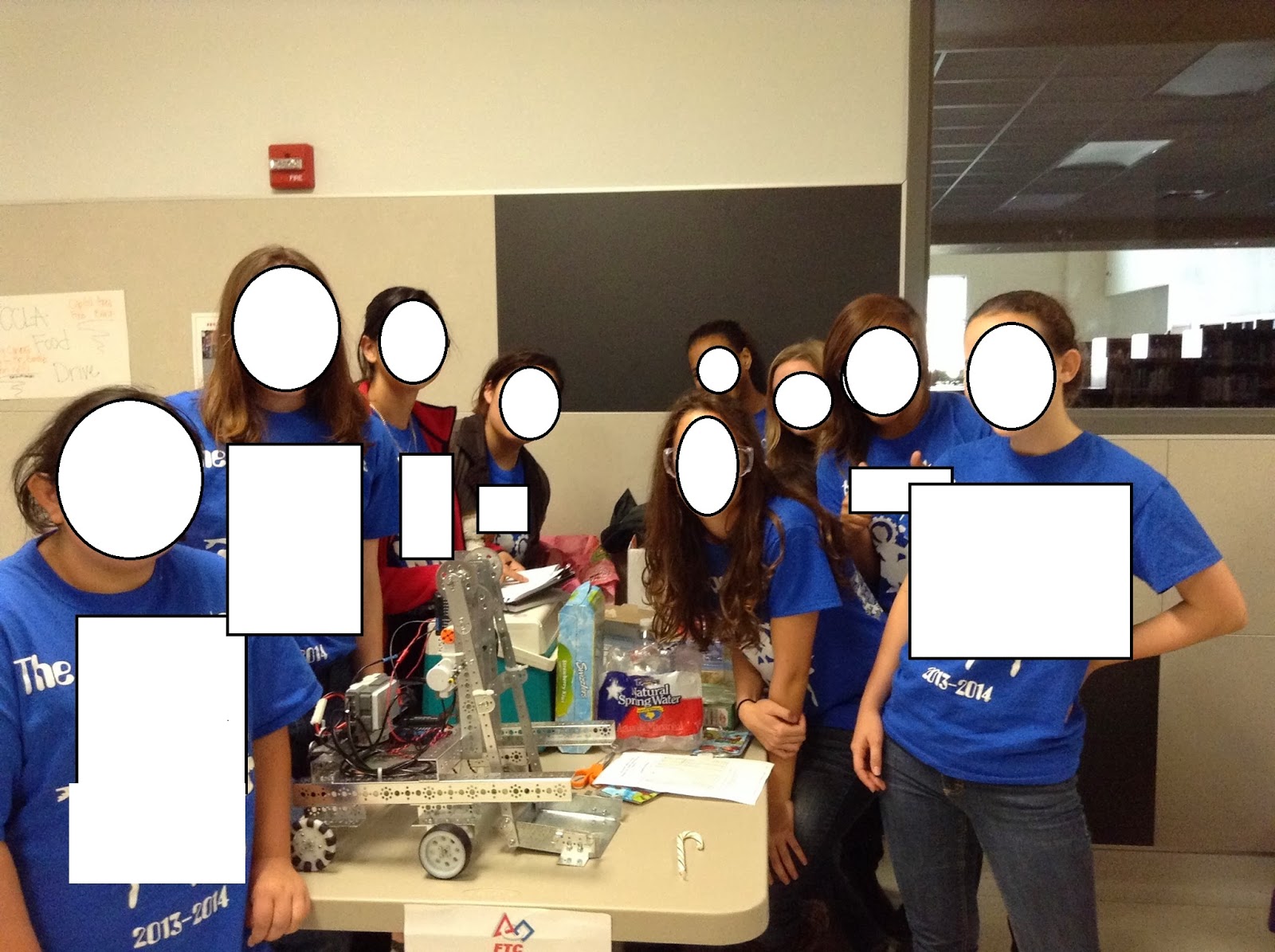
This year I am coaching an FTC Robotics team for the first time (for me and our school). Here are some of my students at our first scrimmage. We were so nervous and being all "girly" and judging ourselves harshly, me included.

Things going through our minds:
* We'll embarrass ourselves.
* Everyone else is better.
* We won't know what we're doing.
* We're nervous.
* We don't know the process and aren't ready.
* Our robot is not finished yet.

But that (obviously) is ridiculous, even though it still streams through our thoughts. STILL. If we stifle ourselves with self doubt and angst, we'll never try anything new, and we'll never improve, and we'll never have the thrill of learning and experiencing new things.

Thoughts that got us through:
* Everyone has to start somewhere.
* We're a rookie team. Other teams have had more years of experience.
* Let's give ourselves a break, we're WAY further than we were in September.
* People are here to help us.
* This is a learning experience. 
* We can do it.

Ultimately, we had a blast, though we were super tired from the adrenaline and stress and lack of sleep and worry. We learned a ton. We met nice people. We can make progress. We had cool t-shirts. We're on our way to more robotics challenges. Our pit area rocked:


Friday, November 08, 2013

Yay! End of the Six Weeks ... And We Know What That Means.

The joys of students scrambling to take care of business on the LAST minute of the LAST day of the LAST week of the grading term. What's that? You say ... why didn't they do things the other 4 to 5 weeks? Good Question.

I just had a math student literally wait until AFTER the last minute to try to turn things in. For any other student who I'd seen trying throughout the grading period, YES I would have accepted the work. For this student who has not turned in 7 of 10 homework assignments and has come in maybe 10% of the available time for help? Not so much.

Yes, I know it's for the student's own good. Yes, I know that they won't step it up until they don't get any free rides any more. But yes I also know that it scrambles up my insides and I'm having angry conversations with the kid in my mind.

To maybe detox, I just sent this e-mail to her and cc-ed the counselor and her mom. I am crossing my fingers that she figures things out.

Dear You,
I'm concerned about your work ethic this year in math. As it stands, there have been 10 homework assignments on the grade book. I see that you have not turned in 7 of them. That is part of the reason you are failing, but it is not the whole picture. Because you do not do the homework, you then do poorly on the Section Quizzes (based on homework). It also seems that you don't do the rote memorization skills necessary for the IR quizzes.

There have been 5 weeks of time for you to come in and reconcile your misunderstandings. I have barely seen you for tutoring. I am available every morning from 7am until 9:15. I am in my room at lunch every day. I am there after school M-Th. You have come in for a scattered amount of tutoring, but not enough to take care of business. I frequently see you in the halls talking with friends, and I have to bite my tongue when I want to ask you why you are not doing make up work. Yes, friends and socializing ARE important, and they are a vital part of life. However, there has to be a balance of taking care of business, and enjoying your free time.

In advisory, which is a prime time to seek help ... a FREE 30 minutes at least 3 times a week in MY advisory, with me willing to answer your questions, you have not been doing any calculus work.
It worries me that you scramble at the last minute and try to turn in extremely late work, and it is still not on time, and yet you say that it is.
More importantly, I see you being exposed to challenging work and then not stepping up to the plate. You say you don't want to turn in the homework because you don't understand it. Great. And yet I do not see you taking the necessary steps to make progress. I do not see you putting in the brain work and the hard work and the thinking work to make it happen.
I'm wondering how you are watching the flipped videos. Are you just going through the motions when you do watch them, or are you taking the required (at least) 40 minutes of time to absorb and think?

I have been filling out college recommendations this year for seniors, and these are some of the questions asked by the colleges (i.e. things they want to see in prospective students):
* How does this student behave when faced with challenges?
* How does this student react when confronted by setbacks?
* What are this student's "disciplined habits"?
* How is this student's initiative?
This is the 3rd math class I have had you in. I know you have a very capable brain. I am wondering if you will rise to the work necessary to comprehend topics that don't come easily to you.

I care about you and your school experience, and I hope you don't squander it away because it requires work you are not willing to do.
Ms. D

Thursday, November 07, 2013

Big Sighs

Just a reminder to myself and others about the various EXTRA things kids may be going through in addition to doing/not-doing my math homework (taken from separate things I've heard lately in my town/school, but I'm guessing could be just about anywhere):


* Parents just divorced last month. Student still angry at absent parent and not fully functioning yet.
* Thrown out of the house and now scrambling to keep it together.
* Single parent too poor to pay bills. Kid must find other means of functioning for studying purposes.
* Came out to parents. Got kicked out of the house.
* Temporary housing due to recent weather occurrence.
* Clinically depressed.
* Health issues due to poverty and lack of proper nutrition.

Lately, I think that we just need a big daily hug fest to let kids know we love them and are rooting for them.


Saturday, November 02, 2013

Related Rates and Crowd Sourcing

Year Six of teaching this pickle of a topic in Calculus. I keep changing it up hoping I'll happen upon the magic elixir that will allow students to eagerly gobble up the problems and spit out the correct answers with joy and understanding oozing out of their pores.

Issues:
* Finding problems that aren't the Wisconsin of all Cheese Balls.
* Reading and interpreting the problem.
* Being able to translate known information and subtly given information into Math Speak.
* Finding the right equation that links all the variables together.
* Navigating the Dangerous Path of Implicit Differentiation.
* Plugging back in at JUST the right time.
* Finishing things up with a tidy bow.

I have a good feeling about this year! And yes, I say and mean that every year, so I am allowing my bubble to remain floating blissfully in the air yet again.

First of all, cheesy problems: ladders sliding down walls, circles mysteriously expanding and contracting, lots of liquids being poured into and leaked out of cylinders/cones/prisms, cars passing in the night at some perpendicular intersection.

I started off this year's spiel with just a blathering of why this topic is important:

BP oil spill, how fast is it spreading? How will they know how much resources to devote to the problem?

The rain recently in Austin, TX, people's houses were ruined, water was rising at various rates, what could that mean for drainage capabilities and emergency personnel?

Fires in Bastrop, containment, speed of spreading vs speed of dousing ....

The amusement park problem on some previous AP exam about rates of people in park and number of employees needed ...

But then alas, we had to start on the cheeseball problems. But I prefaced it with, "no one really cares about a balloon being expanded or contracted, but as with all math modeling, we may have to start with a simplified version of reality just so we can gain understanding and maybe add difficulty and more accuracy later. Think about some real life things that could be modeled by a malleable sphere."

That was about as far as I got on that THEN. Wait for it .....

Also, I spent a class period JUST setting up problems with the students, and their homework was to differentiate and solve. I found Bowman's set up with the table for variables very nice and tidy and useful. I'm a convert. In the past, I just set the students on their merry ways to attempting each problem on their own. This year I was uber bossy and said I wanted things set up in a specific way - enter the drawing and table and something new I added: a highlighted box or equation that I labeled SUBTLE information. There are some things that are not specifically mentioned in the problem, but you can figure needed information out like a detective. I wanted the students to be on the lookout for such things and to know that they exist.

I think this is the NEW component I'm adding to the homework next time. They will get the goofy circle/square/car problems, but with EACH problem or maybe just one, they have to do extra. This is where my crowd surfing comes in. I want them to think of a NEW specific real life situation that (say) could be modeled by this simplified version or expanded upon, and discuss what rates are needed and why anyone would care.

I'm looking forward to seeing their responses.

Sunday, October 27, 2013

CS and Algorithms

Last year I knew I did a subpar job on teaching students how to write algorithms to prep their code. How do I know? Thanks for asking. I know because one of my top coding students mentioned after that year something about someone talking about this weird word, "algorithms", and she didn't know what it meant. Who was HER poopy teacher? ME!

So this year in my CS1 class, for their programs they are writing, I have made 3 extra slots on the sheet under each code:

Algorithm (signed off by Ms. D) ____________________
Code (checked by another student) _________________
Code (checked by Ms. D) ________________________

I also had a discussion about the code-checking by someone. I mentioned that if I was ultimately asked to sign off on a code, and it wasn't working, then the "signer offer" would get the BIG FROWNY FACE OF DISAPPROVAL.

Their algorithms are getting better. They started out just regurgitating my words. This allowed for discussions of algorithms being like "steps in a recipe". You wouldn't say: walk to the fridge to get the eggs to crack 2 open into the mixture. You would say: beat in 2 eggs.

I also like the fact that their code has to be checked by someone else. They then get to talk with others and see others' code and practice the art of checking code for bugs and direction following.


Monday, October 21, 2013

Teacher Mistakes and Teacher Voice

I make a lot of my own materials, and though I check things, I am human and make mistakes on keys and answer banks and such. Now I'm not saying that it's 50 bazillion mistakes on every assignment, but still.

I've just realized this year that that could be thought of as a good thing. My kids now know to be skeptical if their answer doesn't match mine. I hope that lots of them stop and think and redo their work and then in their mind if they can convince themselves that they have done no wrong, then they ask me to check things. This way: they gain confidence in their abilities, they learn to trust themselves, they don't always take the printed word at face value, they practice polite conversation in the how they approach me. Sometimes I'm NOT wrong even if they've done all this, but I use this as an opportunity to thank them for checking and to say that THIS TIME I was not wrong.

In a related type of situation, at various times when I ask questions of kids in class, and they answer, and the answer is correct, I put on a scrunched, disbelieving face and ask if they're sure or if that seems like the right answer. I've done this often enough that they stop and redo their thinking in their heads, and MOST times they go against the "ADULT" voice and say YES, that is the correct answer. Again hopefully they're being trained to stand up for themselves and their thinking.

Okay, ending with a silly joke that made all of us laugh on a much needed stressful day last week:
Q: What's brown and sticky?
A: A stick.


Saturday, October 19, 2013

Calculus Practice

I'm trying to incorporate more AP Calculus multiple choice style questions throughout the year this year. I've scanned for various released documents and then changed them up with different problems but same intent. I guess this is kosher. We are not supposed to publish secure documents or let the kids take them home. I have not done that, but then I still am feeling antsy because the kernel of the ideas came from secure documents. Anyone have an opinion on that?

Here is what we/they had for homework recently. I like my last question (not from another source). I realized that the students were still not clear on the distinction between the derivative being the GENERAL tangent slope equation for ANY x versus a SPECIFIC slope at a SPECIFIC x using the general equation.


Thursday, October 17, 2013

"Baby" Applications of Trig Functions

We just finished learning how to solve all sorts of basic trig equations (cos ___ = #, cos # = ____). We'll get to equations soon, but we wanted the students to see some applications right away. I didn't want the standard: Billy is standing 5 feet away from a tree and how tall is the tree problems from geometry.

I searched in my favorite precalculus textbooks for some ideas, and found some applications under the GRAPHING and TRANSFORMING of sine wave functions/equation section. With a bit of fiddling, I adjusted the problems, so that the students could just find the angle or plug in the angle.

We first had a discussion on the cyclic behavior of sine. Then we brainstormed as to what in real life gets bigger then smaller then bigger and on and on. Then I showed them this sheet. We made sure to discuss how in algebra when you are solving for a variable you have to isolate it by undoing what's being done to it. Then I mentioned that this is JUST like solving for "x" in algebra, but on "steroids".

Voila! New problems for the kidlets to tackle:


Wednesday, October 16, 2013

Trigonometry on the Calculator

I came up with a memory tool that I hope will help the kids remember which process to use when solving/evaluating on the calculator:

csc ____ = 5    versus     csc 25 =____

It all seems to get jumbled up together in their heads after they learn various equations on the calculator.

Entering either one on the calculator involves a reciprocal somehow, and they mix up when to reciprocate. For the first one:

 csc ____ = 5     you enter:   sin -1 (1/5)

For the second one:

 csc 25 =____     you enter:   1 / sin (25)

Here's what I hope will stick:

For the first one:

csc ____ = 5     the BLANK is in the MIDDLE,
so the RECIPROCAL is in the MIDDLE   sin -1 (1/5)

For the second one:

 csc 25 =____     the BLANK is on the OUTSIDE,
so the RECIPROCAL is on the OUTSIDE   1 / sin (25)

Many more ways to mess up, but maybe this will fix one problem.