In Texas, football is BIG. Football, football, football. Last Thursday night, our school team had a game against a town rival. Apparently, the team members don't get home until after midnight or so. So when they came into my math class on Thursday and looked at the homework board, some of them cried, "homework?! on a game night?!". Part of me feels bad for them, but the other part of me says, no, learn to balance your priorities. There's no way I'm going to not give them an extra opportunity to practice their skills because of football.
On Friday, I had a lot of sleepy kids. Some had stayed up doing homework. Some players did not turn in their homework. So am I doing them a service or a disservice if I allow them to turn it in late without penalty? I didn't mention it to them, but if/when I get their late homework on Monday, I'll have to think on this.
Saturday, September 30, 2006

Tuesday, September 26, 2006
Progress but not Perfection
I've been "teaching" related rates in my BC calculus class for the last 3 days, and I did change it up from last year since I saw the struggles they had with the topic. I made some improvements, but I guess there's still more to make. Finally today after watching my mixed level class stare back at me for 2 days with a wide variety of looks, from, "yea, yea, I get it already", to "great! another topic I can struggle with to add to my ever-growing pile", to "related whats? related whos?", I had an epiphany.
As they walked into class, I moved the "yea, yeas" to the back (about 1/2 the class of 19) to quietly work on old AP exam questions on related rates. My other 1/2 I moved right up front by me, and I handed out a sheet with 4 problems. I left BIG space between the problems, and under each I had 4 categories: Picture, List of variables, Equation, Solve. I walked them through each, gradually weaning them off, and then I had to cover my eyes from all the light bulbs going off by the 3rd problem with "ohhhhhh! is THAT how you do it" looks.
As one kid said, "why didn't we do this in the first place?" Why indeed. I had to be honest with him and say, "well it's a learning process for all of us. I'm also learning what works with you all".
As they walked into class, I moved the "yea, yeas" to the back (about 1/2 the class of 19) to quietly work on old AP exam questions on related rates. My other 1/2 I moved right up front by me, and I handed out a sheet with 4 problems. I left BIG space between the problems, and under each I had 4 categories: Picture, List of variables, Equation, Solve. I walked them through each, gradually weaning them off, and then I had to cover my eyes from all the light bulbs going off by the 3rd problem with "ohhhhhh! is THAT how you do it" looks.
As one kid said, "why didn't we do this in the first place?" Why indeed. I had to be honest with him and say, "well it's a learning process for all of us. I'm also learning what works with you all".
Monday, September 25, 2006
Spaghetti Sine Curves
I heard of a great way to get the graph of y = sin x to "stick" in students' heads, so today I tried it out. You're supposed to link the graph of the function to its value on the unit circle. Most sites I searched had the students either gluing the spaghetti lengths to the paper (too messy for me), or had the students use protractors to get exact angle measurements around the unit circle to use (not necessary and too time consuming in my opinion). So, I made up my own sheet.
I taught it for 3 periods, and by the last period :) I liked how it ran. For the first 2 periods I verbally gave instructions, and then pointed to the instructions on the back and had them "make sure you follow the instructions carefully". It seemed like I mostly wasted my breath because they still had questions, and it seemed like too many kids were zoning out with the "ach, there's the teacher blabbing again. I can tune out until we have to do something" face.
I also feel I lost an opportunity for the students to learn how to read math .... and read lots of words and follow them without giving up. For the 3rd period, I just started them on their way by mentioning the instructions. I gave a little spiel about how reading math is not like reading a novel or magazine. They worked beautifully. I also used a little trick I read on someone else's blog. I kept reiterating, "the instructions are VERY clear and EASY to understand". Tee Hee.
Their graphs turned out great. If anyone wants a copy send e-mail, and I'll pass it along. Or download it here.
math_mambo@yahoo.com
I taught it for 3 periods, and by the last period :) I liked how it ran. For the first 2 periods I verbally gave instructions, and then pointed to the instructions on the back and had them "make sure you follow the instructions carefully". It seemed like I mostly wasted my breath because they still had questions, and it seemed like too many kids were zoning out with the "ach, there's the teacher blabbing again. I can tune out until we have to do something" face.
I also feel I lost an opportunity for the students to learn how to read math .... and read lots of words and follow them without giving up. For the 3rd period, I just started them on their way by mentioning the instructions. I gave a little spiel about how reading math is not like reading a novel or magazine. They worked beautifully. I also used a little trick I read on someone else's blog. I kept reiterating, "the instructions are VERY clear and EASY to understand". Tee Hee.
Their graphs turned out great. If anyone wants a copy send e-mail, and I'll pass it along. Or download it here.
math_mambo@yahoo.com
Friday, September 22, 2006
Skills
I was taken aback this week. Four students have been diligently coming in for tutoring for the past few weeks, and I wanted to let their parents know how hard they've been working. Before school started I bought these pretty marble "stock" cards from the scrapbook section at Michael's. My idea was to make postcards out of them for quick notes to parents.
While 3 of the boys were in for a "retest", I got a card for each and drew a line down the middle "postcard" style and asked them one by one to address them to their parents. The first boy wrote the address first and then their names and left out the city, state and zip entirely. The second boy wrote the correct information but 90 degrees rotated. The 3rd boy did it perfectly. The next day when the 4th was in for tutoring, I asked him to address the postcard, and I prompted him with "name" first, then street address. Then he asked me if he had to put down the city and state. I asked him if he would have known what to do if I hadn't told him, and he said no.
Hmmmm, this was just a skill I thought everyone had, but I guess if you've never written a letter, then how would you know? I learned when I went away to summer camp as a kid. I do remember messing up in the following way, though, so I'll get off my letter-addressing-high-horse. At home my parents sent and received letters from relatives in other countries, so there was always "air mail" written somewhere on the front. So when I went to camp 3 hours away from home and wrote home, I also wrote "air mail".
While 3 of the boys were in for a "retest", I got a card for each and drew a line down the middle "postcard" style and asked them one by one to address them to their parents. The first boy wrote the address first and then their names and left out the city, state and zip entirely. The second boy wrote the correct information but 90 degrees rotated. The 3rd boy did it perfectly. The next day when the 4th was in for tutoring, I asked him to address the postcard, and I prompted him with "name" first, then street address. Then he asked me if he had to put down the city and state. I asked him if he would have known what to do if I hadn't told him, and he said no.
Hmmmm, this was just a skill I thought everyone had, but I guess if you've never written a letter, then how would you know? I learned when I went away to summer camp as a kid. I do remember messing up in the following way, though, so I'll get off my letter-addressing-high-horse. At home my parents sent and received letters from relatives in other countries, so there was always "air mail" written somewhere on the front. So when I went to camp 3 hours away from home and wrote home, I also wrote "air mail".
Tuesday, September 19, 2006
Insomniac Math Teacher Thoughts
Whew! I finally got that last riddle, though I'm not sure if I like my husband's hint. I thought and thought and couldn't get it, and I broke down and asked for a hint after a few days and asked how he got it. (we'd already established the first letter and the last 3 letters of the "singular" word). He said, well I was thinking of you, and the word came to me. Hmmmm, is that in a good way?
Then this morning I couldn't sleep, and I thought of this variation of an oldie:
You have an unmarked 5 cup container and an unmarked 9 cup container and unlimited water and a sink. Using only these containers and being able to fill up and pour out in the sink, how could you measure out exactly: 1C, 2C, 3C, ...., 12C, 13C, and 14C?
Then this morning I couldn't sleep, and I thought of this variation of an oldie:
You have an unmarked 5 cup container and an unmarked 9 cup container and unlimited water and a sink. Using only these containers and being able to fill up and pour out in the sink, how could you measure out exactly: 1C, 2C, 3C, ...., 12C, 13C, and 14C?
Sunday, September 17, 2006
Mastering Skills
I did something in all my classes on Friday that I think I'll do periodically. Everyone got a half sheet (to turn in at the end of the period) that said basically:
What "skill" are you struggling with currently?
What did you do in class to make progress on your knowledge?
Who (besides me) did you get help from?
What specifically are you going to do this weekend to deepen your understanding?
How will you show progress to me next week?
What would you like to tell me?
Most kids worked hard (some chose to goof off, of course). I had many verbal and written comments about how this session helped. For my calculus classes, I had "reteaching" sheets written out for 3 topics (all I could come up with on my short time schedule from when I had this idea to when I implemented it). These sheets had worked out examples and then practice problems with answers on the bottom of the page.
Riddle posed by one student this week (and I'm still working on the answer), but I thought I'd share: What word is plural, but when you add an "s" to the end becomes singular?
What "skill" are you struggling with currently?
What did you do in class to make progress on your knowledge?
Who (besides me) did you get help from?
What specifically are you going to do this weekend to deepen your understanding?
How will you show progress to me next week?
What would you like to tell me?
Most kids worked hard (some chose to goof off, of course). I had many verbal and written comments about how this session helped. For my calculus classes, I had "reteaching" sheets written out for 3 topics (all I could come up with on my short time schedule from when I had this idea to when I implemented it). These sheets had worked out examples and then practice problems with answers on the bottom of the page.
Riddle posed by one student this week (and I'm still working on the answer), but I thought I'd share: What word is plural, but when you add an "s" to the end becomes singular?
Wednesday, September 13, 2006
A Giggle & a Quandary
I'm going to have a "word wall" for calculus, and I've never had one before, so it's going up a wee bit at a time. Apparently, they're all the rage in English (ahem, language arts) classes. Well, it's going pretty slowly, and I had my student aide be artsy with the words. She got one word done: "derivative", and I thought I'd put it up instead of waiting for all the other words to be done. The next day in calculus class, I proudly pointed to what was going to be the word wall, and the students said, upon looking at the one word up there, "oh! is that the "word" on your word wall?".
I have yet to think of an effective response to students who claim: I knew all the stuff in class and when I did homework, I just choked on the test. .... or .... I understand perfectly well in class, but then when I get home, I don't know how to do things. ... or ... I just don't "test" well.
I want to say, that well, then you really DON'T understand and you're just fooling yourself. I have to think of a constructive way of saying that. I also question effective study habits. Or effective note/text reading and processing.
I have yet to think of an effective response to students who claim: I knew all the stuff in class and when I did homework, I just choked on the test. .... or .... I understand perfectly well in class, but then when I get home, I don't know how to do things. ... or ... I just don't "test" well.
I want to say, that well, then you really DON'T understand and you're just fooling yourself. I have to think of a constructive way of saying that. I also question effective study habits. Or effective note/text reading and processing.
Saturday, September 09, 2006
Reviewing Angst
Since I've started teaching older students (ones that I picture closer to college age than middle school age), I've become more reluctant to use a whole class period to review material for an upcoming assessment. My thinking is that I warn them a week in advance. I tell them what will be covered. I expect them to study at home and ask me questions if they have them. I've even started NOT handing out review sheets for them to do at home. Right. Apparently, I live in an ideal world where everything goes as it should, and all students are well-rested and don't work jobs and do their homework consistently, etc.
I still feel a time crunch and want to use class time for practice and new material. But on the other hand, I can think of a "review" day as just an extra practice day. I could even think of a "review sheet" with answers provided as extra practice. I wouldn't even have to refer to the sheet unless a student was proactive and asked questions about it. Maybe that's what I'll do in the future. Provide practice/review sheets with answers a few days before the test. ..... I still think of it as enabling, but maybe that's MY problem.
I still feel a time crunch and want to use class time for practice and new material. But on the other hand, I can think of a "review" day as just an extra practice day. I could even think of a "review sheet" with answers provided as extra practice. I wouldn't even have to refer to the sheet unless a student was proactive and asked questions about it. Maybe that's what I'll do in the future. Provide practice/review sheets with answers a few days before the test. ..... I still think of it as enabling, but maybe that's MY problem.
Wednesday, September 06, 2006
Homework Checking System
I started to leave this as a comment of my last post, but then it seemed to be getting to long (who's the babbler?).
Hi Dan,
On an ideal day I have the homework answers on the overhead (which I turn on before the class starts for the early arrivers). The minute the bell rings, I set the 5 minute timer, and they have until the beeps to correct their papers in a different color. I grade on completion because I think homework is their time to practice. I also walk around during this time to make sure no one is blatantly copying only. I also grade on work shown and header (name, date, page and problem #s listed, corrections, attempt of all problems).
During the 5 minutes, they can also ask each other or me questions. Then I turn off the overhead, and ask for more questions. I answer the popular questions (5 more minutes). If I don't cover their particular question another 5 minutes, I tell them to mark their questions very visibly on their papers, and I'll answer them when I'm checking their papers later (out of class in any pockets of time I find).
I have my student aid (or me) stamp the papers in some goofy rubber stamp. This way later on if I've accidently marked them a zero, they can prove they've turned in their paper. And visa versa, if they claim they had already turned in their papers, I can check for a stamp. I also go through each paper and check for my list of homework musts (see above) and enter the grades.
It's been the case lately that MOST of the time it doesn't take the full 10 minutes. This has been a great improvement over the BT (before timer) days when they dawdled getting out their materials and talking to their friends and then "wait! wait! I'm not finished correcting" while everyone else was politely and patiently waiting because they had done what they were supposed to do. The timer seems to focus them and curb their overchatting, and they're motivated to correct since they know they're graded on corrections.
I don't know if it's an ideal system (I still spend too much cherished time carefully going over the papers for header, attempt, questions, and maybe I'm not catching all the copying), but it seems to work best for me so far. I also figure that if someone is not using the system correctly (copying, etc), they'll pay for it on tests and such when they don't know the material.
Hi Dan,
On an ideal day I have the homework answers on the overhead (which I turn on before the class starts for the early arrivers). The minute the bell rings, I set the 5 minute timer, and they have until the beeps to correct their papers in a different color. I grade on completion because I think homework is their time to practice. I also walk around during this time to make sure no one is blatantly copying only. I also grade on work shown and header (name, date, page and problem #s listed, corrections, attempt of all problems).
During the 5 minutes, they can also ask each other or me questions. Then I turn off the overhead, and ask for more questions. I answer the popular questions (5 more minutes). If I don't cover their particular question another 5 minutes, I tell them to mark their questions very visibly on their papers, and I'll answer them when I'm checking their papers later (out of class in any pockets of time I find).
I have my student aid (or me) stamp the papers in some goofy rubber stamp. This way later on if I've accidently marked them a zero, they can prove they've turned in their paper. And visa versa, if they claim they had already turned in their papers, I can check for a stamp. I also go through each paper and check for my list of homework musts (see above) and enter the grades.
It's been the case lately that MOST of the time it doesn't take the full 10 minutes. This has been a great improvement over the BT (before timer) days when they dawdled getting out their materials and talking to their friends and then "wait! wait! I'm not finished correcting" while everyone else was politely and patiently waiting because they had done what they were supposed to do. The timer seems to focus them and curb their overchatting, and they're motivated to correct since they know they're graded on corrections.
I don't know if it's an ideal system (I still spend too much cherished time carefully going over the papers for header, attempt, questions, and maybe I'm not catching all the copying), but it seems to work best for me so far. I also figure that if someone is not using the system correctly (copying, etc), they'll pay for it on tests and such when they don't know the material.
Monday, September 04, 2006
Changing Impressions
School has been in session for 3 weeks now, and I find it interesting how my impressions change as I get to know the kids. For the first week it's all a frenzy, and I'm a bit overwhelmed with all these new faces in class that I don't know. I already start to form some impressions (chatty, lazy, depressed, good-natured...) some right and some way off base.
Then the second week comes along and I get a better sense of the kids, and I know most (or all) of their names. They're more comfortable, and hence some are more chatty in class. I keep meaning to change seats (and I have some) but I need to wait until the 4th week when I can remove some extra desks from my class. (In hind sight, I could have just left the seats but not assigned anyone to them).
Now after 3 weeks have passed, I *almost* have my classroom the way I want it. I had a day or 2 where I could walk around most of the period to help the students while they practiced on a "puzzle" sheet of trig problems (How do you make chicken napoleon? Use only the bony parts! ar ar ar ... thanks pizzazz company). I have my homework correcting system in place (with the timer it takes at most 8 minutes or so after I answer questions).
Grades are due tomorrow, so I'm now in a frenzy of checking homework I've collected and such. With all this, I'm still not fully applying some of the teaching knowledge I wanted to test out yet. Soon. Soon.
Then the second week comes along and I get a better sense of the kids, and I know most (or all) of their names. They're more comfortable, and hence some are more chatty in class. I keep meaning to change seats (and I have some) but I need to wait until the 4th week when I can remove some extra desks from my class. (In hind sight, I could have just left the seats but not assigned anyone to them).
Now after 3 weeks have passed, I *almost* have my classroom the way I want it. I had a day or 2 where I could walk around most of the period to help the students while they practiced on a "puzzle" sheet of trig problems (How do you make chicken napoleon? Use only the bony parts! ar ar ar ... thanks pizzazz company). I have my homework correcting system in place (with the timer it takes at most 8 minutes or so after I answer questions).
Grades are due tomorrow, so I'm now in a frenzy of checking homework I've collected and such. With all this, I'm still not fully applying some of the teaching knowledge I wanted to test out yet. Soon. Soon.
Thursday, August 31, 2006
Radian Technique
Last year my kids struggled with visualizing the placement of radian angles in standard position. They either had to convert (say 7 pi / 6) into degrees and then draw the angle accurately, or they just shook their heads at the crazy things their teacher asked them to do.
Over the summer my retired teacher friend mentioned that he used to teach the pi/6 and pi/3 parts by having them look at the clock and noticing that (say) from 3 to 9 (moving counter clockwise as a positive angle does) there are 30 minutes. Break that into 6 parts. They notice that's on "the hours" 2, 1, 12, 11, 10. Then the kids go back to their unit circle and place dots all around signifying the "hours" and those are the pi/6 separations. Then they go from there. Similarly, from 3 to 9 counterclockwise (a full pi), if we want to break it into 3 parts (pi / 3), that's every 10 minutes.
I had great success on Wednesday with them accurately placing the angles without converting. Woot. Woot. Hopefully, it'll stick in their heads better this year.
I also didn't do a great job last year with having them memorize thoroughly (and "get") sine and cosine of any multiple of 45 degrees or 30 / 60 degrees. They still had to work at it without immediately being able to answer. This year, I'm going to laminate page size unit circles. Then everyone gets laminated 30-60-90 and 45-45-90 triangles that have the side lengths and angles in degrees and radians on both sides and that fit nicely on the circle. Then we'll do an activity where they will place the reference triangles on the circle for various angles I give them. Hopefully, this will allow them to later on picture in their heads the height/placement of the reference triangle and quickly be able to recreate sin 135 or cos 5pi/6. We'll see.
Over the summer my retired teacher friend mentioned that he used to teach the pi/6 and pi/3 parts by having them look at the clock and noticing that (say) from 3 to 9 (moving counter clockwise as a positive angle does) there are 30 minutes. Break that into 6 parts. They notice that's on "the hours" 2, 1, 12, 11, 10. Then the kids go back to their unit circle and place dots all around signifying the "hours" and those are the pi/6 separations. Then they go from there. Similarly, from 3 to 9 counterclockwise (a full pi), if we want to break it into 3 parts (pi / 3), that's every 10 minutes.
I had great success on Wednesday with them accurately placing the angles without converting. Woot. Woot. Hopefully, it'll stick in their heads better this year.
I also didn't do a great job last year with having them memorize thoroughly (and "get") sine and cosine of any multiple of 45 degrees or 30 / 60 degrees. They still had to work at it without immediately being able to answer. This year, I'm going to laminate page size unit circles. Then everyone gets laminated 30-60-90 and 45-45-90 triangles that have the side lengths and angles in degrees and radians on both sides and that fit nicely on the circle. Then we'll do an activity where they will place the reference triangles on the circle for various angles I give them. Hopefully, this will allow them to later on picture in their heads the height/placement of the reference triangle and quickly be able to recreate sin 135 or cos 5pi/6. We'll see.
Tuesday, August 29, 2006
Start of the Year
Right now after 10 days of school, I finally can place student names with faces (if they're in their seats in their period). Soon, hopefully, I'll even recognize and name all of them in the halls (out of context).
My homework policy of having them correct their work in a different color in class (I grade on completeness), was taking too long (15 minutes or so sometimes), and I was rushed and couldn't get through the current lesson. I figured out that they were dawdling and taking forever to get out their homework after the bell rang, and then they were talking too much and joking with their friends (some of them), but then we had to wait for everyone to be done. So. I have now brought in a timer, and when the bell rings I told them I won't remind them to get out their homework, I'll just start the timer and have the answers on the overhead. After 5 minutes I'll turn it off and take questions for at most 5 minutes. Any unanswered questions, they can write on their homework, and I'll answer it there. They are partly graded on their complete "grading", so hopefully this will be successful.
I'm still getting to know the kids and their abilities. I know I have some very bright ones, so I'll have to find more time in the day (hmph) to find extra challenging problems for them.
Anyone have any extra time they'd like to pass my way? I know we all just sit around and daydream most of the day.
My homework policy of having them correct their work in a different color in class (I grade on completeness), was taking too long (15 minutes or so sometimes), and I was rushed and couldn't get through the current lesson. I figured out that they were dawdling and taking forever to get out their homework after the bell rang, and then they were talking too much and joking with their friends (some of them), but then we had to wait for everyone to be done. So. I have now brought in a timer, and when the bell rings I told them I won't remind them to get out their homework, I'll just start the timer and have the answers on the overhead. After 5 minutes I'll turn it off and take questions for at most 5 minutes. Any unanswered questions, they can write on their homework, and I'll answer it there. They are partly graded on their complete "grading", so hopefully this will be successful.
I'm still getting to know the kids and their abilities. I know I have some very bright ones, so I'll have to find more time in the day (hmph) to find extra challenging problems for them.
Anyone have any extra time they'd like to pass my way? I know we all just sit around and daydream most of the day.
Friday, August 25, 2006
Growing Pains
My class sizes in order are: 31, 19, 30, 24, 28. In my first class I already have chatters that just WON'T BE QUIET. I've done seat changes, I've done the stern teacher look, I've waited patiently. Today, I think there will be some field trips outside the door (either for a discussion, or maybe I'll just leave them there). In my 3rd class (gee, it happens to be the 2 largest classes) one of the problems is that they all know each other and have had math class with each other forever, AND it's right after lunch and they're hyped up on FDNVs (an acronym I just saw sprinkled all over a memo indicating that Texas will no longer allow the selling of FDNVs for fundraising during school hours .... "foods of diminished nutritional value").
I love my last period class - sweet hard-working slightly-goofy kids. What a nice way to end the day. I also am quietly thankful that 2 of my duty stations are completely hassle-free, and I can get work done while I'm monitoring hallway doors.
In other news, it's starting again/already where someone who has had me before is now in another teacher's math class, and it's just too ________, and it's not _______, and they wish _________ (fill in the blanks). Invariably as the year goes on, they get used to the new teacher and actually like it and all complaining is forgotten, so now I just have to reassure them and mention that they have to get along with and learn how to be successful in a variety of teacher's classes.
I love my last period class - sweet hard-working slightly-goofy kids. What a nice way to end the day. I also am quietly thankful that 2 of my duty stations are completely hassle-free, and I can get work done while I'm monitoring hallway doors.
In other news, it's starting again/already where someone who has had me before is now in another teacher's math class, and it's just too ________, and it's not _______, and they wish _________ (fill in the blanks). Invariably as the year goes on, they get used to the new teacher and actually like it and all complaining is forgotten, so now I just have to reassure them and mention that they have to get along with and learn how to be successful in a variety of teacher's classes.
Saturday, August 19, 2006
Math Autobiographies
At the start of every year, I have my students write a math autobiography: tell me about yourself, tell me about good/bad experiences with math, tell me about good/bad ... effective/ineffective experiences in any previous class (no teacher names), etc. I like this because I learn something about the kids, and I learn about what their take is on how they learn best.
This year I learned some interesting things. I have an 11th grader who has moved around various countries and has been homeschooled up to this year and is a wee bit apprehensive about public schools. I have a girl originally from Jamaica who is tired of being stereotyped and has some strong words to say about how people treat each other. I have a creative child who put her autobiography in the form of a fairy tale. I have a student who wants to enter the air force and got his first ride in an aerobatic (or jet??) plane this summer. I have a few students who are brand new to our school. I have (already!) a pregnant student. And as usual, I have funny, fun, studious, laid back, intense, happy, apprehensive, unique students.
This year I learned some interesting things. I have an 11th grader who has moved around various countries and has been homeschooled up to this year and is a wee bit apprehensive about public schools. I have a girl originally from Jamaica who is tired of being stereotyped and has some strong words to say about how people treat each other. I have a creative child who put her autobiography in the form of a fairy tale. I have a student who wants to enter the air force and got his first ride in an aerobatic (or jet??) plane this summer. I have a few students who are brand new to our school. I have (already!) a pregnant student. And as usual, I have funny, fun, studious, laid back, intense, happy, apprehensive, unique students.
Wednesday, August 16, 2006
Already Behind
Sheesh, 2 days into school, and my to-do list never seems to be completely accomplished. Oh yea, and then there's the actual prep for "teaching". I guess it's all the initial set up of the year: organizing the online grade book, starting your lesson plans, setting up the room, teaching the students your procedures, learning all their names, striving to remember your 4 extra duties and when you're supposed to be when, waking up at 4:30am every day from bad dreams and then not falling back asleep, getting all the proper furniture in your classroom, so that you're not tripping over computer wires or overhead wires, etc.
Then I never cease to be amazed at how frequently my first impressions of a student are way off. For example, a girl that I thought yesterday was a "toughie" and "sullen" turns out on the 2nd day to be the sweetest quietest mild-mannered girl with a "tough" exterior. I guess that's a good example of waiting and seeing and being able to be nicely surprised by all the nice kids I'll meet.
Then I never cease to be amazed at how frequently my first impressions of a student are way off. For example, a girl that I thought yesterday was a "toughie" and "sullen" turns out on the 2nd day to be the sweetest quietest mild-mannered girl with a "tough" exterior. I guess that's a good example of waiting and seeing and being able to be nicely surprised by all the nice kids I'll meet.
Friday, August 11, 2006
Inservice Week Over
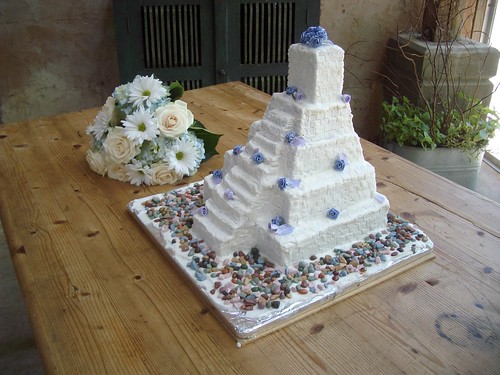
Our first week back at work is over, and I think I have a pretty good start on things this year. We have 5 new (out of 20) math teachers, and I'm wondering if we'll ever level off. I've already seen some of my kids who are working away on a project at school, and I've seen a ton of other friendly faces. That's one of the nicer aspects of going back, seeing work friends that you don't see over the summer.
Here's a picture of the wedding cake my husband and I made for my sister-in-law. Pretty snazzy if I do toot my own horn (or really my husband's horn since he did the constructing while I made the royal icing and rolled out the marzipan and put on the flowers and such ... and of course helped make the EXTREMELY delicious fruitcake base that even the Americans liked).
It's modeled after a Mayan Temple since she's an anthropologist and studies bones found in/near them. We found cool chocolate rocks to sprinkle around the base. We (he!) used a toothpick to put creases in the shape of stones in the icing. And voila! A wedding cake.
Monday, August 07, 2006
whew. But not WHEW! yet
It's practically the last day of "teacher" summer as Tuesday (tomorrow) is our first day of inservice (lasting a week) before we start back with the kiddies. For about the last week or so we've been inundated with my husband's family that have come for his sister's wedding (which was yesterday, so most of the chores are over). ... I don't care how nice people are, it's still challenging to have houseguests for a bazillion days. Currently there are a total of 7 people sleeping at our house. Okay, I say "sleeping" but that doesn't include a certain someone who seems to be getting up at 3am and not falling back to sleep and is looking forward to having bags under her eyes for the start of school.
And this wedding thing. It was nice and all, but I still feel it's uncomfortable to be a voyeur at a pretty private-seeming (at least to me) moment. All these emotions are out on the table and the future bride and groom are getting choked up and professing all sorts of love for each other and it feels invasive to me.
On a funny note, my husband's brother's girlfriend is a hoot, and she also wanted to see if she could fry an egg on the sidewalk (this being steamy hot Texas to a Canadian). We cracked an egg on the pavement in front of our house. I didn't feel it was a terribly hot day (98F or so), and it was cloudy at the time, so it felt cooler. The egg white ran and basically disappeared. The yoke did "cook" after about an hour or so, and there were then all these attractive (fire?) ants feasting on the buffet. Our laziness (or something) has the egg still out there 2 days later, and most of the yolk is gone. Yum.
And this wedding thing. It was nice and all, but I still feel it's uncomfortable to be a voyeur at a pretty private-seeming (at least to me) moment. All these emotions are out on the table and the future bride and groom are getting choked up and professing all sorts of love for each other and it feels invasive to me.
On a funny note, my husband's brother's girlfriend is a hoot, and she also wanted to see if she could fry an egg on the sidewalk (this being steamy hot Texas to a Canadian). We cracked an egg on the pavement in front of our house. I didn't feel it was a terribly hot day (98F or so), and it was cloudy at the time, so it felt cooler. The egg white ran and basically disappeared. The yoke did "cook" after about an hour or so, and there were then all these attractive (fire?) ants feasting on the buffet. Our laziness (or something) has the egg still out there 2 days later, and most of the yolk is gone. Yum.
Monday, July 31, 2006
Summer Reading
Every summer I reread all or parts of each of these books to refresh my aging memory on the kind of teacher I want to be.
"How to Talk So Kids Can Learn" Faber & Mazlish (ISBN 0-684-82472-8)
This is a great book on how to interact more successfully with students (well really anyone) and to make them (and you) better people.
"Tools for Teaching" Fred Jones (ISBN 0-9650263-0-2)
I love his methods on discipline. Here's just one thing that sticks in my head: no means no. So if you say no the first time and then the student/child keeps pestering you or whining and you finally give in, then you're teaching them to whine again in the future. But if you're consistent with your "no", that works out better in the long run. He also has a section on body language of the students and their compliance and such. I don't use all his methods, but several things have helped me.
Three David R. Johnson books: "Every Minute Counts", "Making Minutes Count Even More", and "Motivation Counts".
They're all math related, and he has great ideas on how to ask questions, collect homework, structure a class, etc.
This year at an airport bookstore of all places I found "Fish for Schools". I was excited because I'd heard of it before. It's basically a structure for living that's based on 4 concepts the authors developed by watching the Pike's Place Fish Market workers. I like their ideas, and I was eager to see how this book could help, but alas, it seemed to be just an advertising to get their school video package. I wouldn't have minded, but it was really pricey. Still, the book had some great ideas and teacher stories.
I also skim through "The First Days of School" by the Wongs to remind myself of (for example) what 7 things (7? ... better start skimming) students want to know on the first day of class, etc.
Any other teaching book recommendations out there?
"How to Talk So Kids Can Learn" Faber & Mazlish (ISBN 0-684-82472-8)
This is a great book on how to interact more successfully with students (well really anyone) and to make them (and you) better people.
"Tools for Teaching" Fred Jones (ISBN 0-9650263-0-2)
I love his methods on discipline. Here's just one thing that sticks in my head: no means no. So if you say no the first time and then the student/child keeps pestering you or whining and you finally give in, then you're teaching them to whine again in the future. But if you're consistent with your "no", that works out better in the long run. He also has a section on body language of the students and their compliance and such. I don't use all his methods, but several things have helped me.
Three David R. Johnson books: "Every Minute Counts", "Making Minutes Count Even More", and "Motivation Counts".
They're all math related, and he has great ideas on how to ask questions, collect homework, structure a class, etc.
This year at an airport bookstore of all places I found "Fish for Schools". I was excited because I'd heard of it before. It's basically a structure for living that's based on 4 concepts the authors developed by watching the Pike's Place Fish Market workers. I like their ideas, and I was eager to see how this book could help, but alas, it seemed to be just an advertising to get their school video package. I wouldn't have minded, but it was really pricey. Still, the book had some great ideas and teacher stories.
I also skim through "The First Days of School" by the Wongs to remind myself of (for example) what 7 things (7? ... better start skimming) students want to know on the first day of class, etc.
Any other teaching book recommendations out there?
Friday, July 28, 2006
Note Taking / Using Your Notes
I'm batting an idea around my head about actually teaching "note using" skills this year in all my classes. It seems to me that a majority (or at least too many to be comfortable) of my students don't know how to use their notes once they get home. They seem to be just humoring me by "taking notes" and then don't really see the point of them later (or their book for that matter).
I've not fleshed everything out completely yet (all ideas are welcome), but here's what I've come up with so far. Every so often during a class (10 minutes? 5 minutes?), I'll pause the class and ask them to quickly scan over what they've written and then put a noticeable star or mark near things that they need clarification on or more time to think on. Time seems to be in short demand in class, and there are those students who don't need the extra time, so I don't know if I'll spend too much time in class going over every concern. I also want them to become self sufficient and confident in their skills of figuring things out on their own, so maybe I won't address concerns.
Then I'll discuss or teach them how to use their notes when they're at home doing homework. ... Maybe a poster up in class (and give them a copy) as a constant reminder:
"How to do homework"
1. scan over class notes to refresh your memory
2. spend time figuring out the starred/confusing sections (ponder / look in book / call a friend / go on line)
3. start your homework (with header: page #, problem #s, date, topic(?)). attempt every problem.
4. for those you do not know how to do, make a start / look for examples in book/notes, write down specific reasons you got stuck
5. in class as we are going over answers, IN A DIFFERENT COLOR, put a check by correct answers, indicate wrong problems and write down the answer. Make sure to ask someone (me / groupmate / friend) for help on the ones you didn't understand.
6. later on make sure you go over incorrect ones and find out how to do it (friend / notes / book)
Hopefully, this will grab some extra students and make them more successful. I think when I check homework, their points will be based on: attempt, in class corrections, header.
I've not fleshed everything out completely yet (all ideas are welcome), but here's what I've come up with so far. Every so often during a class (10 minutes? 5 minutes?), I'll pause the class and ask them to quickly scan over what they've written and then put a noticeable star or mark near things that they need clarification on or more time to think on. Time seems to be in short demand in class, and there are those students who don't need the extra time, so I don't know if I'll spend too much time in class going over every concern. I also want them to become self sufficient and confident in their skills of figuring things out on their own, so maybe I won't address concerns.
Then I'll discuss or teach them how to use their notes when they're at home doing homework. ... Maybe a poster up in class (and give them a copy) as a constant reminder:
"How to do homework"
1. scan over class notes to refresh your memory
2. spend time figuring out the starred/confusing sections (ponder / look in book / call a friend / go on line)
3. start your homework (with header: page #, problem #s, date, topic(?)). attempt every problem.
4. for those you do not know how to do, make a start / look for examples in book/notes, write down specific reasons you got stuck
5. in class as we are going over answers, IN A DIFFERENT COLOR, put a check by correct answers, indicate wrong problems and write down the answer. Make sure to ask someone (me / groupmate / friend) for help on the ones you didn't understand.
6. later on make sure you go over incorrect ones and find out how to do it (friend / notes / book)
Hopefully, this will grab some extra students and make them more successful. I think when I check homework, their points will be based on: attempt, in class corrections, header.
Friday, July 21, 2006
Nightmares
TMI alert.
It hasn't happened lately, but who's to say it won't again. Invariably when I have to get up at night to pee, you know, that mind-ping-pong: "but I'm tired. but I'm uncomfortable. but I don't wanna get up. but you'd better" feeling, right when I wake up, I realize I've had another "pee nightmare". Maybe I'm not the only one.
The dreams often occur in public restrooms and one or more of several things occur. Either there are no doors on any stalls, or there are doors, but the bowls are filled to the brim, so that you would not want to sit down, or there's no paper, or there are a lot of people in the bathroom and one or more of the previous things occur. Or there's the dreaded "dippage": somehow a piece of your clothing gets dipped in an unflushed toilet.
I guess that's my mind's way of waking me up and prodding me to take measures.
It hasn't happened lately, but who's to say it won't again. Invariably when I have to get up at night to pee, you know, that mind-ping-pong: "but I'm tired. but I'm uncomfortable. but I don't wanna get up. but you'd better" feeling, right when I wake up, I realize I've had another "pee nightmare". Maybe I'm not the only one.
The dreams often occur in public restrooms and one or more of several things occur. Either there are no doors on any stalls, or there are doors, but the bowls are filled to the brim, so that you would not want to sit down, or there's no paper, or there are a lot of people in the bathroom and one or more of the previous things occur. Or there's the dreaded "dippage": somehow a piece of your clothing gets dipped in an unflushed toilet.
I guess that's my mind's way of waking me up and prodding me to take measures.
Subscribe to:
Posts (Atom)